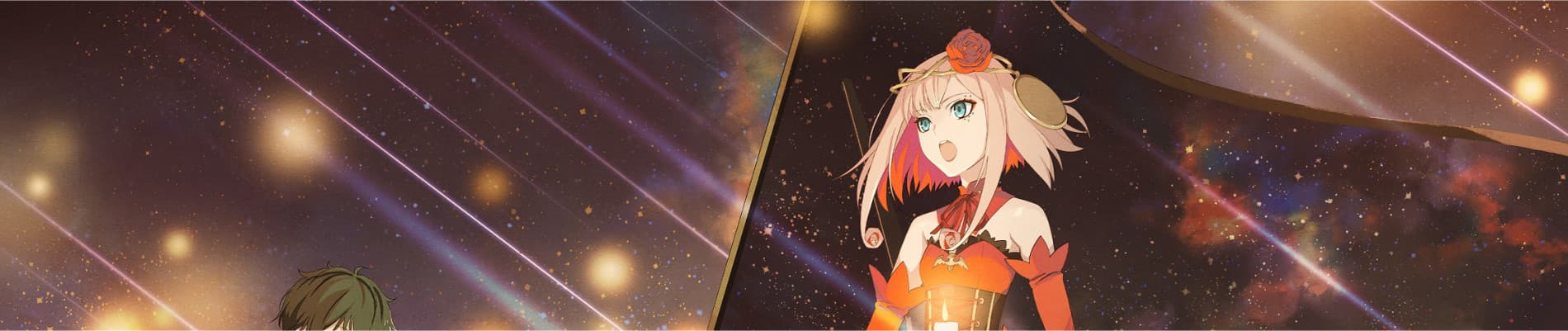
takt op.Destiny
a review by ZNote
a review by ZNote
SPOILER-FREE!
Most anime, in some form or another, is a form of advertisement. That does not necessarily mean that it’s meant to draw attention to an adapted source manga or light novel, though. Anime as advertisement could also be for the studio that made it, as certain studios have established clout or reputation, and thus naturally have more attention drawn to their works. Other times, an anime could act as an attractor for a new enterprise altogether, serving to drum up enthusiasm and hook in a new audience to the emerging property.
takt op.Destiny was a Fall 2021 anime that served to draw attention to the takt op franchise. As a new collaboration between studios MAPPA and Madhouse, a show like this has a two-fold mission that it must complete – succeed as a standalone piece of media, while also being good enough to make people think to themselves that the mobile game it’s helping to market is also worth their time and energy. Making an anime is already hard enough especially in the current anime industry climate, and these extra expectations upon the show don’t exactly make its job any easier.
______
In an apocalyptic future, monsters known as D2s violently attack any location that plays music, as music is the only thing that can hurt or kill them. To battle the D2s and attempt to bring peace and music back to humanity, various individuals called Conductors are imbued with the power to command Musicarts, superpowered beings that use music as a combative force. The Conductor Takt Asahina and his Musicart Destiny start a journey with their mutual friend Anna to the New York Symphonica, hoping to learn the truth behind the D2 appearances, all while trying to stop them and allow music to be played freely once again. Along the way, they will meet other Conductors and Musicarts, battle D2s, and struggle.
The series starts off well by integrating its exposition with actual events. Takt is well-oriented as being the odd duck out in this post-music world, being so drawn to the piano that he plays it, despite knowing the danger it would entail. Destiny’s laconic personality clashing with Takt and Anna’s impatience at Takt and Destiny paints a good foundational tableau, establishing the chief dynamic among the three. With an action sequence to show the power of the D2s and Musicart concept, takt op.Destiny manages to convey most of its information effectively. The intriguing premise behind Musicarts and the D2s, and the comedic moments with Takt, Destiny, and Anna, gives the first episode a strong first impression as they travel on their merry way.
But the potential fun of a road comedy action series gets derailed quickly once more time is spent with the main trio beyond the first episode. Takt’s personality is so disenfranchised and aloof that unless someone is having a discussion related to music, moments just seem to mostly bounce off of him. He’s cold, and while that might make sense in a post-apocalyptic landscape, it makes getting endeared to him far more difficult. Because she is neither a Conductor nor a Musicart, Anna serves as little more than the means to get the group to the Symphonica by driving them, or is trying to make contributions to the relationship between Takt and Destiny.
As far as Destiny is concerned, it is revealed very early in the show that she used to be a human named Cosette, that she was Anna’s younger sister, and that she also likes music. Her relationship to Takt is, at best, incredibly vague and at worst is stunningly underdeveloped. The idea that they are bound together by their Conductor-Musicart connection reads more as a flimsy attempt to give Cosette characterization without actually going through the effort of doing so. Any character development that Destiny would undergo, or that Takt and Destiny would undergo together down the line, becomes too rickety and forced because not enough time is taken to make Cosette a more rounded character beyond being adorable. Whether it be through Anna attempting to make Takt and Destiny get along, or Destiny realizing something about Takt, herself, or the world around her, it reads as clumsy.
And the bit of development that we see from Destiny isn’t that engaging, either. Since she functions as a robotic or emotionally blank character, she falls into a lot of the common trappings associated with such an archetype. Calling something a “creature” instead of a “cat,” or a “tool” instead of a “hammer,” Destiny’s bed of knowledge seems almost completely centered around fighting D2s and food. The latter of which is mostly used for comedic purposes, even if it’s supposed to refuel her to continue fighting. Aside from a character obsessed with food not being inherently funny, Destiny’s actual switch from emotionally blank to a more-complex emotional palette doesn’t have a solidified point of orientation. The result is that the shift is abrupt and crammed.
Also crammed is the idea of how music factors into this story. takt op.Destiny offers a lot of proselytizing about how great music is, but largely without probing it further. Music is, supposedly, more-engrained in the show’s DNA both in regards to the plot and the characters, but is kept bizarrely at a distance throughout most of the run. This even impacts moments where music is meant to take centerstage. There’s a sequence where Takt is playing jazz piano and Destiny talks about what Takt’s music does to her, but so little of the music actually plays that it never got the opportunity to enter myself as a viewer. Destiny’s discussion happens in a setting completely divorced from Takt’s playing. This sequence, and others like it, insinuate that music’s contribution to the story is limited to being a plot device or gimmick, rather than an actual force that moves things forward. This also factors into the series soundtrack – despite all the famous classical pieces, we so rarely hear good quality recordings or re-orchestrations of the works, which takes away from the sense of raw power that they allegedly have.
That’s not to say that the show doesn’t try to incorporate music, because it does, albeit not very well. One other Conductor-Musicart duo, Lenny and Titan (which is probably a Leonard Bernstein reference), meet with the main trio and they try to train Takt and Destiny. It ultimately boils down to Lenny saying, “Feel the harmony,” without actually explaining what that means. I can readily accept that becoming adept at battle requires practice, just like music requires practice. But the idea that a single phrase or battle somehow manages to put Takt and Destiny in such synch together makes little sense. I wanted to believe that it was going to go for an angle that their synchronicity was a sign that Cosette was within Destiny somewhere. It would have helped salvage the ambiguous relationship between Takt and Cosette. Unfortunately, that doesn’t happen, nor is their relationship ever put in its proper limelight.
Visually, the series manages to be just adequate on most fronts. The action sequences are alright, but never blew me away despite their fluidity. The landscape depictions are decent, and the designs on the D2s crazy forms and the Musicarts show creativity. Speaking of the Musicarts, just like music’s ability to take on different forms and genres, the various Musicarts all have distinct designs that establish them as their own individualized beings, emotional content notwithstanding. Some of the ways they’re able to incorporate their forms into attacking are fun, although takt op.Destiny misses an opportunity to make even fuller use of this. Each Musicart is named after a piece of classical music, yet it never seems like the piece of music serves as an actual influence on the attacks themselves or their personalities. The composition names are framed more as namedrops instead of having a deeper, symbolic connection to the character. “Destiny” as a designation is indeed a reference to a Beethoven’s Fifth Symphony nickname, but it doesn’t extend any further other than implying that Destiny the character is a protagonist, “destined” to stop the D2s. I guess I’m just confused as to what this show was trying to accomplish with all its musical business.
And that, in a sense, is why takt op.Destiny doesn’t work; it’s a series confused about what it actually is trying to do. It wants to be a mahou shoujo action piece, but also wants to aspire to more meaningful discussions about what music means to people. It wants to be a road comedy, but the comedy dries up so quickly that it breaks down rather than cruises. It wants to make the D2s out to be malevolent, but leaves them without direction. Not knowing what the point of the D2s or their attacks was remained until the final episode, making the show’s building to the climax come across as ill-conceived and desperate.
________
takt op.Destiny fails as road comedy, action romp, and thought-provoking show about music. Its characters are never given enough time to fully flesh-out their personalities beyond small quirks or emotions, and the true aim of the antagonists is kept in the dark for far too long. The action pieces are merely passable despite some decent individual moments, yet do not salvage the languishing story. Its discussions about music cannot move beyond simplistic blanket statements about how wonderful the art form is, and it never sufficiently explains the connection between Musicart and Conductor. This show committed the cardinal sin of art – it made me, derisively, ask what the point of it all was, and not even care enough to hear an answer. It may have been a glorified advertisement for the mobile game, but that is not an excuse for poor execution.
300 out of 333 users liked this review
