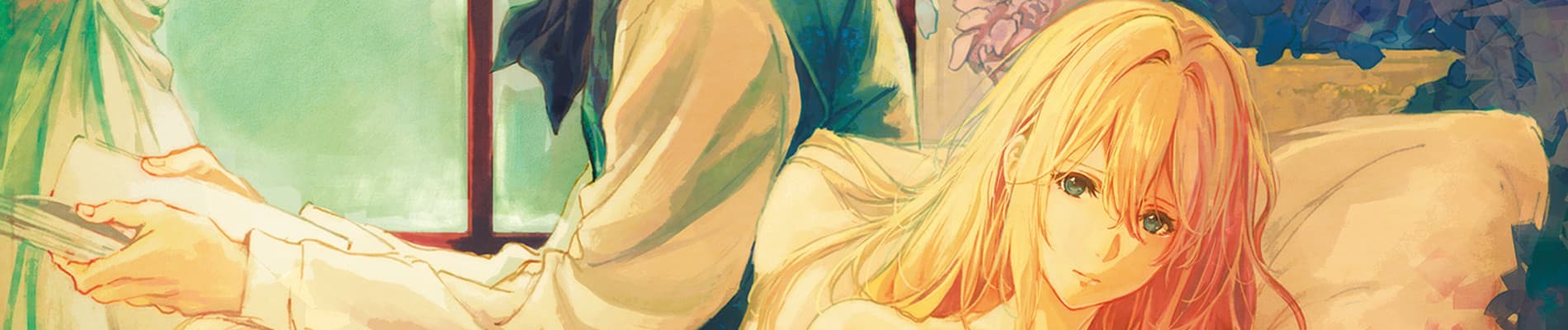

This analysis will contain heavy spoilers, so read it after you watch the movie.

This is where one of my favorite parts of drama anime, or any drama really, is seen.
Violet is portrayed as the most "extreme form" of her emotions. What I mean by this is the only thing she cares about in life is Gilbert, everything else is almost inconsequential. I've seen this in other anime and I would like to bring up Deishuu Kaiki from the Monogatari series. If you are familiar with the character you may be confused as to why I mention him here, and it's because of his ideology:
"Sengoku, I love money! You know why? Because money can replace everything. It lets you buy things. It lets you buy lives. It lets you buy people. It lets you buy hearts. It lets you buy happiness. It lets you buy dreams. I love money because it's so important, and yet not irreplaceable. So looking at it the other way around, I hate irreplaceable things. 'I can't live without this.' 'Thats the only reason I'm alive.' 'Thats my only purpose in life.' Things that have scarcity value like that piss me off the most." -Deishuu Kaiki, Monogatari Series: Second Season
This is a quote that I believe perfectly summarizes his character, and which sets his ideology at odds with Violet's. I point this out because they both have these extreme views. I see this used a lot in some of my favorite drama anime, and for good reason; it's easily one of the most effective ways to portray a specific emotion or idea. I don't totally agree with Kaiki's statement and I don't think many would, but it's hard to argue with his point about irreplacable things. Of course, this method of character writing isn't limited to thought provoking views on life, in Violet Evergarden (especially this movie), it is used to explore loss; in my opinion, to great effect.
The Portrayal of Loss
Violet Evergarden as a whole is all about the emotions that come with loss, and it does such a good job of portraying them; I think that much is indisputable. It may sound ridiculous, but while watching the movie it was almost as if I was feeling the same emotions that Violet was feeling as she was feeling them. Whether this is due to going through similar experiences in my own past I can't say, but the truth is that the emotions that are being conveyed, are real. This is the reason why you as the viewer know exactly how Violet is feeling just from watching her expressions. This is also a big part of why I say this movie transcends fiction, because it does a flawless job of portraying these very real emotions and everything that they entail.
One very literal way they portray loss is through Yuris and his family. Yuris is sick and tired of the way that everyone around him reacts to his condition, and perhaps it's partly because of this that he refuses to see his best friend; but the truth is he's not being honest with himself. This is seen when Yuris is writing the letter to his family and he says to spoil his little brother, who he thought stole his attention most of the time, in his place. Violet points out to him that what he truly wants is for himself to be spoiled by his parents, and what Yuris' character serves to prove here is that when you're alone it can be practically impossible to be honest with yourself. Violet however with her outside perspective is able to see this and inform him of it; which we see later in the movie with Gilbert's change of heart.
Of course as Yuris reaches the acceptance stage of grief, he comes to terms with how he truly feels and reveals it to his best friend as he passes away.
The Point
I mentioned Gilbert's change of heart, but now I will go more deeply into what it really means as it is one of the most significant parts of the movie. I had only realized this after my 3rd watch-through, but I'm certainly glad that I realized it at all. Gilbert's internal conflict is written as a parallel to Yuris', which I think is absolutely genius. Gilbert only sees the worst parts of himself and with no-one to tell him otherwise, he truly believes that that's all that he is. The reason that he doesn't want to see Violet is that he believes that he was a burden to her, and kept her from living a normal life. He believes that he used her as a tool, despite promising himself otherwise. He blames himself for her not being able to live a normal life. But the truth is that he doesn't see the big picture.
What he eventually comes to realize is that his impact on her life was far, far more than he sees. The old man tells him that it's not his burden to bear alone:
"We're probably all to blame. We all thought our lives would be better once we won the war. We all hated the people from Leidenshaftlich. But, we all suffered in the end."
At this point it still hadn't sunken in yet, but here comes Dietfried... Dietfried is certainly one to give the truth, no matter how harsh; and that's exactly what he does even to his "long-lost brother". Despite this, Gilbert still is hanging onto the idea that it's all his fault and that he ruined her life. But finally, he recieves Violet's letter.
"The reason I'm alive today and learned how to love others, is all thanks to you. For accepting me, I thank you. Thank you for reading to me, for teaching me how to read, and showing me many things; I thank you. For the brooch you gave me, I thank you. For always, always keeping me by your side, I thank you. For giving me 'I love you', I thank you. Hearing you tell me 'I love you' has been like a guiding star throughout my life."
And finally, as Gilbert finally realizes that he was anything but a burden to Violet, the song Michishirube (which translates to "guiding star") begins to play as the two poetically reunite.
A movie so great that it practically transcended fiction.
I hope that you enjoyed it at least half as much as I did, and I also hope you enjoyed my "analysis" of sorts. Thanks for reading!