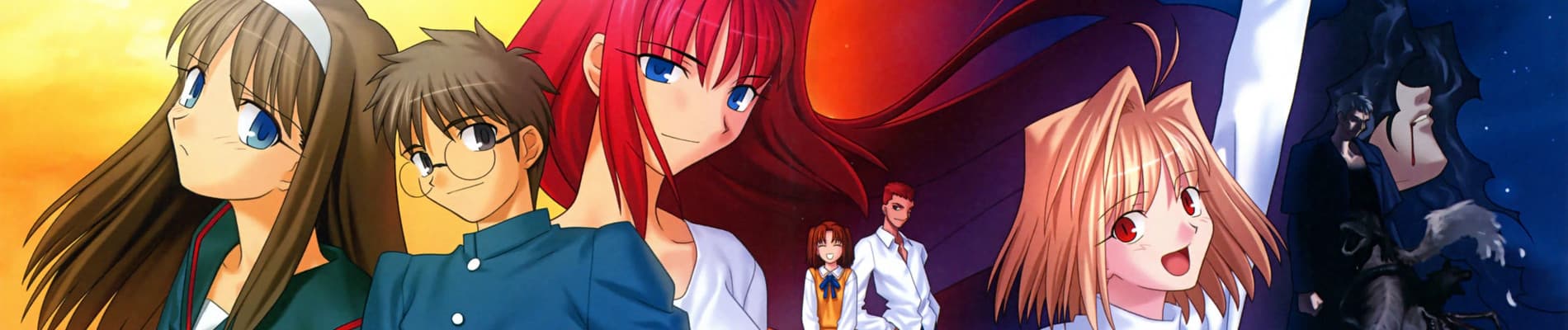

A bit burned out from manga recently, I sought a different escapism through visual novels and consequentially hopped down the intimidating rabbit-hole that is Nasuverse. With Fate/Stay Night, Fate/Hollow Ataraxia and, of course, Tsukihime (Fuck Kagestu Tokhya) presently under my belt, I can say that TYPE-MOON's most gravitating trait is strong characterization. And by far, Tsukhime stands my favorite in that regard. Tsukhime is certainly Fate/Stay Night's archaic, janky prototype in stylistic and narrative senses but these limitations strangely give the underlying character writing a brighter sheen. Though watering down the original story down to 20~30%, this manga is extremely faithful to the visual novel, albeit some notable changes. Nevertheless, much of what entranced me in the visual novel remains unchanged in this manga.
Visual novel and manga spoilers ahead. Skip to the end for a short, spoiler-free review.

I like what if's
In the original visual novel, Arcueid's route felt a bit janky in cohesion with the other routes for an overarching story, with how it mostly scrutinizes Shiki and Arcueid's relationship and the supernatural horror. However, the manga adaptation turns this hugely in its favor, turning their relationship and the supernatural horror into the overarching story. As a stand-alone route here, it's very easy to enjoy the two's budding, quirky relationship and allows the best heroine to steal the spotlight (stealing Ciel's route wasn't enough). Opposites attract, rather, the ordinary Shiki's anomalous eyes attract the anomalous Arcueid. Slicing a girl into a myriad of meat slabs upon first encounter isn't the most romantic, but it does act to kick off the horrific worldbuilding and quirky, humanizing relationship between the two.
Though, when I say worldbuilding, it's nothing expansive. Tsukihime isn't so fanatic about deep lore or mechanics like Fate/Stay Night is, using a black-tempered plot of vampires, immortals and other spooky goobers as a foothold for characterization and Shiki's and Arcueid's relationship. However, this isn't to say it's lacking nor dull, with the Roa/SHIKI subplot coming into play, thanks to the infusion of Ciel's route in this adaptation. Where Arcueid's route touched on worldbuilding and Ciel's route on psychological and philosophical themes, the manga combines both cohesively to bolster both the SHIKI/Roa and Shiki/Arcueid narratives. To touch upon the latter first, it's like warm chaos. Where one night involves helping Arcueid rip apart Dead Apostles, another involves Shiki taking Arcueid sightseeing in town to eat at burger joints or watch B-list flicks. Shiki's dive into the supernatural world's underbelly turns from begrudged obligation to determination and Arcueid's dip in the humdrum activities of the human world from hesitant to enjoyable. Where Arcueid lacks a reason to live beyond her instilled duty to kill True Ancestors, Shiki instills a new one in her and simultaneously, that becomes his raison d'etre to grit past anything that may come their way. Initially being forced into helping her, Arcueid gradually refuses Shiki's support in fear of his death and Shiki who refuses to let Arcueid remain alone as she has for the past centuries. One short week is enough for Arcueid's humanity to flourish and give new meaning to Shiki's life beyond salvaging the past. Despite all the blood and Ciel's curry, bittersweet doesn't taste any stronger than the end to their story.
 ___
___Eyes that see Death
In spite of the rather straight-forward vampiric plot, the SHIKI/Roa subplot is certainly more chaotic and harder-to-follow. However, it does add a fantastic psychological taste to the story, adding flavor and depth to Shiki's character. Otherwise ordinary and altruistic, Shiki's mental shell is oft broken by his estranged foster brother/pseudo-immortal vampire's mind connection, gaslighting him into believing their murders are his. Not to mention, his Nanaya instincts possess him, in the cases of murdering and nearly violating Arcueid, furthering his horror at himself. The gore and monsters paint a vivid supernatural horror that you'd expect from a vampire story, yet the psychological mindfuck is what overwhelmingly comprises Tsukihime's horror. Witnessing the already frail Shiki fall into deeper pits of despair and struggling to fight against his own murderous instincts may come at the cost as pleading edgy, but nonetheless makes for an enthralling ride.
In addition, the manga gives more fruitful character to SHIKI, under the scope of the Near Side routes. Whereas Roa acts as the crux of Near Side's conflict, SHIKI acts moreso as a device, that is to say, Roa's physical medium. However, because of the tad inclusion of Akiha's route in this adaptation, the two are more-or-less given sufficient characterization considering the limited amount of material adapted. As opposed to feeling like an anomaly without reason in Near Side, the manga illustrates SHIKI moderately more empathetic and with presence. The manga canon flashbacks of his past with Shiki and Akiha immensely lend a hand in this, depicting his humanity and reason as a child, gradually escalating to fighting his strengthening Tohno blood, much like the present Shiki. I always felt that SHIKI was the most tragic character in Tsukihime. His uncontrollable instincts and possession by Roa lead to his eternal banishment and his existence stolen by Shiki, his own sister refusing to call him her brother, and a lacking exploration of this all beyond cold explanations and his crazed monologues. Thus, I have nothing but gratefulness for how his descent to bitter chaos and the remaining humanity foisted in that abyss are shown thoroughly.

Chairs
Not just narratively and thematically, the manga also faithfully adapts stylistically. While there's blatant archaism to the original character designs, Takeuchi's designs still have immense charm and the manga delivers them untouched. Designs apart, the art works fantastic narratively. True to the gritty and despairing tone, Shounen Sasaki opts for gradience in both background and panel frames to illustrate a blackening abyss in plot direction and Shiki's mental state. However, the fight scenes felt rather contrived and janky. Since Tsukihime isn't so gung-ho about action and fights as it is with horror and characterization, this is understandable. Although, the janky flow of the fights also work to illustrate the chaotic tone to Shiki's imbalanced state of mind and his otherworldly opponents, so take them as you will.
While not in the same realm as Chainsaw Man or Koroshiya 1, the gore is satisfyingly present in the aftermath of Nero's hotel attack and Shiki/Arcueid's battles with Dead Apostles. Where the gradience could've been easily applied as masking censorship, the slew of headless, limbless corpses are laid bare, albeit lacking gory detail. Regardless, it adds to the overarching horror tone.


Conclusion
Horror foisted more in the entrancing psychological trip than the actual vampiric plotline, Tsukihime spells out a humanizing descent and sub sequential climb from a bloody abyss. With a strange relationship between an ordinary, yet unordinary Shiki Tohno and unordinary, yet ordinary Arcueid Brunestud at the heart of the bizarre chaos of vampires and monsters, this story maintains a balance between otherworldly supernatural and warm romance. Despite the gory and otherworldly action often present, Tsukihime possesses tunnel vision on heartfelt characterization casting warm light on the darkening tone. With fantastic art supplementing, the story is easy-to-follow, albeit confusingly appetizing in conjunction with the psychological subplot. Clever use of gradience, charming character designs, chaotic fight scenes; age isn't an issue with this manga.
Addendum: