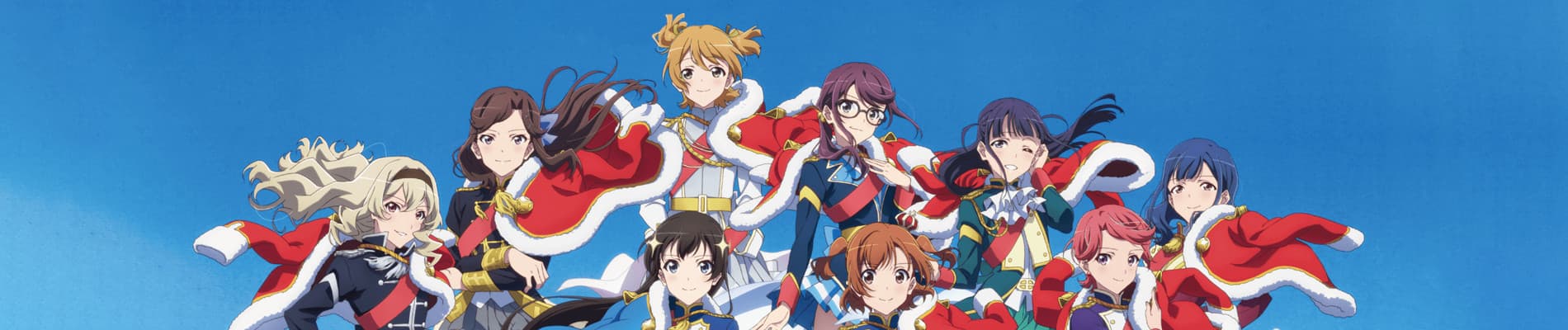
When I first heard there was gonna be a Revue Starlight sequel movie, my reaction was, “Why?”
Here’s the thing: Revue Starlight is one of my favorite anime of all time. It’s a truly one-of-a-kind showstopper, melding symbolism-drenched storytelling, breathtaking battle sequences, and a beautifully realized cast of characters into the ultimate exploration of theater and what it means to be a drama kid. No anime so perfectly understands the struggle, the meaning, and the metatextual wonder of theater as Revue Starlight. But it’s also in large part about the fact that stories shouldn’t go on forever. Trying to recapture the same glimmer over and over again is only going to lead to diminishing returns, stagnating your craft and life alike. In order for art and people to survive, we must move forward; curtains must close on one play in order to make room for another. And in just twelve episodes, Revue Starlight closed its curtain expertly. It wrapped up all loose ends, fully explored all its themes, and ended its run with a complete thesis that said everything it needed to say. It was about as perfect as closure can possibly get.
So what’s the point of doing a sequel? What’s there even to continue when it feels like everything’s been brought to a close with no room for elaboration? Why undo the ending for a story that was all about why stories need endings in the first place? There’s nothing to continue here, and even if there were, continuing at all would be contrary to the point this franchise was trying to make in the first place. Surely, even a good sequel to Revue Starlight could only ever feel like a step back at best, and an outright betrayal at worst. Why bother trying at all when it seems doomed to be a losing prospect from its very premise?
And then I actually watched it.
And folks, I could not be happier to tell you I was completely wrong.
The Revue Starlight movie is one of the most astounding things I’ve ever seen. The best way I can describe it is a cinematic crossroads where Adolescence of Utena, End of Evangelion, and Liz and the Blue Bird all crossed blades, spilling each other’s blood and painting the earth in its rainbow color. It’s at once a staggering deconstruction of itself and a reconstruction into something entirely the same, a study in the complexity and maturation of humanity and interpersonal relationships, a dizzying spectacle of sight and sound that would put most professional opera to shame, and a climactic battle cry that made all my doubts melt away like ice before a roaring inferno. It embraces its own seeming superfluity and turns that into its greatest weapon, burning itself, its characters, and its very franchise to the ground so that a new phoenix may burst forth from the ashes. Hours later, I’m still reeling from the sheer experience of watching it all unfold. I struggle to find the words to do it justice, to grasp my reeling thoughts and re-arrange them into something comprehensive that isn’t just screaming and flailing with a mixture of awe and delight. This. Movie. Fucking. OWNS.
Sadly, to talk about why it owns so much, I can’t remain fully spoiler-free in this review. This movie is not something one can talk about without at least hinting at some of its biggest surprises and unexpected left turns. But I’ll do my best to avoid specifics wherever possible, and if anything I’ve said thus far has convinced you to give this movie a shot, then I suggest you turn back now. You deserve to experience it as unspoiled as possible. If you need a little more convincing, though... then read on.
The smartest thing the Revue Starlight movie does is make the question of its existence the central question of its story: where do we go from here? The characters have passed the auditions intact, performed their new and improved version of Starlight, and come into their own as young actors. So what happens now? Where do Karen, Hikari, Mahiru, Nana, and all the rest continue their journey on the stage, now that external forces are no longer prompting their forward motion? Life, after all, continues ever on past past the end of a play; the auditions may be over, but with graduation around the corner, a new chapter in their lives will soon begin. And none of them are quite sure what new stage they’re going to stand on when that time comes. Hikari’s even gone back to London to continue training at her old school, leaving Karen once again unsure how to move forward without her own shining star to guide her. It’s a beautiful way to weave that metatextual uncertainty into the fabric of the movie itself, something this franchise has always been masterful at. The curtain has fallen on one show, but a curtain is about to rise, whether the girls are ready for it or not.
And indeed, it’s only a matter of time before this existential concern becomes the bedrock for a new series of battle revues. Only these aren’t auditions for Top Star like they were in the show; no, they’re something much more complex, much more intense, and much more challenging to the very core of who these people are. I’ll avoid spoiling the specifics of how and why these new revues come about, but suffice to say, this is no longer a tournament for some far-off prize that only one lucky main actor can win. This new stage is a stage for all nine girls to sweat, bleed and die upon, fully coming to terms with themselves, and their relationships with each other, so they can grow past their doubts and become fully actualized, fully self-confident young women. Karen was the protagonist of the show, and she still technically is here, but more than anything, this movie is a story of each and every girl becoming the protagonist of their own life, finding what drives them forward, discovering what path they wish to take, and embracing the way forward with all the drama, exertion, and over-the-top zeal that comes with the territory of being a theater kid.
In other words, this movie is about breaking free of the confines of who you were and charging headfirst into the person you wish to become, fears be damned. And in true Revue Starlight fashion, the metatext of breaking free of the story itself is part and parcel of that same layered metaphor. Just as Nana once trapped the girls in an eternal rerun of their golden years, just as the play of Starlight was a prison that had to be rewritten for the characters to move forward, the stasis that Revue Starlight must now overcome is the stasis of its own perpetuation. As long as this franchise continues, the movie seems to argue, these girls will forever be caught in cycles of torment and struggle, forever performing bloody plays for an audience drunk on the spectacle of it all. It’s a feature-length expansion of that chilling moment where the giraffe turns to the audience in the final episode, condemning us as complicit in the continued suffering of its characters and world. For the characters of Revue Starlight to truly escape the death knell of stasis, then Revue Starlight itself must be destroyed, freeing them from this cyclical story and delivering fate into their own hands. Only then, at long last, can the curtain rise on the next act.
What we have on our hands here, then, is nothing more or less than Revue Starlight enacting its own apocalypse. It’s a two-hour cinematic self-sacrifice that seeks to send itself out with as beautiful a blaze of glory as it can possibly muster, confident in the knowledge that what made it so valuable will survive long after the curtains come down and the stage is swept clean of broken glass. Characters clash and fall apart, but promise to never truly leave each other. Iconic symbols from the show crumble and shatter, remixing in an endless array of new possibility. It destroys the fabric of its very existence, only to pull something even more precious from the wreckage it leaves behind. Even the in-universe world feels bigger than ever, with more focus on background characters, more locations outside the school, and flashbacks that flesh out Karen and Hikari’s childhood friendship, back when they were still just ordinary kids outside the pressure cooker of the world of theatre. Watching this movie is like watching the foundations of Revue Starlight itself come undone, revealing everything beyond its narrow stage and encouraging us to leave the audience at last. To call it breathtaking would be an understatement; I still don’t know if I’ve fully remembered how to breathe.
And the revues themselves! God, the fucking revues! Free of the tournament bracket, the musical battles that dominate this movie’s second half are able to break free of their formulas and deliver this franchise’s most stupefying spectacles of all time. Characters you’ve never seen fight before! Characters you’ve wanted to see fight for ages! Interpersonal conflict that builds off what the show established and strips it down to its core! The raw emotions of each match-up, the way previously established relationships are tested and laid bare with both participants’ worst qualities fully unleashed... it’s like you’re meeting everyone for the first time all over again, understanding them more deeply than you even did over those past twelve episodes. And that’s not even taking into account just how fucking gorgeous they all are. The show’s uneven production schedule lead to some of its later duels lacking the polish they needed to truly shine, but here? Every battle is a feast of sakuga and symbolism. Every fight bursts with jaw-dropping imagery. I could spend hours poring over all the best moments from each fight, the moments that made me screech and howl and gasp and cheer. And if you were as disappointed as I was that Claudine and Maya’s revue in the show was too compromised by production issues to really do them justice as the queens of their class, then hooooooooly fucking shit, you need to watch this movie as soon as possible. That’s all I’ll say to avoid spoiling any more, but trust me: you will not be disappointed.
Believe it or not, I could keep going. I could discuss how masterfully the flashbacks are integrated into the overall structure, the brilliant way the giraffe is thematically repurposed, the absolutely mind-blowing final act. But I think it’s best I take this franchise’s advice and let the curtain fall before things drag on past their natural stopping point. Revue Starlight is truly over now; this movie is as definitive a finale as that last Evangelion movie, a stopping point that ensures no possible continuation. It’s a swan song for a franchise I didn’t think needed one, but now I can’t imagine without. It’s as stunning a finale as I could possibly hope for, bringing itself to an irreversible end and celebrating its demise with the performance of a lifetime. It is, without question, one of the single most incredible movies I’ve ever experienced. Take a bow, Revue Starlight. Thank you for one of the greatest curtain calls in cinematic history.
49.5 out of 50 users liked this review