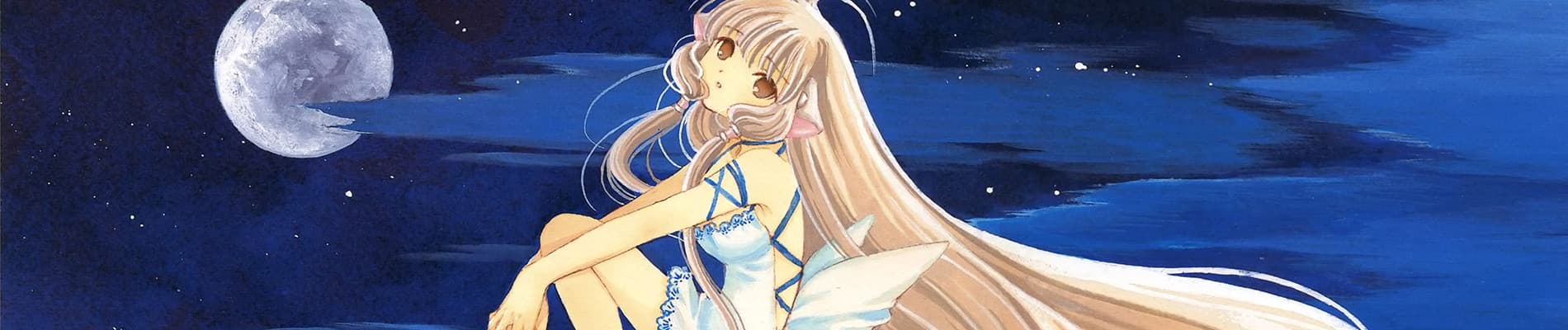
“The town was completely empty. There were houses, and lights could be seen from the windows... But nobody was on the streets. I tried peeking in the window. There was someone there, but he was together with ‘it’. I looked in other houses. They all were together with ‘it’. Because it’s fun to be with ‘it’. Because it’s more fun than to be with people. So nobody comes out now. This town is empty. I’m going into a journey. I’m going to another town.”
[Atashi Dake no Hito. “A City With no People”. Chobits]
SPOILER WARNING
If a few months ago someone asked me if I'd imagine I was writing this review, I would definitely answer no. My past self could barely imagine that someday I would make space on the list to watch a potential Madhouse romance classic, nearly 20 years after its release. And if I were asked if I would imagine my experience as exactly it was, my present self would also answer no. After all, despite the many caveats I'll put into words here, Chobits surprised me with a relatively pertinent discussion for something that started out as just a rom-com embroidered ecchi lace.
Chobits begins as a work exactly like what some of its genres and synopsis sell. Hideki Motosuwa is an 18-year-old boy born in a country town. Unfortunate by his failure in the entrance exam, he decides to migrate to a big city and attend a preparatory course. However, contrary to our common sense of what to expect, the culture clash between the two environments is significantly greater than it would be in a real situation, as Hideki's world is inhabited not just by people, but by robots with whom they coexist. These, of various sizes, shapes and functionalities, here present themselves by another name: “persocoms”. Don't worry, you'll soon learn more about them.
On one of his walks back home, at nightfall, Hideki finds a persocom abandoned on a pile of rubbish. With difficulties, the young man carries the heavy humanoid to his modest house and is able to restart it. However, what appeared to be a common abandoned model, in reality, shows a much greater complexity when you first come into contact with it. Stripped of her old memory and with vestiges of a much more advanced system compared to others, the persocom, now renamed "Chii", her apprenticeship, her relationship with Hideki and her mysterious past become the focal point, and the narrative follows from there.
The initial product is the attempt at an anime centered on comedy and that leaves its Sci-Fi in the background, while the element that occupies the most stage is the romance story filled with sexual jokes, involving moe situations, innocence and its heroine principal that exudes submission. The audience is amused by Chii's lack of knowledge about things and the mistakes she makes while trying to learn. The audience laughs at the protagonist and at the constant sexual situations, whether coincidental or accidentally created by himself. The public thinks the relationship that is built between the main couple is cute, despite the fact that, in this period of history, the pair is not defined as a couple. And I could have fun with this product too, if I didn't find it repetitive, silly and filled with unproductive episodes at times.
One criticism I make of the first half of the show and its ecchi atmosphere in general is that the applied jokes constitute a simplistic and time-saturated formula. The vast majority of gags are based on two main elements: sex jokes involving the protagonist's behavior, through his young adult virgin nature; and jokes with misunderstandings of sexual meanings, involving Chii's innocence and deviations during her apprenticeship.
In the early episodes, this serves the purpose of the characterization. However, the show evidently loses its way of humor as the same joke with porn magazines starts to appear in several of the episodes. Or, when any girl who approaches the protagonist induces the same reaction of sexual fantasy and shame (ok, luckily this behavior improves reasonably as the work progresses). In addition, more artificial situations, created solely and specifically to forge the joke, start to jump out, such as the scene where Chii finds a kitten carrying a handkerchief in its mouth and mistakes it for panties.
Amidst the application of ecchi, I must say that it is not just harmful in the context of repetition. In some cases, it is also an anticlimactic agent, undermining scenes that should have a more symbolic or dramatic weight. In this department, perhaps the most famous example is in the infamous EP24, when there is a reconciliation between Yumi and Ueda. I mean, the formation of a couple and mutual acceptance here are the key points that seek to move the audience and provoke reflection on the central theme of the work (I'll get to it soon). The dialogues and the weight of the lines are purposefully more dramatic, but the climax of the scene is interrupted by the fact that Chii takes off the clothes of Ueda's old persocom and offers it to Yumi, while the protagonist blushes.
In a certain point of view, the first half of the anime is necessary. The focus of the narrative is centered, above all, on Chii's learning and we see the character's development, the ability she acquires to communicate and the concepts she barely understood and that, later, she is able to understand. Unlike the protagonist, who squanders less development here, this portion is indeed important for the heroine.
But, on the other hand, I must say that I was disappointed with the amount of scenes and episodes that were not very useful for the plot in general. At moments, I really see the story move forward, like when we get in touch with Kokubunji and Yuzuki's backstory. In others, I find myself bored and want to drop the work, while in front of my face there are beach episodes, scenes of Chii looking for a panty store and episodes of Hideki terrified by an urban horror legend. It's boring, and this last one, in particular, is the one that my humble opinion attributes as the worst of the work.
Perhaps because I complained about the predictable and simple structure that follows the first half, I finally found myself satisfied with the work after its change in theme. That's because, as soon as the specific milestone of Shinbo's revelation hits the plot, Chobits has a shift from its core. The show's spotlight is no longer distributed over Chii and Hideki individually, but rather illuminates the entire stage and brings it all together in a central message that becomes more and more evident. Its greatest merit. Its important message aimed at viewers.
Chobits is a work that evokes a concept that has already been so explored and used, but that has barely deteriorated in terms of relevance. It's as if it were a “tin man”, but it will never rust. Since the human being was conceived as a creator of technologies and holder of the ability to give life to other intelligences, futuristic projections entered the universe of popular imagination and soon spread to paper, where the most diverse authors write fiction. They range from optimistic views that portray the magnitude of electronic resources and their impact on various social spheres, to pessimistic views that choose to point fingers at our own creations as superior and substitute for human beings. I know I'm about twenty years into the future with regard to Chobits, but several works have touched and will touch this theme even being ambivalent in these views, such as Sword Art Online, Psycho-Pass and Koukaku Kidoutai.
Fear of substitution is natural. Everything we create is liable to risk becoming obsolete one day, and the technical-scientific-informational revolution has only accelerated this process even more. As what is around us is always in constant change, it is evident that, at some point, we would ask ourselves if the human being itself would not become obsolete and would be overtaken by evolution. And, as much as its reflections are not philosophical like those in the titles I quoted above, Chobits is right in portraying this uncertainty, projecting a possibility that is not necessarily as romantic as it sounds, nor is it as atrocious as we imagine.
You see this duality from the perspective of relationships. While people are thinking creatures, they are also walking contradictions and beings endowed with defects, free wills, and memories that influence our worldview and reactions. On the other side of the coin, a machine or artificial intelligence is theoretically not bound by these fetters. We can put in any features and paint them according to our own individual palettes. Machines are theoretically rational and data driven, which is why artificial intelligences are often portrayed based on their purposes. That is the essence of a creation.
But at the same time, this limit also removes the layer that exists in human coexistence. Human beings are constantly looking to define themselves by the other, and the presence of another person, someone who is not you, talking to your ego and giving you the uncertainty of how you will react to each word, represents a glamor in social interaction. See? While we are limited, our creations are also limited existences. There are things we can do and things we can't. And there are things that machines can do, but others that only humans can provide, from the most intuitive act of having children to details of the psychological dimension of interaction between a pair.
That's why Chobits' message is impactful. The reality of the work, although fictional and somewhat distant, proposes a reflection based on the illustrations of its characters: what would a reality be like in which a relationship between a human being and a robot is possible? And, going further, on both sides, how would the species psychological deal with loneliness, or with substitution?
Personcoms represent an extremely important extension in this context. Their existence within society opens up the range of possibilities for different situations that would truly happen. For example, the portrait of Ueda and his stable union with Yumi, the persocom, depicts a pertinent illustration of adaptation during this incorporation of robots into society. Not only the development of human feelings for the machine is portrayed, but also the prejudice that society would potentially have, the inexistence of legalization for a stable union, and, mainly, the impact that this experience would have on those around them. Yumi, the human, and her separation-related drama is proof of that.
If that's not enough, why not talk about Takako and Shinbo? The illustration that revolves around Takako's drama is a great example of how this replacement also has a dark side. Like it or not, the naturalization of the machine as an ideal partner is a possible reality in this science fiction. After all, it is much easier to accept the one you created yourself and be sure of how it will react, that it will always be there for you, than it is to love those who essentially have their faults and accept them. And, little by little, this vision being assimilated into society, abandonment and loneliness are indeed side effects, to the point where we are not even more sensitive to others of our species. Just look at the quote I put at the beginning of this review. The scenario created by it says it all.
There are cases where we use this ability to paint our creations for other purposes. Kokubunji, for example, does not necessarily sustain a romantic relationship with his persona, Yuzuki, but instead draws on the flexibility of technology to immortalize his sister's existence. Here, there's an overwhelmingly optimistic side to the technology, though his obsession with the memories he once lost represents an unhealthy spot. See the pattern, reader? Chobits deals with this theme with some respect, as the reality of persocoms is not seen solely as negative or positive, but rather as a mixture of the two.
Unfortunately, not all characters in the work have relevant illustrations or some more expressive development. In addition to the protagonist, who is often a reason for jokes and whose development is based almost entirely on discovering feelings for Chii and her past, there are others that I would consider shallow in the context of the show. One of the greatest examples is Yoshiyuki Kojima, or, as we know him, "Dragonfly". His role in the work is to kidnap Chii to move the foreshadows of the script, his only motive being his interest in that persocom. He later switches sides and, again, his only job is to support the operation of hacking the mysterious syndicate's database. Without even a backstory, he's a veritable script lever, left and right, that doesn't do much for the message and that is forgettable to probably many of us.
But of course every story has to come to an end. There is no better way to get your message across than to complete it as an expression. Thus, after ten episodes in a second arc relatively superior to the first, Chobits brings together the confluence of its elements in two climactic episodes, in which Hideki finally realizes his feelings and he and Chii confess to each other. And I must say, my sincere apologies to anyone who was moved by this final part, but I believe that CLAMP made some logical slips in it.
Do not misunderstand me. The ending carries a valuable symbology, in fact. Ichirou's paternalism reflects the story that the creator himself and his wife attributed to Chii, keeping the hope that one day she will be able to transcend the tragedy Freya went through and find someone to match her. Ichiro instilled a program in Chii, and this program, at the end of its execution, makes it possible for all the persocoms connected to Chii to acquire, just like her, the capacity to love. In the anime, this isn't extremely clear, but it's interpretive. Persocoms' eyes become realistic for a while, which brings them closer to human features. After all, feelings are the main difference between machines and people, and here their acquisition would bring them closer to us. Dima blushes when Zima hugs her after the program runs, and that attitude is also a hint.
Other symbologies, such as Freya and Chii's lines about the button she has in her vagina can only be touched by “the one just for her”, gain a meaning more than the mere presence of ecchi, and that I need to appreciate. But at the same time, it appears that CLAMP has forgotten some of the sci-fi details that lack more tangible explanation. For example, why are Chii and Freya able to move around by jumping gracefully and seem to glide around town in episodes where Freya takes control of the body? Why do Freya's movements give the impression that she can fly? And why does this happen to Zima and Dima, too? It is assumed that all three are close models of persocom, and this physical ability may be implied, but as this is never formally explained or said, we only need to accept this “physics” during the robots' wanderings.
The factor that perhaps bothered me the most about this ending is the lack of detail in some of the sci-fi elements. Another example that raises this question is the functioning of the Chii program. How exactly can Chii be able to induce other persocoms to deliberately gain the ability to love? At what point did the acquisition of feelings become something transmissible by electromagnetic waves or a dataset that can be sent from persocom to persocom, without cables? As far as I know, the anime convinces us that Chii was able to learn to love due to her set of experiences plus the complexity of her model. So, the application of this program, despite being symbolic, is difficult to digest. It is difficult to accept that, while for Chii love has been a difficult path, for other artificial intelligences this is such an immediate and easy achievement, since the vast majority of them are not even assembled by their owners.
Other solutions the script comes up with, like Chii and Freya's ability to control their cables like telekinetic tentacles (yes, I'm not lying, she literally does that when Dima tries to stop her from running the program) make me question how much of logic was put at the climax of this work. And just like the physics that governs persocoms jumping from pole to pole, I am again forced to just accept and move on.
To be fairer, I must emphasize that these details are not always CLAMP's fault. I haven't read the manga, but in my wanderings around Wikia, I've found that in the source material Chii's program doesn't have this function, but rather represents a darker version of the heroine's journey. Rather than enabling persocoms to be able to love, the program was originally activated not when Chii found her love, but when she didn't. And its effect, originally, was not to create conditions for robots to win love, but rather the opposite, permanently turning off their facial recognition capabilities. This means that, in the original story, if Chii wasn't able to find "the one just for her", Ishiro would assume that none of the other persocoms could do that, and their ability to distinguish humans would forever be erased, dying along with the possibility of falling in love.
This ending makes a lot more sense. Deleting facial recognition functions is a much more tangible achievement to be done through the connection Chii has with other persocoms than transferring data that enables them to conquer their own feelings. It's a simpler solution, but it doesn't bump into the fact that Chii is much more complex than her “sisters”. In addition, she is also more visionary, as Ichiro would leave open to her daughters a future in which persocom models would be more complex and closer to Chii's, and evolution would bring this achievement to them. That said, I believe Madhouse has made an unfortunate choice here, overpriced for moving its viewers, but unfortunately sacrificing the logic the authors stabilized in this part.
Speaking of foreshadowing, I must say that the clues offered to the spectator in Chobits, although a little obvious in some of the moments, are present and relatively competent. The picture books that Chitose writes help us understand the reality of Chii's feelings and make up a “larger interpretation” when connected and related to understanding the end of the work. The phrases in the book are also illustrative of a reality in which behavior such as Ueda's would be morally accepted and disseminated, and this projection only adds to the reflection that the work attracts. Other elements such as character phrases that serve as a prelude to their later backstories, such as Yumi's comments on Chii and persocoms in general, are also welcome and I value them.
Finally, I don't feel comfortable commenting on the production on Chobits, as I can't use the same molds we're currently seeing as a parameter. All I can say is that the art, even dating back twenty years, still plays its role relatively well and is consistent in most paintings. As one of the most influential studios in the industry at that time, Madhouse did a good job in that department if you look at it chronology, and I don't think that's a surprise to anyone, although there's the age shock if, like me, you decide to visit this show in 2022.
The soundtrack is competent, from the calmest songs to the sound design of the most tense and sad moments. Despite this, I personally found some of the director's choices strange, like the one made in the Ueda and Yumi scene during EP24, which denotes expressively calm music for a moment that should have been more dramatic. I add an afterthought about opening as, contrary to popular opinion, I hated the fact that it was so static and so weak in its density of symbolism. Little happens in the storyboard, there is little fluidity and even less symbology. All that happens are changes in position and expression by Chi and Hideki in step with color, pixelation and music. Personally, I found it uninspiring, aside from giving the impression that the show is solely about romance between the two of them when in reality it isn't. As for the ending, although it is close to this archetype, my judgment is lighter. Fluid endings, full of symbologies, image transitions and deeper ones are rare, even more so at that time, so I can't charge much more than the reference made to Chitose's stories.
Watching Chobits, like the message the work tries to convey, was an ambivalent experience. Half of the work is tedious, with some considerations, and the other half is rewarding, with other considerations. Some characters compose valuable illustrations, while others are shallow. Science fiction projects a pertinent universe, but it has its problems of explanation. That's why, at the end of this review, as much as it surprised me for a genre I'm not so interested in, my enjoyment was balanced and I can't rate it any other than as balanced and neutral as possible.
14.5 out of 17 users liked this review
