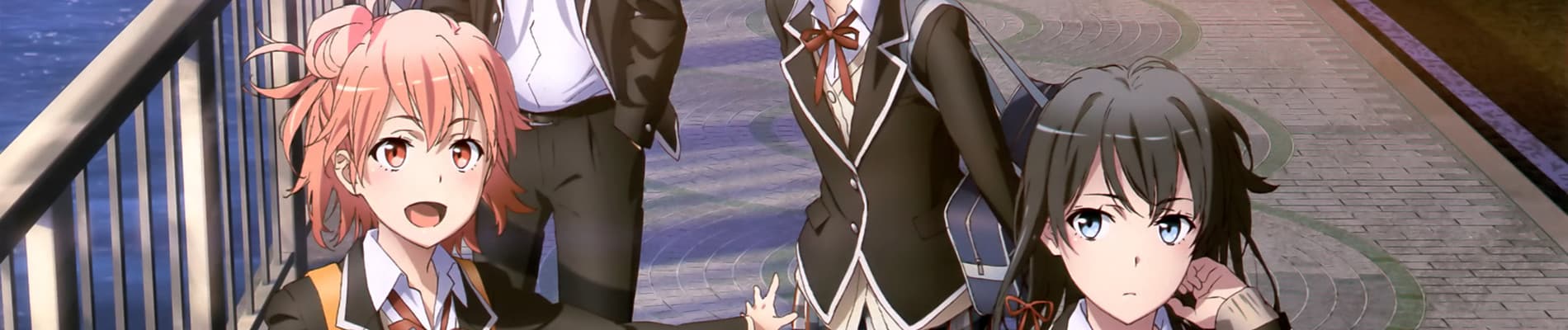
In a world comprised of endless chatter, how do you separate the signal from the noise? Oregairu, as one of many dialogue-based anime, uses conversation between its characters as the primary method to drive the plot, build relationships, and push motifs forward. I mentioned this in my S1 review, but this romcom is heavily dialogue-based, and while that’s definitely not inherently a bad thing, it does take a little bit of getting used to. Particularly, it’s up to the viewer to determine what, from the endless conversations, actually matter. And this might be very different for different viewers – there’s honestly not one right way to watch this show. In this review, I’ll give my perspective on how I filtered meaning out of the dialogue and found satisfying progression from the second installment of this comedic wrong.
Before I begin, however, I find it ironic that I’m readily able to identify how incredibly wordy this show is, but I’m somehow unable to keep my own reviews at a reasonable length. Consequently, I’m not going to cover all the categories in detail here, focusing on what I think is most important: plot and characters. Instead, I’ll take a brief look at music and art right here. I really enjoyed this season’s OP, with Yana’s vocals reappearing much to my pleasure. The OST in general is as solid as S1’s, and while no part of it stands out as incredible, it achieves its purpose of filling in the sensory gaps when needed. Again, as a dialogue-based show, I feel like the soundtrack needs to be focused on enriching the words the characters say, and staying silent when the time calls for it. In these regards, it succeeds. The art, I’d argue, is an incremental improvement over S1, retaining the same general pallete and shading. The animation is also a bit more fluid and overall enjoyable to watch – not that you’ll see a ton more than talking heads. Overall, music and art are definitely adequate, maybe not incredible but definitely sufficient in their roles driving the rest of the show forward.
With that out of the way, let’s now turn to my favorite part: plot and characters. As I described in my S1 review, Oregairu is really about the juxtaposition of opposite worldviews. Hikigaya and Yukinoshita’s opposing ways of approaching life, their peers, and their own goals is cast as one edge of the ubiquitous love triangle. This theme is presented quite simplistically in S1, but grows significantly in nuance throughout S2, where the curtain pulls back a bit more. S1 largely resolves the mutual tension that arose between the three leads due to the freak accident that somehow pulled all together. With that out of the way, things really should go one of two ways – either the trio organically bonds with their newfound equal footing, or gradually drift apart in light of mutual disinterest, right?
But in Oregairu, as in real life, things are rarely that simple. The gauntlet remains cast, and Hiratsuka’s challenge persists. Most importantly, however, while the audience may have a better idea of what, exactly, comprises the heart of the leads’ disagreeing worldviews, the details remain unclear. This is cast, again, into the forefront as soon as S2 kicks off. If mutual resolution within one friend group is one thing, resolution among an external clique is quite another. Hikigaya and Yukinoshita may have reached a temporary armistice within their own social circle, but they definitely disagree regarding the right way to addressing the shifting power circle surrounding Hayama Hayato.
In comparison to S1, however, resolution becomes a bit more nuanced, and serves as an excellent case study for how I believe S2’s plot evolves on its predecessor. To study this, however, we’re going to have to turn first to a supporting character. As I mentioned in my S1 review, it’s going to be difficult to visit every supporting player individually, but I’ve been waiting for an opportunity to look closer at Hayama, and it just happens that he serves a pivotal role in this season, and indirectly in the development of each of our three leads. Yukinoshita and Hikigaya are painted as stark opposites, but upon closer look, they share a striking similarity in social ostracization, albeit for different reasons. Hayama and Hikigaya, however, are portrayed as even more extreme opposites. Hayama is popular, suave and athletic, each of which contrasts with Hikigaya’s capabilities. Most significantly, however, Hayama is portrayed as socially apt, as the de-facto leader of his own clique, while Hikigaya is pulled into a social circle against his own will.
It’s a surprise, then, when it’s Hikigaya who resolves the uncomfortable tension within Hayama’s friend group within the first two episodes of S2. Surely, with his limitless social charm and aptitude, this should fall within the capabilities of the group leader, right? Instead, we see the self-imposed social outcast further degrade his own social standing to resolve Tobe’s romantic misgivings. It’s arguable that this simply builds upon his resolution of the uncomfortable dynamics within the same clique in S1, but this situation reveals quite a bit more about Hikigaya’s own character. This is really the first time where we see his actions impacting the feelings of those who surround him – most significantly those of Yukinoshita and Yuigahama. Most significantly, the dialogue surrounding their response is where feel.’s nuance comes to light. There’s not a straightforward interpretation to this response, and the audience is invited to draw their own conclusions regarding how this will influence their own dynamic in the future.
Perhaps my favorite part of this season, however, is how plot points that are introduced within the first few episodes are given appropriate time to ferment and reappear, for more satisfying conclusions, in later episodes. Although punctuated by the start of an arc so large it extends well into S3, Hayama’s own arc comes full circle towards the end of the season. His failure to notify his future plans to his own friends re-introduces the audience to latent issues within his power circle. It’s not until episode 11 that we figure out the true nuance within the two’s relationship – sure, Hayama may surpass his peer in in outward social aptitude, but ultimately he feels inferior to Hikigaya. While such a conclusion may seem shocking to an audience consistently reminded of the male lead’s “grossness” by other major characters, the truth stares back at us from the depths. Certainly, Hikigaya’s approach may seem tactless and self-sacrificial, but is Hayama’s pride-preservation any better? Does he betray his own hypocrisy by attempting to reveal to Hikigaya the failures of his personal-scapecoat appraoch? What do we, as the viewers, think when we’re faced with the hard benefits to Hikigaya’s own worldview?
I alluded to this earlier, but this season also introduces one of the entire series’ largest arcs and along with it the primary supporting character, who plays a significant role both in the remainder of S2 and the entirety of S3. Love or hate her, Isshiki Iroha arrives in full force this season, and her dubious prank nomination and ongoing duties in the role of student council president serve as a major plot point. As before, Hikigaya and Yukinoshita disagree with the best way to address the prank nomination, with Hikigaya’s proposal of image-desecration being repulsive to the latter. Significantly, however, Yukinoshita and Yuigahama’s own approaches to the problem far exceed the comparatively-mild solutions of S1
It’s in this particular moment that the tone subtly changes, and where I feel the true rest of Oregairu begins. Suddenly, Hikigaya isn’t the only vertex of the love triangle taking self-sacrifice as the only solution. Yukinoshita and Yuigahama sacrifice their own comfort to run against Isshiki, the former in an effort to fulfill her duty in service club, the latter to preserve the club’s future. Suddenly, all three points are opposed once more to each other, leaving Hikigaya with yet another issue to resolve. Unlike S1, which mainly dealt with diametrically opposed viewpoints addressing the same issue, S2 poses all viewpoints the other coming out victorious. Hikigaya’s tactics leave him with what amounts to a moral and social dilemma, which ultimately results in him solving the latter problem by not resolving the former. Does convincing Isshiki to accept the role mean he failed in his responsibility as a service club member? Or does doing so ultimately save the club and its ideals?
I don’t think I can wait any longer before introducing what serves as the final missing pieces of the Oregairu cast: Yukinoshita’s family. While Yukinoshita Haruno may have served a simplified contrarian role in S1, she reappears with more nuance in S2, and Hikigaya begins to realize the complex inter-nuclear dynamic that Yukino holds with her elder sister. By opposing his peer’s approach to solving problems, does he perpetuate the feeling of tenuous inferiority that she holds in the face of her elder sister? Moreover, does the surprisingly-strong sway that the elder sister holds over Hikigaya’s own social dynamic inappropriately influence his own understanding of Yukino’s character? In particular, the suggestion that her sister’s own cold, decided demeanor may be a façade or coping mechanism strikes a deep question into the mind of Hikigaya and the audience. Like I mentioned before, this show is about diametrically-opposed viewpoints. But where do these viewpoints come from? In Yukinoshita’s case, we are for the first time given a hint that they may stem from a complex hurt spurred by dynamics within her own family.
Even beneath these broader arcs, however, we see evolution in the cast within smaller plot arcs as well. Yuigahama’s true feelings towards the service club and its trio of members comes to surprising force in this season, where the three struggle to come to an understanding of how their relationship will develop. Does her desire to remain as things are reflect a sense of delusion? Does she postpone an inevitable conclusion or only look to perpetuate the enjoyment she currently sees within her dynamic? Perhaps more than any other character, Yui’s progression within S2 away from simple naïve optimism challenges the very premise of worthless youth that founded Hikigaya’s worldview. I’d argue that she, moreso than Yukinoshita or any other character, really confronts the “wrong” aspect of Hikigaya’s approach and the franchise’s own name. I can’t really enter too much into detail without spoiling major plot developments, but I’m impressed with how S2 deals with this development.
And such, S2 draws to a close, albeit with higher tensions and a final request that leads the audience to anticipate and dread what’s coming next. Do I recommend it? Yes. Similarly to S1, I feel like Oregairu manages to integrate a central motif – opposition of worldviews – that set it apart in the world of generic romcoms. Are there generic, stereotypical elements to this high-school slice-of-life? Of course, many. But do I feel like the interesting characters and plot progression make it a more enjoyable watch than other shows within the same genre? Yes, and the sensible pacing of S2 make the plot feel sensible and almost realistic, something I feel to be totally untrue for other romcoms.
54.5 out of 64 users liked this review
