
Spoilers will be discussed, so go watch the show if you haven't already.
"Your name is Violet. I'm sure that you will grow into a woman just as lovely as these flowers."
War is a hideous thing. It's one of the darkest aspects of human nature. But when it comes to my own personal tastes, I've always had a love for war stories. Perhaps it came with an early childhood fascination with history at large, or my love for video games such as the Metal Gear Solid franchise or Spec Ops: The Line. But that interest in how war effects those who take part in it and those who are caught in the crossfire is ripe for creative exploration.
Those who haven't watched 2018's Violet Evergarden might be a bit confused to why I opened my review with the paragraph above this one, as was I when I first heard details of the show back before I watched it. I went in completely blind, starting it with a friend of mine before finishing the show and it's subsequent specials and movies by myself. It's hard to write about this show, mostly because I watched it in a rather slow manner, but also because the show itself is a bit of a slowburn, but we will get to that in a few minutes.
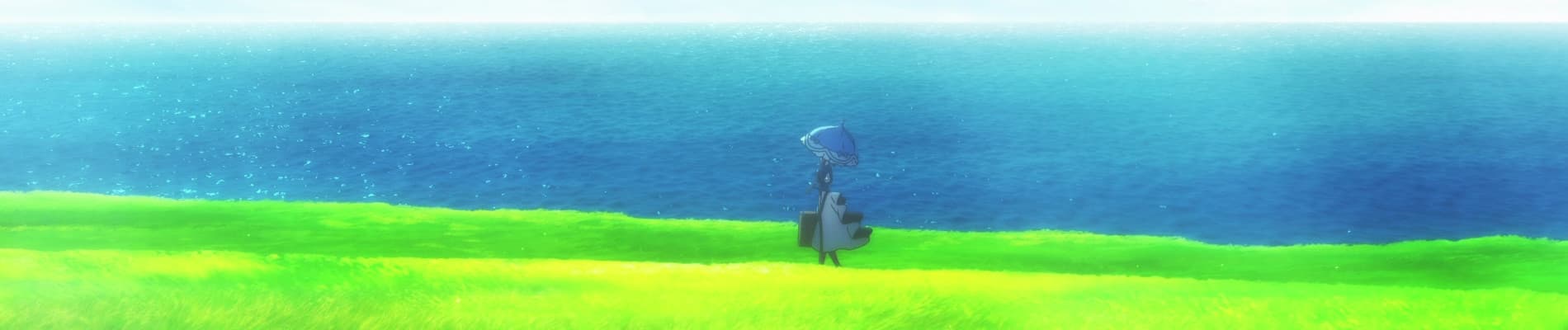
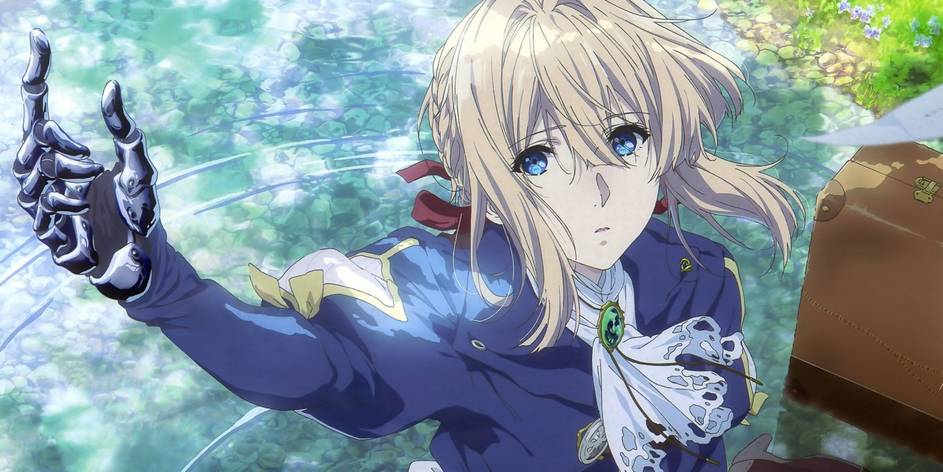
To start, the show's visuals are absolutely stunning. Kyoto Animation, the studio behind the series, once again knocks it out of the park. The hand drawn animation is gorgeous, as is the general art direction and character designs. It's color palette is exquisite, bringing the world to life with these shimmering and bright colors. I could honestly say the show is mesmerizing at points, as all aspects of it's presentation flow together into this beautiful quilt of just pure bliss. Much like any of Kyoto Animation's works, it's animation is incredibly fluid at almost all points. Yet it also knows when it needs to be more snappy, mostly during Evergarden's more action oriented scenes. They also use CGI quite well, I rarely noticed it at points. There were also some scenes that were so striking and impressive visually, that I couldn't tell if it was hand drawn or CGI. The best example of this was the water in episode 7, when Violet attempts to walk on the leaves of the lake. It's a visually stunning scene, and even more awe-inspiring (and tear inducing) when combined with the music and dialogue.
The musical score was something that at first stayed in the background, it was something that I didn't fully appreciate until the tail end of the series. That's no harm to the music itself, which is incredibly moving and well orchestrated, I think it's more that the composer knew what he needed to do. Evan Call, who did the composing for the show, is incredibly talented. Much like the animation, the score has this shimmering quality to it. It's breathtaking and subtle, knowing when exactly to bounce between the two. A small detail that I liked was when the sound of the type writer was incorporated into the music itself. I love details like that, and it's the mark of an expert musician.
So, now it's time to discuss the story. I want to first discuss the beginning of the show, it's first three episodes specifically. The beginning of the series is a deal breaker for many, because it's quite slow. The structure of Violet Evergarden plot wise is rather unique; it's episodic in nature, but only for a portion of the show. And that's why these first few episodes feel slow, because the beef of the show is in these subsequent episodes. But I wouldn't dare write off this first part of the series, because of how central it is in setting up these characters. Violet especially.
Violet Evergarden, the titular character, was one I was caught completely off guard by. At the beginning of the series, one could call her emotionless. A war had been raging before the show starts, and it ended just as the show begins. Violet lost both of her arms in battle, and they're replaced by these steam-punk styled robotic prosthetics. This further adds to the emotionless persona, to the point where many characters see her as like a living doll. Violet is taken in by Claudia Hodgins, a man who served along side Violet's protector and caregiver in the war. This care giver, Major Gilbert Bouganvillea, is Violet's entire world. He adopted her, protected her, taught her to read and write, and even gave her a name. He died during the final battle of the war, and his last orders to Violet was for her to live. Before passing, he tells Violet "I love you." Violet does not understand what that phrase means, and this becomes the crux of the entire show.
Hodgins owns a postal company, and a job at said company is that of the Auto Memories Doll. Think of these ladies as scribes, people who are hired to ghost write for those who cannot. Although they write a wide range of things, Dolls are often hired to write letters for people. The show takes place in a fictitious world that's technology is not too different from our own. Sure, there's robotic prosthetics, but the show remains pretty grounded. Think of the war that Violet served in as this world's version of our first World War. Because of that, the show takes place during the late 1910s. And because of that, letters are still an incredibly important form of communication.
As Violet learns more about the job, she becomes adamant in learning to become an auto memories doll. Her goal in life is to understand what the Major meant when he said "I love you." Hodgins and the head doll Cattleya Baudelaire decide to allow Violet to pursue this, and the first two thirds of the show follow her progression in this trade. Violet is an incredibly blunt person, but not emotionless. Although she struggles with her first few letters, she is incredibly observant. This helps her better understand what the people she's writing for are going through. Essentially, Violet learns how to sympathize and then empathize with the people around her. Her clients leave an incredible impact on her, and this episodic nature is used masterfully when it comes to Violet's development.
But as they drip feed this development in the present, they also slowly give us glimpses of Violet's past. We see how the Major's kindness is what saved Violet from being treated as a weapon, and how one person can have such a large impact on a child. One night, as Gilbert and Violet were visiting a festival, Gilbert insists that Violet deserves a gift. Although she does not understand the concept fully, she eventually chooses out an emerald broach. She tells Gilbert she wanted it because it has the same color of his eyes. Violet carries this broach with her always, and it's a representation of how she struggles to move on from his death.
But Violet isn't told the truth of Gilbert's death until episode 8, almost two thirds of the way through the show. This is when we get a true glimpse back into Violet's past, and learn how many lives she had taken during the war. Although we never get told how Violet is able to do this, Violet is incredibly agile and possesses great strength. Because of this, she is treated as a weapon during the war, despite being only a child. She's even treated as such by Gilbert's brother Dietfried, who was the one that showed Violet to Gilbert. But because of her abilities, Violet took many lives during her service in the war. Violet and the audience themselves aren't fully aware of the pain, destruction, and death caused by Violet. We may catch glimpses, but really we are only served a rather haunting quote from Hodgins.
__
"You don’t realize your body is on fire and burning up because of the things you did. You’ll understand one day. And then you’ll realize for the first time that you have many burns."__
Because of Violet's work as an auto memories doll, she learns to become better in tune with her emotions. She sees pain caused by the war, she understands and empathizes with how the loss of a loved one can absolutely decimate someone. So when she learns the extent of her actions alongside that the Major, the center of her whole world, is dead... She becomes overwhelmed.
There's a particularly emotional scene where in the heat of her grief and self hatred, Violet tears apart her bedroom. Just as she's about to throw her stuffed dog, a gift from Hodgins when she first awoke after the war, she stops. Slowly, she places the dog on the floor. She then proceeds to choke herself, in an attempt to take her own life. When she fails, as tears run down her face, the scene ends with a shot of her screaming in silence. This is only made more tragic as Violet asks Hodgins, who's essentially her adoptive father, if that she even has a right to live after all the lives she has taken.
But what breaks her out of this depressed state is a letter. This show treats letters as these magical things, not in a literal sense but in a more emotional one. Letters are a way for people to fully express themselves in a way that goes beyond them. As a writer myself, this was something I was completely enraptured by. The setting only furthers this point, as letters (especially during a time of war) was something that everyone used and looked forward to sending and receiving. When Violet receives this letter from her co-workers, it's what brings her back to life. What she takes away from this is as follows; her action in the past cannot be erased, but neither can her actions in the present. Violet returns to work, with renewed interest in life.
The series does not end there. Episode 10 is the most applauded episode of the show, and I highly recommend anyone to watch it. The last three episodes, though, focus more on this anti-peace faction trying to start another war. Violet comes into contact with these terrorists after being hired to write a letter for a soldier, who she ends up saving from being killed. She does end up writing these letters for his parents and lover, but he tragically passes. Violet then delivers these letters herself, in a very sad scene. This faction comes to a head, when they attempt to bomb a bridge that a train with Violet's coworkers are on. I personally feel like this anti-peace faction is the weakest part of the whole series, but it does tie back to Violet's past and allows her to bond with Gilbert's brother. They stop the bombs, the peace treaty is renewed, and the countries celebrate.
The show ends with Violet, who seems ages ahead of where she started. She now better understands what "I love you" means, and in a sense, this helps her come to terms with Gilbert's death. It's a beautiful and quaint ending, one that's later continued in the following OVA and movie.
I cannot speak for everyone, but the themes of this show are just perfect to me. The importance of writing, the effects of war, how crippling grief and loss can be, and also just the importance of love. A phrase as simple as "I love you" is so complicated, one that even I had to learn the weight of. So seeing Violet learn this, to have that be her main and driving goal, it's brilliant. The show is just a masterwork, in all honesty, when it comes to plot structure, themes, and character development. It's incredible how everything, as heart wrenching and sad as it is, loops back to Violet's progression as a character.
The show is almost perfect in every regard. Breathtaking animation, a beautiful score, wonderful characters (including the supporting cast,) and an incredibly emotionally packed story. This story is only furthered by the the voice actors and actresses. Violet's English actress, Erika Harlacher, was particularly outstanding. She gave Violet such a soft, but almost firm voice that completely fit her character. And her screams, sobs, and other emotionally intense moments were also amazing. The whole cast is great, I really recommend the English dub to those who haven't watched it.
It feels weird to review this, as I feel the show by itself isn't the complete package. It can stand completely on it's own, as again its pretty much perfect in my eyes, but the special, OVA, and movie add so much more to it. The world and story of Violet Evergarden was one of the most enrapturing and emotionally charged that I've ever had the pleasure to have watched. It made me cry throughout the show, and the emotions of it's story are only amplified by the sheer and staggering talent in it's presentation. It's a rare moment of a studio being given the right source material with the right team, and all at the high point of it's career. This is peak anime right here, and I hope it will continued to be cherished for years to come.