SPOILER-FREE!
Special thanks to @Nomatix for watching this with me.
Depending on what walk of life you come from, your image of a god or gods is going to greatly vary. Do you envision God as a bearded man above a cloud, casting light upon the heavens? Do you see multiple gods instead, or some taking more anthropomorphized forms? With such an unknowable concept as something that is divinely watching or presiding over the universe, one has an enormous canvas to use for their creativity.
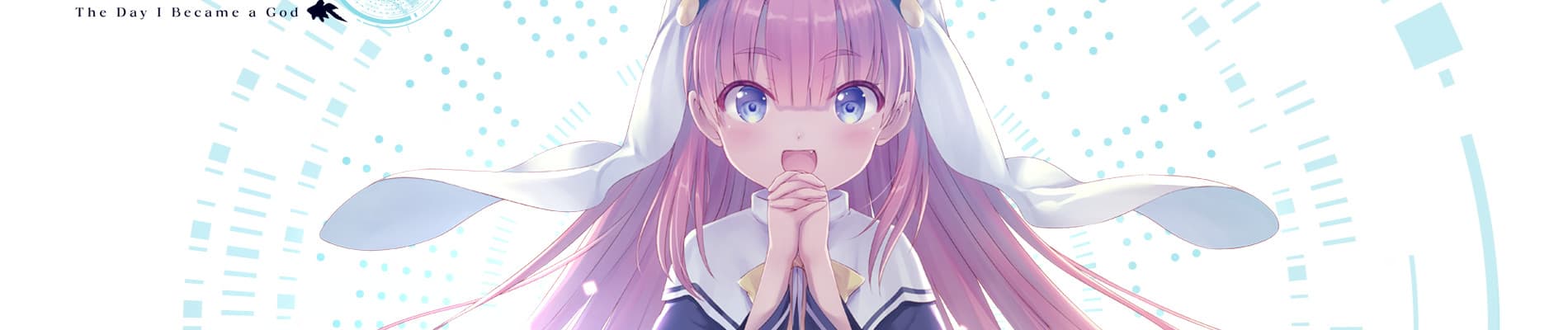
The Day I Became a God clings to the time-honored tradition that anime does so well – taking a concept and revolving it around an anime girl. Aside from that, the only other thing about this anime I knew going in was that it’s the most-recent product by industry figure Jun Maeda, whose work on other Key adaptations and originals endeared him to audiences since the late 90s. My own history with Maeda’s work runs the gamut of admiration to indifferent, so I was interested to see where this anime would fall on that spectrum.
_______
During the midst of a summer vacation, Narukami Yota meets a young girl named Sato Hina, who claims to be an omniscient god. Yota, naturally, does not believe such an outlandish claim. However, after she says some fantastical predictions that turn out to come true, she affirms her most-dire prediction – the world will come to an end in thirty days, the time summer vacation ends, which Yota does not want to accept as possible. Hina ends up residing at Yota’s house, getting acquainted with his family and friends. As the days carry onward and the date of the world’s ending draws near, Yota and his friends spend their time with Hina doing various activities and making happy memories.
Right away, this premise already had me unenthused. Barring the fact that Maeda’s previous works had already explored concepts such as happiness and memories, the idea of a teenage girl being a god is one that I don’t find that fascinating. That being said, I felt it important to give The Day I Became a God the benefit of the doubt, since the potential to tell a good story is most definitely there. In actuality, every story has the potential to be good, but potential does not automatically translate to good.
The titular god, Hina herself, is poorly conceived. Although she fashions herself as omniscient and all-knowing, the things that she does not know are arbitrary and contrived for the purposes of fitting whatever comedic gag the series attempts to make. The idea that she can do something as odds-defying as perfectly predicting the weather, but not understand the basics behind why someone would try to get a basketball through a hoop, is not an inherently funny juxtaposition. At first, I thought that the character was meant to be written as someone who has, to use two expressions, their “head in the clouds” rather than their “feet on the ground.” But, each time that juxtaposition arises again, I found myself rolling my eyes rather than laughing like the series wanted me to. It also does not help that Hina’s usual personality is boisterous and loud – while she may be prideful in her abilities to foresee the future, her hair-trigger temper and propensity for outbursts failed to endear her to me as a character, and she instead became an annoyance, if not simply aggravating. I was so easily able to predict when she would have outbursts that I could time them to the mute button, and the few seconds of silence that afforded was more precious than I would like to admit.
Despite the seriousness of Hina’s prediction hanging over the narrative, most of the time, it is not mentioned beyond a passing line or two in most of the first two-thirds of the show. The Day I Became a God is divided between two unequal portions, with the slice-of-life goings-on with the characters taking up the bulk of the show, and the final portion bringing Hina’s prediction into its proper focus. This would be fine if the episodes could build the character dynamics, but they horribly struggle trying to accomplish that. Part of the reason for this was that some of the characters really don’t get any plots or through-lines in the series, or the ones that do exist feel so hastily slapped together that they’re unrefined. They come across less as characters and more as genre archetypes or templates. By the time this portion of the show had ended, I didn’t come away at all with the impression that these characters had intimately bonded or gained a sense of camaraderie that would make the ensuing drama impactful. What impact is the drama supposed to have if I don’t care about the participants involved?
The series feels so desperate for characterization that it tries to give someone who wasn’t even introduced until the penultimate episode some semblance of backstory. This isn’t even taking into consideration that one antagonistic character ends up coming back into the show seemingly out of nowhere, and it’s hand-waved with a throwaway line that left me bewildered. Not only do endeavors such as these not provide any substance to the characters in question, it eats up more time that the series already cannot afford to waste.
Which may be indicative of the show’s greatest problem – the unengaging slice-of-life moments and lack of characterization are all the result of The Day I Became a God simply does not having nearly enough time to do everything that it wants to do. It seems that, to get every single idea he had into the show, Maeda overloaded on situations at the expense of character. The summer vacation adventures are primarily condensed down to one episode per scenario, which comes across as rushed and scrambling. The worse side-effect is that this also crushes the dramatic tone later, as it features concepts or issues proposed in the story that are not adequately addressed because the storytelling lacks BOTH time and character. It would be one thing if the plots themselves contributed to a larger thematic tapestry, which in the show’s defense, it does attempt to do, but the theme of creating memories to cherish is too paper-thin to carry significance down the line.
Keeping in mind that the thematic importance need not matter so much if the episodes themselves are fun, they sadly are not. One outing features Yota playing in a mahjong tournament that failed to provide any endearing smiles, despite doubling down on its comedic method. The consequence is that not only are the outings themselves not funny, but they cause the episodes to drag and feel a lot longer than only twenty-four minutes. The fact that episode after episode comes along like this makes the bulk of the show immaterial, as fluff that occasionally attempts to tug an emotional string that is too slack to contain tension. There are brief attempts to inject some mystery with the inclusion of a white-haired cyber genius and occasional glimpses into Hina’s past, but the payoffs they promise cannot land.
Not that I would have liked seeing them land anyway, because The Day I Became a God wasn’t presented terribly well, either. The overall color palette and attention to lighting detail seemed bizarrely plain for PA Works, and none of the soundtrack, from the in-show music to the OP and ED, left any sort of impression. The only time the show approached the usual sense of acoustic flair that could stick around was one episode involving composing a song. The actual sequence itself is okay, and the tune is fine, but I would be lying if I said I could remember how the tune went.
But the final nail in the coffin, the ultimate piece that had this show rapidly ascend the list of my least-favorite anime I’ve ever had the displeasure of experiencing, was Yota. He is the crowning example of a bare minimum “nice guy” protagonist, as there is so little to his character aside from his romantic feelings for the quiet and laconic Izanami Kyoko, and that he’s not that bright. His connection to basketball is flimsily implemented, leading to one ending so absurd that even by the crazy premise of the series, I couldn’t bring myself to be swept up in it. As a presence, he is a nothing. Between Yota’s lack of substantial personality beyond being the butt of jokes, his interactions with the frustrating Hina, and the show making every effort possible to draw them together, my patience at last reached an end. I so loathed seeing one of these characters on screen, let alone both at the same time, that by the time The Day I Became a God was over, I was overjoyed that there was no more to see.
After the series was done, a thought had occurred to me, one that I had to ruminate on for some time – if this series had been longer, and given more time to flesh itself and its plot threads out, would it have worked? In truth, that hypothetical game could be played with essentially any media, and I had to shake my head in the end. Especially considering that Maeda himself wrote every script for this series, I would have assumed that, as seasoned as he was, he would know how to make cuts to his work (whether by director’s demand or his own sense of theatre) without damaging the dramatic or thematic catharsis. With what was kept in the final product, I have to seriously doubt whether an extended run would have remedied the underlying issues. The thought of seeing further stories with these characters, with Hina and Yota grating on my nerves and character archetypes that fail to leave a real nuance, is wholly unwelcoming to me. For being a series with a supposedly-divine character, my faith was quashed so completely.
________
The Day I Became a God forgets that Jun Maeda’s melodramatic formula only works if the characters are endearing and likeable, for which no one in this series qualifies. Bogged down by slice-of-life moments that fail to build character relationships meaningfully, a tired and frustrating comedic tone, the shift from comedic to serious lacking weight, and a general feeling of rushing throughout, this show desperately needed a return to the drawing board to salvage any of it. Its aesthetic also feels stunningly mediocre for a PA Works production, leaving it so languished for positives that I struggle to find anything worth grasping. This anime is a most-unintentional rallying cry for converting to atheism, and was one of the more unpleasant viewing experiences I’ve had in a while. I will happily never be going back to this one.
I hated this.
51 out of 61 users liked this review