Warning: This review contains (light) spoilers.
Memories are fickle. Frequently, after the passage of time, only the most significant and meaningful experiences remain at the forefront of our memories. But other times, seemingly- mundane things seem to persist when everything else fades. For me, it ends to be fragments of conversations, vocal exchanges between myself and others, that stick with unusual tenacity. The old adage says that “talk is cheap,” but if you’re anything like me, it’s impossible to tell in the moment what talk will instantly fade and what will stick to my mind until the end.
Maybe it’s for this reason why Oregairu proved such a challenging show for me to both watch and analyze. I’ve said this at first in my S1 review and again in my S2 review, but this romcom is hugely dialogue-based. Sure, there’s some action scenes, and others that forego dialogue for drama, but it’s really the conversations that make this show what it is. For me, the biggest challenge is separating the significant bits from all the rest. So much is vocalized, but what really matters? Through my watching and subsequent introspection, I’m coming to realize that the answer isn’t clear-cut. Indeed, many different viewers seem to extract different meaning from this show, and I’m impressed with the range of themes that my fellow reviewers draw out. Indeed, I’d argue that the central tenet of this show – the juxtaposition of opposing views – serves as a helpful base from which viewers can extract any number of different conclusions. In this review, I’ll draw out my own conclusions in context of this central motif’s prominence.
Let’s look at the music first. In previous reviews, I noted on the adequacy of S1 and S2’s soundtrack. Both seasons had good OPs and EDs, with the former featuring always-excellent vocals from yana. I also observed that the rest of the soundtrack, while not outstanding, did an adequate job of setting the stage of the show, and retracting into the background to give the dialog prominence. In short, they were good insofar as they were inconspicuous when not needed, and sufficient when required. S3, I’d argue, takes it one step further. S3 OP, again with yana vocals, is probably one of the strongest, and really helps to set the tone of the developing drama. Maybe it’s the character development growing on me, but Megumi no ame almost seems more mature than the others, fitting closely with the concluding narrative that S3 portrays. However, the EDs take it even further. While 10 of the episodes feature Diamond no jundo with vocals by Hayami and Yoyama, episode 4 concludes with a version of the ED featuring vocals by Toyama alone, and episode 10 concludes with a parallel version of the ED featuring vocals by Hayami alone. Each variant is a fitting music piece in its own way, but the together vs. alone contrast of eps. 4 and 10 from Yuigahama and Yukinoshita’s respective VAs do something else. I’d argue that the placement of these variants help to emphasize the “breaking and rejoining” themes that become prevalent in the plot throughout this season. In conclusion, I’d summarize that S3’s soundtrack is the best of the three seasons, and really is best described listened to in context of the full show.
I don’t want to spend too long on this point, but I’ll turn briefly next to art and animation. In my perusals, I’ve noticed that the art development between all three seasons have been a point of contention. While I’d personally argue that the art improves from S1 to S2 and S3, I’ve heard arguments that suggest the contrary. Some people truly enjoy the visuals that Brain’s Base produced in S2 and dislike the changes that studio feel. generated for S2 and S3, and I can’t argue with opinion. S2 and S3, from my perspective, feels lighter and more detailed. I’ve heard it said that the art from the latter two seasons is more “complex,” and I feel that this description accurately parallels the increasing convolution that each of the main characters experiences as the plot wears on. In isolation, however, I feel like S3’s art is pleasing to watch and very consistent, while animation continues the fluidity of what we saw in S2. In contrast with S2, however, I’d argue that the art contributes more to the dialogue at critical scenes, particularly with respect to better light design. In other shows, art design tells a story of its own, and while I’d argue that this isn’t the case in any season of Oregairu, I’d say S3 art contributes to the rest of the existing story than either of the preceding two.
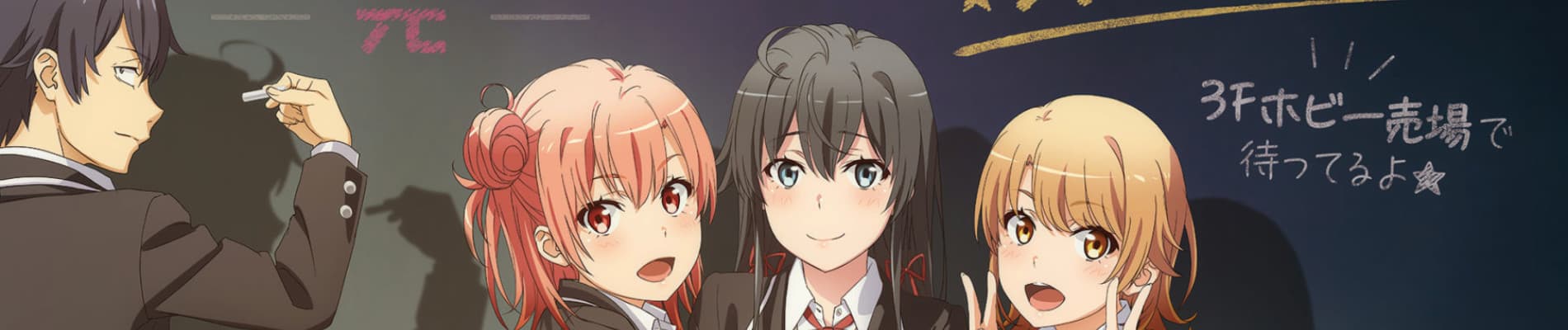
All right, formalities aside, let’s turn to the plot and characters. Like I suggested, Oregairu is a dialogue-based show, and from my perspective, the dialogue is only as good as the characters that speak it. It’s no argument that the major overt sub-arc within this season is Yukinoshita’s desire for self-sufficiency. This topic, heavily suggested throughout S1 and S2 and explicitly so in the last few episodes of the latter, comes to a head in the very first episode of S3. Internal favoritism within the Yukinoshita family, along with Yukino’s request to the other club members, heavily suggest at one of the major sub-arcs that I alluded to earlier. The club is, effectively, breaking up, with Yukino’s desire to independently organize the school prom becoming a matter of personal decision. Shortly afterward, we see an opposing effort, yet again led by Hikigaya, to organize the prom on his own terms.
Where, then, one might ask, is the development? S2 contained a very similar arc within the student council vote, right? Didn’t Hikigaya intentionally counter-plot against Yukinoshita’s plans to run for presidency in an act of self-deprecation? Yes, but in S3, the difference lies in the context. In S2, the leads pursued different avenues of mitigating Isshiki’s prank application, due to their diametrically-opposed worldviews. In S3, the leads pursue different avenues of organizing the prom because they no longer desire to be dependent on the other. Much of the language alters significantly throughout the dialogue. In S1 and S2, Yukinoshita rejected Hikigaya’s ideas because she found them repulsively opposed to her own, but in S3, she rejects Hikigaya’s help for her own sake. While the details of what she hopes to obtain from this are still unclear, it’s obvious that something considerable has shifted within their dynamic.
But it’s not just the opposition of worldviews that seems to have shifted in S3. In episode 4, Hikigaya vocalizes for the first time what was painfully obvious to viewers from the first few episodes of S1 – the love triangle between the three leads. Yukinoshita Haruno, however, describes this relationship as codependent instead, a term which carries quite different connotations. This leaves Hikigaya with a personal choice – take the alleged shift in his relationship, and the alteration in worldview dynamics that he carries, at face value, or reconsider both in light of the developing circumstances? For perhaps the first time, the answer isn’t just a viable black and white, personal and communal, Hiki vs Yuki juxtaposition. The main characters, just like the audience, is left to draw our own conclusions, and these views continue to be challenged as the season wears on.
Even considering these developments, how does this season tread the third lead, Yuigahama? I’d argue that despite the quickly-changing tension between the other two leads, S3 actually develops Yuigahama’s character the most of the three seasons. From episode 2, we get an intimate glimpse into Yui’s mind, where she’s forced to acknowledge explicitly the mutual tension within her group. She, of all the leads, is the first to truly admit her emotions when considering the relationship between the other two, and is also the first to admit that her present desires may not be ultimately realized. Yui is placed under a considerable tension, unsure whether she can act honestly in front of her friends or if she if even capable of making her ultimate request. But again, the thread is intertwined. Circumstances force Hikigaya to become honest in subsequent episodes, a movement which forces Yuigahama to become honest about the way she feels. There’s a rawness in this development that struck me upon first watch but again upon subsequent visits to this moment. So much of Oregairu, up to this point, had been talk about thoughts, and now, for the first time, we see the thoughts themselves laid bare.
I’d say that the turning point in this tension comes midway through the season, where Yui finally comes to a critical crossroads. She, perhaps moreso than anyone else, recognizes the tension between her companions and understands how their differing prom plans serve as the end of their previous oppositions. With the knowledge of her friends’ relationship and the contents of Yukinoshita’s own request, she has a decision to make. Assist Hikigaya, with the foreknowledge that her own true wish may be crushed in the process? Or oppose him and stand by Yukinoshita by refusing to help either party, and in doing so have a viable chance of maintaining her beloved club dynamics? While not a member of the final confrontation that Hiratsuka developed in earlier seasons and renewed in this one, Yui’s perhaps the most affected, as it directly touches her own dreams and desires. While her decision forms perhaps the pivotal moment in the entire plot, I’d argue that it also forms the pivotal moment in her own character development, and manages to be incredibly identifiable to me as a viewer. How many times have you needed to make a decision with an unsure conclusion, one that may carry with it significant emotional baggage?
In the avoidance of major spoilers, I can’t discuss much of S3’s plot conclusion, except to commentate at the character development of the final two leads. Yukinoshita, like Yuigahama, is faced with her own challenges of personal decisions. It’s really in the end of this season that I see, for the first time, a bit of fear in her eyes. She’s not only concerned about the pushback from her own family with respect to her independence, but she’s also concerned about how her opposition to Hikigaya influences her relationship. At the end of S2, she had requested that Hikigaya fulfill one of her wishes, but at the end of S3, she realizes that perhaps Hikigaya needs to oppose her in order to do as she wished. Just as Yuigahama has to decide if she will support Hikigaya’s actions, Yukinoshita must decide if her male counterpart is doing the right thing. All her previous conceptions about his moral character, his dull outlook on youthful life, and his objectionable approaches to problem-solving become intensely challenged.
And finally, turning to Hikigaya, I see perhaps the most significant character development in any individual male lead in any show I’ve watched till this point. Hikigaya, coming from a cynical and simplistic view on life, finds his dispositions directly challenged by the choices that lie before his two good friends. Sure, the two majors decisions in S2 lie at the hands of Yuigahama and Yukinoshita, but ultimately Hikigaya must navigate how to grant both of their wishes. In his efforts, Hikigaya is forced to reconsider the central motif of Oregairu – the juxtaposition of opposing viewpoints. Two seasons ago, Hiki would tell those who disagree with him, those who believe in the compelling spice of life, to simply go die. But now, Hikigaya realizes that he’s trapped in between two friends who truly seem to desire fulfillment from their youthful endeavors. But unlike how he previously thought, this youthful living isn’t intentionally naïve and self-delusional. It comprises honest desires and passions, yearning for self-improvement and independence, and really difficult decisions between your own wants and the wants of those around you.
In this way, we see a reconciliation in Hikigaya’s character. What was previously a simple cynic, with no justification for his worldview, is someone who deeply desires to meet the needs of those he cares about. It’s someone who intentionally foregoes disinterest in his peer’s lives to become intentionally involved in those closest to him. It’s someone who builds and crosses bridges with the ones he disagrees with the most, to meet in the middle and form a bond of mutual connection. I’m not trying to argue that Hikigaya ceases to be himself by the end of S3 – even in the final episode, he remains so many of his mannerisms and base dispositions that makes him who he is. But he becomes a better version of himself, refusing to let past rejection and mockery define him. While some people disagree on a personal level with the ending (and for your opinion on that matter I can’t argue), I feel there’s a common good we can observe from Hikigaya’s character development.
In conclusion, I feel like S3 supersedes its predecessors in the art and music departments, and continues on the centralizing motif of Oregairu to its ultimate conclusion. I’ve seen a couple of romcoms at this point, some of which concluded in very satisfactory ways and others of which fell prey to poor pacing and lack of direction. Because I saw this show after all three seasons were released, I didn’t experience a 7-year waiting period, but I’m so glad that the writers took as long as they did to cover this story. S3, despite having less arcs and less of a focus on comedy as the preceding two seasons, is incredibly well-composed and gives due respect to character development of the most important figures. Sure, at the end of the day it’s just another romcom, but its focus on hard decisions, personal challenge, and self-development make it easy for us as viewers to sympathize with the main characters. Ultimately, the heartache and joy that each character faces is something common to the human race, and I don’t think it’s Wrong to use the themes shown in Oregairu as a conduit to the emotions, suffering and delight in our own lives.
30.5 out of 33 users liked this review
