BELLE
a review by AnimeDweeb
a review by AnimeDweeb
A modern spin on the classic tale Beauty and the Beast, Mamoru Hosoda's ambitious new film lives and dies by this trait. Simplicity leads to raw, unfiltered emotion that resonates in several places during the film. Optimism in the movie's message is unmistakable, and the show's uplifting hope for the future earned it a whopping 14-minute standing ovation at the Cannes Film Festival. But whereas simplicity is an asset in some areas, it can be a detriment in others. BELLE wears its heart on a sleeve that also contains some biased and questionable ideologies. Paper-thin worldbuilding hinders the movie's unique sci-fi setting from delivering an immersive experience. Underdeveloped sideplots feel like rough drafts rather than fully-realized components of the film. Comically unsubtle scriptwriting and plot holes up the wazoo can significantly reduce BELLE 's intended emotional impact.
Whether you like or dislike this movie will depend on how you value its simplicity. And I aim to break down the kinds of simple outcomes on offer – the good, the interesting, and the downright hilarious. This unveiling BELLE is largely spoiler-free, but will occasionally dip into spoiler territory, which will be tagged appropriately. Check out the Tl;Dr below if you're short on time. With all that said, 'it's time to log in…'
The film takes the classic fairytale and asks two key questions: "What if this story was set in the not-so-distant future, and what if there were two Beasts instead of one?" Once upon a time, there was a girl named Suzu who grew up with music in her heart. Tragically, trauma stemming from the loss of her mother in an accident had prevented her from sharing her songs with the world. All that changed when she stumbled upon U, a virtual reality platform with the promise of giving its users "new lives." Based on data and one's physical appearance in the real world, U creates digital avatars that uncover one's hidden strengths. Through her avatar, Belle, Suzu rediscovers her ability to sing. Suzu's compelling music catapults Belle to breakout stardom as one of the biggest personalities on the digital platform. As both an overnight success and an overwhelmed adolescent, the high-schooler decides to pull a Hannah Montana and live a double life, hidden from the spotlight. As Belle's mystique in the public eye strengthens her popularity, another unknown figure begins to grow in notoriety. The Dragon, an elusive mixed martial artist in U, has been sending shockwaves for threatening to damage the code with his unmatched strength. After a major altercation interrupts one of her concerts, Belle soon finds herself in the Dragon's hidden castle. Suzu feels compelled to uncover the monstrous façade and connect with the troubled soul who wears it, but time is in short supply. A vigilante faction and the rest of the U community blame the Dragon for ruining Belle's concert and are demanding justice. It's a race against time to discover the Dragon's mysterious origins, and the movie's innovative answers breathe new life into a familiar story. Far from a traditional fairytale, BELLE puts together an emotional coming-of-age that's full of hope.
BELLE follows after the story it's loosely based off by using the "curse" of the Beast as a tool for self-improvement. Just as the Enchantress' curse helps the Prince learn the error of his ways, it's the digital avatars and technology of U that allow our characters to connect with others and grow as people. BELLE uses digitization within a triumphant narrative of finding courage in the darkest of times, and its uplifting optimism is difficult to miss (the aforementioned standing ovation at the Cannes comes to mind.) In attempting to introduce new story elements for a new audience, BELLE is certainly more enriching than your typical beat-for-beat reboot of a familiar story... just not by much. Points for trying, but there is room for improvement. A whole writer's room, to be exact.
BELLE doesn't just tell a modern coming-of-age tale about a girl who finds her voice, but also hints at various ideas throughout its runtime. These tangents don't feel fully developed, but instead expose the movie's thematic limitations, leaving the audience with an end product that is neither as compelling or relevant as it could have been. For example, look no further than the fictional digital platform, U. This sci-fi setting is brimming with an excitement that boomers at the Cannes may latch onto, but the same can't be said for younger demographics more familiar with the technology of today. Specifically, the consumers of a widely-popular app, with an active userbase exceeding a count above a million.
U pretty much amounts to a society run by TikTokkers. God help us all.
Jokes aside, this comparison isn't going to pivot into some cynical discussion on how TikTok is the bane of modern civilization. But if BELLE intends to immerse viewers in a hopeful reimagining of the future, it needs to do a lot more than simply phoning-in a mashup of TikTok and VRChat. Unfortunately, U is poorly designed and only ever explored in areas relevant to the plot. The main detail of relevance concerning U is its use of user biometric data in crafting in-universe avatars. Aside from that, we never learn that much about U, everyone is just… there. I'm not just at a loss for words here; most scenes in U feature its millions of users floating around in streets surrounded by empty skyscrapers. If not for Belle's concerts and celeb-news broadcasts, there is next-to-nothing for people to do. U is a bleak far-cry from the revolutionary social media site it's touted as; even The Emoji Movie 's Textopolis contains worldbuilding features with more ingenuity and depth. The decision to reduce U to the most uninspired of backdrops is made more baffling when you realize that the movie avoids obvious opportunities to explore this setting. A major subplot of BELLE is written as a sci-fi mystery, with Suzu conducting an Internet investigation on the Dragon's identity and whereabouts. But all of this takes place in the real world, outside of U! Conducting this cyber-hunt within U would not only help make the environment far more fascinating, but also gives BELLE chances to better meet its aim of promoting the wonders of technology. The goal's wide-open, Hosoda, why won't you shoot? In order to address this question, let's make one thing clear about how BELLE pitches its big message. While the movie is more than happy to promote the beneficial relationship we can have with technology, it typically avoids demonstrating what that relationship can realistically look like. Now I do appreciate the sections of the show where this isn't the case, such as the frequent depiction of negative/hate comments online, which is a natural consequence of people freely expressing their personal opinions. Furthermore, U's ability to draw out hidden strengths from users gives the movie its big draw of promoting self-expression on the Internet. However, for a movie so seemingly enthusiastic about having an online presence, it seems strangely silent about possible downsides of such public exposure. Throughout the film, topics such as online addiction and imposter syndrome are hinted at but never explored. The film can't afford to delve into these prevalent subjects and frame technology in any negative context, especially where the main character is involved! Despite attempts at taking more nuanced stances, BELLE continuously falls back on its simple mantra: "technology good." This tame claim by the script isn't wrong, but lacks relevance in stating the obvious. BELLE is a bark that lacks bite, and its undercooked ideas hinder its effectiveness. Taking the sparse worldbuilding and underdeveloped commentary into account, Hosoda gives off an impression of not fully understanding the digital landscape so heavily praised in his film. If this claim sounds like a bit of a stretch, perhaps a trip down BELLE 's strangest rabbit hole can change your mind. Let's analyze the movie's answer to Gaston.
In the Disney movie, Gaston is a devious dude in pursuit of Belle's heart, and he eventually incites a mob to slay the Beast. This same mob mentality is retained in Justin, BELLE 's take on the narcissistic character. As Justin exposits in one scene, U was programmed by liberal creators to be a digital utopia with no rules. These creators believe the society would be run without exploitation, but not everyone agrees with this reasoning. A chief of vigilante group "The Justices," Justin leads a law enforcement operation to keep U in check. BELLE 's update for this character is to turn a hunter into a right-wing authoritarian who sways public opinion against potential threats that the Dragon presents. So what? The first thing worth pointing out is how goofy Justin's portrayal is. BELLE seems almost too eager to snuff out and mock Justin' rhetoric of justice. Justin gets roasted by Belle for being a control freak who's just looking for an excuse to flex his power. He has comical dialogue befitting of a dollar-store superhero. He wields a weapon known as "the Power of Justice": a light beam designed to unveil an avatar's biometric data within U, thereby revealing their identity. So yeah, Justin can doxx people. In a movie that's largely celebratory and positive, Hosoda's awkward anti-establishment biases stick out like a sore thumb. This cynical caricature is perfectly captured in the silliest scene in the entire movie. The painfully loaded imagery features a shot of Justin ‒ leader of the Justices ‒ aiming a doxxing laser at the Dragon in the name of a "righteous" cause, as a bunch of corporate sponsorships begin flashing behind him:
So what are we looking to achieve by going on this tangent? While this situation is amusing to me, I'm not exactly comfortable with what Hosoda is pitching here. Justin and the script's vague potshots at the right-wing feels so bizarrely disconnected from the rest of the film. More importantly, this case study shows how BELLE yet again drops the ball with regards to worldbuilding and developed story ideas. Making U a functional society with no rules is either wishful thinking or lazy writing; flip a coin. Furthermore, I think it's real rich that Hosoda decided to have an unauthorized vigilante doxx people as part of law enforcement. It's not easy to miss the parallels between the fear of "unveiling" within U and the concerns surrounding data privacy in the present day. Privacy on the Internet is a controversial gray area that isn't fully understood, with individuals, corporations and companies still working towards a healthy compromise. This complex conundrum maybe isn't the best subject to tackle in a teenage YA cartoon, and should be approached with sensible care. Yet, here we see Hosoda chucking shade and all caution to the wind. I obviously don't agree with Justin's actions in the movie, but he is onto something in saying that the current society of U shouldn't work. There's monetary and identity theft at stake in U, so it's only natural that stuff goes wrong at some point. Yeah, governments aren't perfect, but you know what's worse? Anarchy! BELLE 's script makes Justin out to be a clown, but becomes the whole circus by ignoring its own issues. Once again, Hosoda fails to demonstrate a coherent understanding of how technology and society work together, and these incoherent sections of propaganda aren't exactly helping his case. "Technology good." "Regulation bad." These two-word claims aren't thoughtful additions to a script, but purposeless fluff that distracts from and discredits the good message BELLE intends to leave with its audience. Rather than add to the movie, these simple ideas only take away from it. The worst part about all this? BELLE 's script is already struggling enough as is.
What distinguishes this adaptation from the fairytales that came before is the lack of screentime between Belle and her monstrous beau. The two characters only meet proper roughly 45 minutes into the movie, and their interactions make up approximately a third of the 2-hour runtime. This is a really big change for a story often revolving around two love interests, and BELLE responds by putting more emphasis on Suzu through a brand new arc. For what it's worth, I think the film is commendable for this refreshing approach, and its twist involving the Dragon's identity is a praiseworthy highlight. BELLE 's problems don't stem from cutting out the old source material, but from its overall weak attempts at making up the difference. A new component this film introduces is the digital detective search for the Dragon's identity, which comes across as a tacky way to kill time. While Disney's version of events had Belle search for the Beast in order to satisfy her taste for adventure and rescue her dad, there is no such motivation behind Suzu's quest other than random curiosity. Hiro, Suzu's best friend and IT whiz, just spontaneously decides to track down the Dragon, and our befuddled main protagonist simply tags along without any question. This contrived, "zero-shits-given" writing rubs off on the audience; there's a chance viewers too could feel uninterested until the movie's third act. The film frequently hops between various plotlines involving Suzu's adolescence, but ironically feels like it's going nowhere. This middle section of the movie feels like unconnected vignettes rather than a larger story, and the repetitive way these derivative scenes play out do little to hold audience attention. Given the shoddy writing in the lead-up, it's no surprise that BELLE 's script truly falls apart as it's forced to ramp up the stakes in the third act.
Contrived writing returns with a vengeance, with a whole string of occurrences that make no sense. Allow me to give you a taste of how laughably bad the script gets through a quick example.
In one scene, Suzu and newfound friend Ruka are walking to the train station after having a gal's chat over their respective crushes. Earlier, Ruka learned about how Suzu and her love interest Shinobu used to be childhood friends. This is all the context we get for why Ruka suggests meeting up at Suzu's old elementary school for their next hangout. Why a school of all places? Right off the bat, this interaction between two human beings makes no damn sense, but Hosoda's about to make his intentions clear as day. Suzu leaves the train station, only to bump into Shinobu himself, whom our lovestruck protagonist has been dodging for the entire film. Yet again, Suzu runs away from this encounter, and Hiro calls her back to their HQ in order to deal with stuff as Belle. Where is this HQ you ask? Yup, you guessed it. Meanwhile, at the train station, Shinobu finds Ruka and asks if she could guess where Suzu might be headed. And as if Ruka bringing up the elementary school was uncalled for before, she does so again, even though it has nothing to do with what Shinobu wants... except it totally does, because the script couldn't come up with a less hamfisted method of assembling its side characters for the grand finale.
And for those who have already seen the movie, let's break down how BELLE jumps the shark in its final stretch:
(Spoiler warning)
Now here's where stuff gets stupid. Just as Kei reveals his address, the father angrily returns and abruptly ends the call. He was tipped off about the live stream by an anonymous party who sent an incriminating clip of him nearly beating the Dragon's disorientated younger brother. Riddle me this: who sent the clip? See, the movie kindly left us with a watch count of active viewers of the stream, and it was set to 1 right up until the main ordeal ended. That 1 comes from Suzu's crew at HQ, meaning that the only people who could have sent the blackmail are either Hiro or the brothers themselves (the 3 viewers who randomly hopped on the live stream are bait; they only showed up after the abuse happened and couldn't have clipped the incident.) Hiro definitely could have pulled it off, had her tech wizardry didn't get conveniently nerfed in this section of the movie. A girl who was once able to hack CCTV footage suddenly forgets how to track down IP addresses, and it takes a lucky series of clues for Suzu's crew to narrow down Kei's home. But for the sake of argument, let's assume Hiro really did send the blackmail evidence. After locating Kei's prefecture, the gang calls child's services, only to learn that a search warrant would be conducted roughly 48 hours after the call. This rule does exist in Japan, but only in the event that insufficient evidence is presented. I'd wager that a recorded video of a father nearly beating the shit out of his two kids (one of whom appears to be disabled/incoherent) would be reasonable grounds for an investigation. If Hiro made the clip, why didn't she just send it to these cops? Furthermore, if she did manage to send it to Kei's dad, then why didn't she also dig up their residence, sparing Suzu several hours of wandering around a suburb in the rain? It's safe to say that Hiro isn't the culprit, so perhaps Kei is to blame? Well of course not, because why in hell would kids choose that point in time to blackmail their dad while trapped in their own home? It's not in their interest to troll their loved one, given that that individual happens to be an abuser who nearly beat them up. No one we know could have sent the clip. LITERAL MOVIE MAGIC.
The clumsy contrivances still don't stop there. Why did the aunties jump at the earliest opportunity to drive Suzu from the old school in one scene, before leaving her to face a dangerous stranger on her own in the next, defying all common sense? What does Kei mean when he says he "took a stand" against his father? Why does Kei's parenting situation go unresolved, while our characters stroll along the riverside in sing-song fashion? All unanswered questions, but at least I solved one mystery - I figured out why I don't give two shits about this travesty.
(End of spoilers)
Admittedly, I did have some fun pointing out these plot holes, but I'm quite certain that fun at the movie's expense wasn't exactly what Hosoda was going for. And let's be clear, the third act does contain some great dramatic moments. It's just a shame that the steps taken to reach these story beats feel so forced and even disingenuous at times. When viewing these unnatural pieces of writing side-by-side, it becomes more and more difficult to ignore the fakeness of it all. As is the case with the other bits of simplistic writing we've examined, these mistakes are unwelcome distractions that threaten to drag BELLE down into comical mediocrity.
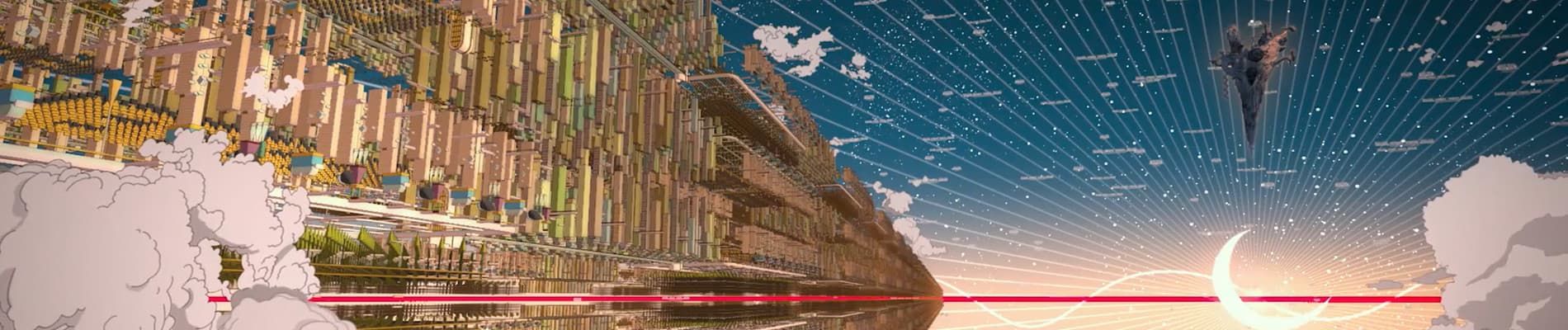
Before we end this breakdown, let's touch on a side of BELLE that I did enjoy: the presentation. Hosoda's traditional animated visuals occasionally correlate with the whimsy of classic Disney films, but rarely wow me from a directorial standpoint. I'm more of a fan of the film's depiction of U. The use of CGI and colorful character designs enables BELLE to indulge in a spectacular visual look. Certain scenes in the movie feel like fantastical scenes reminiscent of Ghibli films mixed with a modern coat of paint, and the results are pretty exciting stuff.
If there's one aspect that BELLE gets absolutely right, it's the music. Wow. One thing I hate about movies featuring singers or pop idols is that you usually just have to take the author's word for it; the songs rarely live up to hype. But when I hear Belle's songs, I'm completely sold on her celebrity status. Kaho Nakamura's VA debut is pretty adequate from a purely acting POV, but it's her showstopping musical performance that decisively knocks it out of the concert park. Her emotive vocals capture the vulnerability of Suzu's character perfectly, and the 4 tracks she sings are all gorgeous tunes I've had on loop whilst penning this review. Taisei Iwasaki is the main man behind an anime OST I'd consider to be my personal favorite in 2021. BELLE 's insert songs are by far the best parts of the film, and make for earnest reprieves from the many flaws mentioned here.
In closing, let's return to the topic that opened this review: simplicity. Perhaps breaking down a simple show in such a pedantic manner ranks among some of the snobbiest things I've done as an amateur anime commentator. But for the record, I'm not here to merely dunk on a script for not meeting some higher intellectual standard. Simplicity can be beneficial, and allows a story's message to best reach the people that need to hear it. I don't hate simplicity; I hate mistakes. And BELLE is unfortunately riddled with many. Having a script that's easily understood should not come at the expense of common sense or unrefined ideas. The shilling of sweet sentiments shouldn't come at the cost of a coherent script. As an audience member, I shouldn't have to worry about plotlines that don't go anywhere, or whether the show really is attempting to sell me on some pro-anarchist propaganda. The problem is that I have , and the show's inability to present coherent messages is what allows room for these potentially-unintended inferences to occur. These poor writing practices are not only undesirable on their own, but also affect the aspects BELLE gets right. Even the genuine message of finding oneself in the digital age feels disingenuous and artificial (intelligence, not so much) when viewed alongside the film's many contrivances. Neglect of the script's logic lessens the impact of its emotion, because the latter starts resembling a soulless product too - something fake being shoved down your throat, no questions asked. BELLE is a movie with good intentions, but it's far from a good movie. And that's simply disappointing.
BELLE is brimming with both optimism and bad ideas. At its core, this endearing coming-of-age imbues an old fairy tale with excitement for the future. A celebration of technology and the self, BELLE 's best moments ooze triumph. That being said, even the film's brightest sections are hampered by a contrived screenplay. Expect unfinished ideas and plot holes to dampen the movie experience. By means of omission and forced writing, BELLE creates an experience that's really distracting. Thankfully, imaginative CGI visuals and amazing music ensure that the movie isn't a complete catastrophe. BELLE can be appreciated as a thoughtless mish-mash of generic feel-good vibes, although I'd recommend just watching clips of the insert songs elsewhere online. Either way, being disconnected from Hosoda's simplistic writing is likely necessary for maximum enjoyment. 3/10~
Hey, thanks for reading! Before I leave you, here's a no-context clip of BELLE that got cut from one of my drafts. Cringe comedy at its gnarly finest, you can thank me later. If you happen to like my verbose rants, feel free to check out my other reviews for seasons past and present. I also frequently post writeups under my list updates, so definitely take a peek if you'd like to see me mald over anime as they hit the airwaves, peace~
58.5 out of 74 users liked this review
