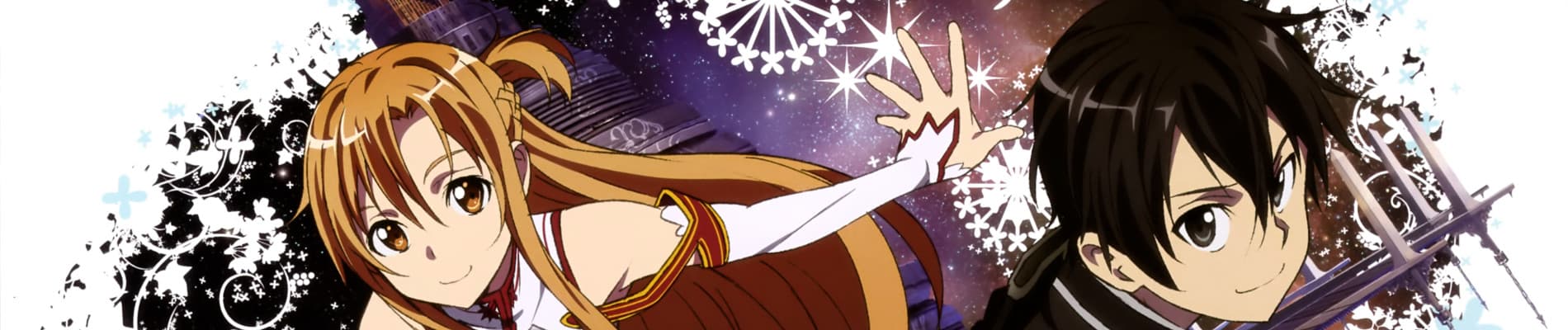
(this review will have SOME spoilers. It has some spoilers, but I will clearly mark them so you don’t get unintentionally spoiled)
The reason I’ve watched SAO (and, subsequently, the reason I’m writing this review) is purely because of its popularity. I didn’t feel particularly interested by its concept, although I admit it is (for the time, I assume) original. I had heard a lot of negative opinions about it, which shocked me, considering how popular it was, and still is. I went in honestly not expecting much, at least hoping I would be entertained by the action sequences I knew I’d get.
The story focuses on a young, shut-in boy referred to as Kirito, who gets stuck in a life-or-death videogame by its evil and mysterious creator. “If you die in the game, you die in real life”. That’s probably the first thing people know about SAO. The only way to escape, according to the creator, is to beat the game, that is, to reach the 100th floor of the world of Aincrad. The story starts at the beginning of the game, but it quickly moves forward, allowing the audience to see the previously chaotic world slowly become more and more structured as time goes on.
As you can tell, the story is not just about the fighting between the players and the game, it’s just as much about emotion, and people's relationships with one another (this part will be important later, remember it!) and the world around them. Yes, this “epic adventure” has time for side-quests, if you will, about love and the morality (and the value!) of certain actions performed inside a videogame.
Well, kind of. At first, I was blown away by how much importance the author of the story gave to themes that, in the grand scheme of things, contribute nothing to the end-goal of our characters. I don’t mean that in a bad way, mind you. It’s just that, when you look at an SAO poster, you’re not exactly expecting a drama, you don’t expect to reflect on love and morality and acceptance. And that’s precisely the reason I was taken aback: the first few episodes have some action scenes, sure (and engaging ones too!), but my focus was entirely on Kirito’s characterization, and its growth as the series progressed.
Sword Art Online, at its core, really is a story about love, morality and acceptance.
Ok, I guess I played you a bit with that last part (we do a lilttle trolling…). “What do you mean? I’ve just read the complete opposite! Have you gone mad?”. Well, yes, but that’s not the important part here. The truth is, SAO lays the foundations for an incredible introspective view of Kirito’s character, but just… gives up on that idea halfway through.
When we meet Kirito, he’s depressed, doesn’t leave the house and is, in all seriousness, a complete and utter loser. He is, not only doing bad on a mental level, but he is also physically weak, as it’s shown to us (even if with zero subtlety) by him getting his finger hurt from basically nothing. When he gets in the game however, that partly changes. He is no longer weak physically, since all his time spent on videogames (and on being a beta-tester) gives him an edge against basically every other player. HOWEVER, the core of his person doesn’t change, as he still is socially awkward, emotionally unavailable (this is important for later!) and has troubles fitting in. Essentially, instead of being weak and alone, now he is just... alone.
--------------------------------------MINOR SPOILER WARNING FOR THIS SECTION-----------------------------------
--------------------------------------MAJOR SPOILER WARNING FOR THIS SECTION-----------------------------------
So… that’s it! An OK end to an OK anime! There’s absolutely nothing after episode 12! Nope. Nothing. It’s over.
exaggerated exhale
Alright, there’s a bit more, however, I would recommend people to stop watching the anime on episode 12, unless they are REALLY enjoying it.
Honestly, I don’t care about episodes 13-25. I don’t like them, I didn’t feel invested, and honestly don’t really want to talk about them. So here’s a super short mini-review.
The author realized that that he could extend the story for money. Kirito stays the exact same from beginning to end and Sugoha is an OK character I suppose, although I really don’t really understand Japan’s fixation on little sisters. The plot is basic (like in the first part) and not all that interesting. What IS better is the action, due to the characters’ ability to fly. The fight scenes are still short, but with the aforementioned ability it allows for more interesting and dynamic combat. That’s it. That’s my review of the second half. I also want to point out that don’t like what they did with Asuna, and I don’t like the cringe-ass romantic tension between two siblings (hmm-hmm, sorry, STEP-siblings - who cares anyways), even if I (mildly) care about Sugoha.
TLDR: It has a good concept and lays an incredibly good foundation for the story it’s trying to tell. Unfortunately, it deviates from its path too easily, misguided by an effort to attract attention. What inevitably happens is to be expected: it falls short of what it sets out to do, only scratching the surface of the themes it wants to explore. It really isn't a terrible show, it's actually somewhat good, however it is inexorably haunted by the greatness of what it could have been…
[If you want to comment something about this review, you're free to message me about it, feedback is always appreciated!]
22 out of 28 users liked this review