The Big O
a review by TheRealKyuubey
a review by TheRealKyuubey
Paradigm City is a community lost in time. Forty years ago, the entire population suffered an abrupt case of amnesia... Nobody who was alive at the time remembers what happened before then, and those born since have nothing to go off of other than various clues that they’ve picked up through media and pop culture artifacts. With no real context to help them decide what’s fiction and what’s not, hard information has been scarce, and memories themselves have become a valuable commodity. As humanity usually does, though, the people moved on, never questioning why high society is kept under domes, or why they’ve been cut off from the supposedly desecrated outside world. Humanity has strived and thrived even under these conditions, but there were always going to be problems, and for some problems, you need a negotiator. Enter Roger Smith, a debonair playboy with a silver tongue for dealing with crises and a giant robot in reserve should things get out of hand. What he doesn’t know is that with the help of a sarcastic android and a network of underground connections, he’s destined to be the unlikely hero who unravels the mystery of Paradigm city once and for all.
The Big O was produced by Sunrise, one of the most prolific and successful studios in anime history. They’re made up of over a dozen sub-studios, and as such, they’ve been churning out countless anime since the seventies, at a rate of about 3-7 titles per year on average. I don’t know whether you can call it genuine talent, good luck or just throwing things at the wall to see what sticks with an absurdly high success rate, but Sunrise has been behind several big-name anime series. Not only are they the primary home of the Gundam franchise, but they also brought Cowboy Bebop, Code Geass, Escaflowne, Outlaw Star, Gin-Tama, Inuyasha and even Love Live into the world. Their DNA is tied pretty strongly to the realm of shonen action and mecha anime, especially with all the classic genre fare they produced in the seventies, but they’ve proven over five decades of work that they have the ability to knock any genre you throw at them out of the park. That’s not to say they haven’t made any stinkers, but they also bought and killed Studio Xebec, so the odd dud here and there can be excused.
It’s easy to look at anime like this one, which was produced just before the dawn of the year 2000, and call it out for looking a little cheap(especially with its archaic aspect ratio), but that context is important. As far as I can tell, Big O is entirely hand-drawn, and it faced a lot of the technical limits of that specific era. There isn’t a whole lot of detail in the background through most of the series, but rather than letting the environment feel barren, director and storyboard artist Kazuyoshi Katayama made sure that what little detail we DID get would be just striking and memorable enough to grab our attention away from their surroundings, keeping our eyes occupied while not really leaving enough of an impression to feel jarring. The next time you’re watching episode 1, and you see the close-up of the open briefcase, take a good look at how uniquely each stack of dollars is drawn, bent and faded in different ways that you just wouldn’t get if you were using CGI to fill in the case more efficiently. You’re not technically supposed to notice something as subtle as that, it’s just supposed to impress you on a subconscious level.
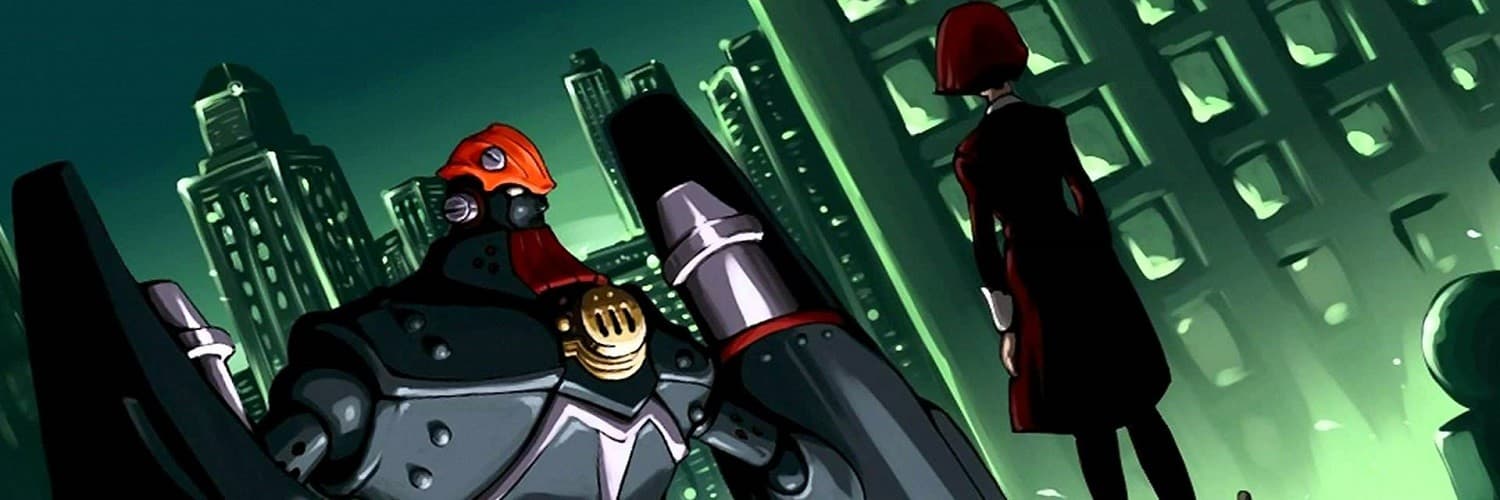
The same thing goes for the animation, which can appear stiff and lifeless in some shots, but it’s never too egregious, and the effect never lasts very long. There’s usually something moving on screen, whether it’s the subject of the shot, whiskey in a glass or even just a puff of smoke or wisp of fog, and while that should be more noticeable than the subtle details are, the over-all style and aesthetic of this series do it a world of good. The hand-drawn cells act as the perfect canvas for a film noir design scheme, using pitch perfect lighting effects and the exact blend of dull and bright colors that either stand out or blend into the dark shadows whenever needed. It’s hard to complain about a lack of movement when every shot just looks so damn beautiful. I’ve complained before about anime using weird camera angles, but in those cases, an anime would use fast shots and unpredictable framing to distract the viewer from long stretches of dialogue. Big O, on the other hand, uses its errant shots the way film noir should, using dutch angles to convey tension, distant perspectives to imply a conversation might not be as private as it appears, etc.
The only place the visual quality really drops in a noticeable way is with the giant robot fights, but those are also the moments when the series picks up the pace with fast movement and quick shots, so you probably won’t notice unless you’re as anal about that kind of thing as I am. The design is also really unique, at least to the anime medium. The best way I can describe the character palette is like, a slightly grittier and grainier Leiji Matsumoto. To be fair, that’s not a completely accurate comparison, so here’s a better one: This looks like Batman the Animated Series, and there’s a reason for that... Sunrise Studio #6, who produced Big O, also did some animation work for Batman, and while I can’t find a direct link between the two, it’s clear to see that there was some inspiration taken from that particular early 90’s classic.
The music for Big O has a heavy leaning towards jazz, dominated by the piano and saxophone and ranging from smooth to sleazy to melancholic and pensive, again, only really slipping into the heart pounding orchestrations you’d expect from a shonen action series(with a slight electronic edge) when Roger slips into his iconic mecha. Even so, it's not married to that divide, and it can surprise you with a perfectly chosen orchestral arrangement during certain fights. For the English dub, there’s no shortage of seasoned and highly respected talent attached to this title, but the best decision that was made in the entire process of creating this show was casting Steve Blum as the main character. Maybe this is blasphemous, I don’t know, but I’ve kind of started to think of him as the Tim Curry of the anime world... A voice and delivery everyone loves, a range that deceptively potent, and more often than not he winds up being the best possible candidate for most of the characters he winds up voicing. He speaks for himself, but I’d also be lying if I didn’t recommend this dub on the strength of Lia Sargent, who pulled double duty as both the voice director and as Roger’s sidekick Dorothy. It’s no small task playing a robot in a way that’s both convincing and engaging, but she gives Blum a run for his money. Dub highly recommended, obviously.
I feel like, to at least some degree, we’re all story-tellers at heart. There’s little that’s more appealing than the idea of having an entire universe in your hands, one whose narrative you exclusively control, and it starts when we’re old enough to know what stories are. If you had Star Wars, Transformer and GI Joe figures as a kid, I can guarantee that at some point, you had Jedi knights swinging their light-sabers alongside their gun-toting soldier allies to stop Megatron. It was your story, anything goes, and you had no reason not to throw everything you liked into it, even if you were just entertaining yourself on a rainy afternoon. When you’re an adult, this sort of thing is called The Rule of Cool... Anything you like can be a part of a story you’re writing, because it’s your story... But depending what you’re planning to do with that story, you may find yourself dealing with rules BEYOND just what’s cool. Sure, if you’re just writing a fanfiction, those rules don’t exist, but what if you’re creating a legitimate piece of commercial media?
Well, obviously, you can’t include licensed material without permission, that’s a given. But what’s a bit harder to grasp is that no matter how many elements you add to the story, be they genre beats or actual licensed content, you have to put in extra effort to make it all fit together. There are elements that clash unless you figure out a way to combine them properly. There are elements you have to add early, because they can be unintentionally destructive if they come in without warning. A good example is Samurai Flemenco, a show about people dressing up as superheroes in a real life setting... Until the monsters just randomly become real in one episode, after which even the most die hard fans say it went off the rails. Bleach had a few really cool elements blended together for a good long while, but some of it’s worst moments came when they tried adding vampires to the mix. RWBY spent it’s first two volumes throwing everything at the wall to see what would stick, and some of it really backfired when they started to take their story and plot seriously three volumes in. But then you have Kingdom Hearts, a franchise that merged two distinctly different franchises, Disney and Final Fantasy, so well that it feels incomplete without both parties being present.
You can tell from first glance that Big O was assembled from bits and pieces taken from several other titles. The ones that spring immediately to mind are Batman and Cowboy Bebop, but you can probably find a ton of others if you look hard enough. It’s the story of Bruce Wayne, but with no childhood trauma or incentive to keep his identity a secret, having traded his cape and cowl for a giant mecha. He still has Alfred, but he’s replaced his long chain of child sidekicks with a sassy android lady, dealing with complex 1920’s style mysteries that always end in over-the-top spectacles. A show like this has every possible excuse to not work, and yet it all comes together with near-perfect symmetry. Mecha fights in a film noir setting shouldn’t work, but the giant robots in this show... They’re called Megaduces, by the way, which only gets funnier when you realize the main one was named after a euphemism for an orgasm... Look archaic and makeshift enough to fit the time period. There’s elements to the Big O’s design in particular that feel more practical than flashy, like the design process was bogged by physics issues they had to compensate for, and while giant mecha will never technically feel realistic, these ones feel believable enough for the series.
The fact that the plot of each episode could only technically be described as a mystery, when the structure of each one paints it more as a question that’ll be answered(and MAYBE with some foreshadowing) just in time for a giant mecha brawl, that should damage it’s credibility as a film noir mystery, but some of the reveals in these episodes are unpredictable and emotionally effective, but even if they weren’t, the over-all mystery over how the world got to be the way it is is more than strong enough to make up for this, and nearly every episode feeds into that mystery in some way. As a result, no episode ever feels pointless or forgettable. I’m not going to pretend like you have to homogenize different elements into a story to make them work, especially not after making such a fuss over how clashing tones worked in Kotoura-san’s favor, but it IS a legitimate method... Everything Big O does makes sense in the universe it created, coming together in an irresistibly anachronistic 1920’s style sci-fi atmosphere, and it all works as a backdrop for the true heart of the story.
As awesome as giant robots fighting each other may be, I’ve never personally been a fan of that sort of thing.. I don’t hate it, it just doesn’t do much for me... So if that were the highlight of the title, I don’t think I’d enjoy it half as much as I do. Yeah, the mecha element is there, it is strong, and I can see it making any mecha fanboy go rock hard, but the real heart of The Big O lies in it’s two main characters, Roger and Dorothy. They’re not a romantic couple or anything, which is kind of a relief, but they have outstanding chemistry with each other as an odd pair of friends and colleagues. They’re both from an archetype that could get boring on it’s own... Someone like Dorothy could come off as boring and stiff, while Roger’s smug denial of emotion in favor of cold logic could make him extremely punchable... But they challenge each other at every turn, exposing their softer aspects and sanding off some of their rougher edges. They have some of the most charming dialogue you’ll ever hear, the kind of banter most screen writers WISH they could create without having it sound forced.
These are the kind of characters who could save a bad anime, but thankfully, the series is so damn cool that there’s really nothing to save. I guess it’s fair to say this isn’t the deepest or most meaningful anime of all time... It plays around with the themes of memory and identity, but not in such a way that you’d ever find yourself pondering it after the credits... But not every anime needs to have depth. Not every anime needs to be an emotional rollercoaster, or a rabbit hole of introspective ideas. Rather, Big O boasts a powerful atmosphere, whip-smart dialogue and a sense of pacing that should have no problem keeping your attention. And while we're at it, you don't need adult content to feel mature, either. Big O features almost no fanservice, there's no foul language in the dub, and while it has a decent body count, the violence is never too graphic. It strikes the same mood as any number of atmospheric detective dramas you might have watched with your parents as a kid, letting you feel grown up because they never pandered or talked down to you, yet also remaining relatively PG so you wouldn't get kicked out of the room. In short, Big O is just really fucking cool. If you needed proof that an anime could succeed just on execution alone, look no further than this.
The Big O was originally available from Bandai before going out of print, but has since been rescued and rereleased by Sentai Filmworks. This includes the second season, which... Well, we’ll talk about that in a minute. The manga is not available stateside.
Much like Cowboy Bebop before it, The Big O didn’t do so great in it’s original Japanese release, and wasn’t able to truly find it’s audience until it came to the west. I’m not sure there’s a solid explanation why, but I mean, you can't prove Steve Blum DIDN'T save them both. It was originally intended to have a 26 episode run, but was forced to cut itself off at 13 due to it’s poor performance. Seeing how popular it was in their Toonami line-up, Cartoon Network actually commissioned a second season, which... I'll talk about in my next review. Thank God Anilist split them into two separate titles so I can actually do that. On it’s own, the first season of The Big O might not be the deepest anime ever made, but it’s certainly one of the coolest.
I give The Big O(1999) an 8/10.
35 out of 37 users liked this review
