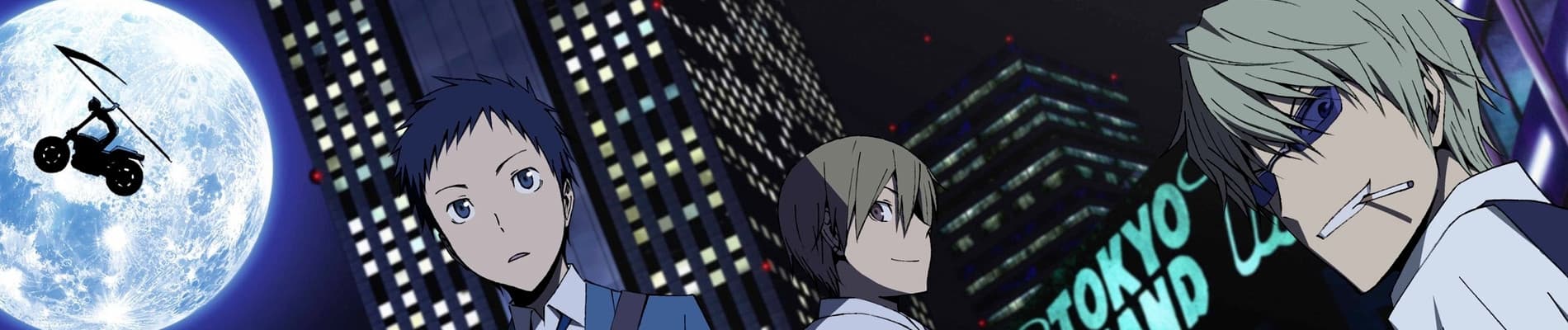
Durarara!!
a review by TheAnimeBingeWatcher
a review by TheAnimeBingeWatcher
Durarara’s a show I’ve been excited to check out for a while now. It’s based on a light novel series from the same author as Baccano, and Baccano is one of the most deliriously entertaining shows I’ve ever watched. From its impeccably eccentric cast of characters to its hypnotically twisting plot, Baccano knows how to kick ass and take names like few other anime. And Durarara doesn’t just share Baccano’s author; the same studio and director that brought Baccano to animated life- Brain’s Base and Takahiro Oomori- were also behind its anime production. Surely, with all the same creatives in charge, Durarara would be just as much a rip-roaring good time as its spiritual predecessor, right? Well... no, sadly, it’s not. Not even close, in fact. And while it would be unfair to simply define Durarara as a worse Baccano- it’s its own show, it deserves to stand on its own- the many ways it disappointed me can’t help but draw comparison to its sister series. How could Baccano succeed so brilliantly while Durarara, which shares so much of its DNA, fall so short?
First, though, what’s Durarara all about? Well, that’s a little hard to pin down. It’s not so much a story as it is a portrait of a location, a hyper-stylized Ikebukuro full of street gangs, quirky vendors, transient guests, and supernatural forces lurking just under the surface. Think Kekkai Sensen if the POV characters lingered on the outskirts of the city’s paranormal underbelly instead of diving right into the thick of it, and you’ll have a pretty good idea what you’re in for. The nominal protagonist is Mikado Ryugamine, a teenage boy who’s just moved to Ikebukuro to attend high school there and reconnect with his childhood friend Masaomi Kida. But much like Baccano, this is a show where most characters could reasonably describe themselves as the protagonist without it sounding forced. And while there’s some semblance of a larger plot, it’s nowhere near the tightly engineered swiss watch of narrative machinery that defined Baccano. It’s a tale of the various people living in Ikebukuro and all the ways their lives tangle around each other, not so much driving relentlessly toward a single destination as wandering down the streets and back alleys, seeing what ‘s there to be discovered around every corner.
In other words, Durarara is almost entirely driven by its characters. And credit where it’s due, this is where the show is at its strongest. Author Ryougo Narita is nothing if not a master at juggling large casts of eccentric, interconnected players with diverse agendas and perspectives on life. From the grumpy, violence-prone superman Shizuo Heiwajima to the pacifist Afro-Russian sushi hawker SImon Brezhnev, from the slippery, snakelike information dealer Izaya Orihara to the mysteries headless rider who patrols the city on motorbike, the world of Durarara is chock-full of entertaining personalities who clash and collide in countless enjoyable ways. It also helps that these characters are brought to life by a murderer’s row of the most iconic voice actors in the industry. Hiroshi Kamiya, Daisuke Ono, Mamoru Miyano, Kana Hanazawa, Miyuki Sawashiro, Jun Fukuyama, Yuki Kaji, Yuuichi Nakamura, Keiji Fujiwara, Ayahi Takagaki... barely a scene goes by without at least two legendary seiyuus flexing their talents in conversation with each other. It’s hard not to have fun when you’re surrounded by that much talent.
So if Durarara does such a good job capturing Baccano’s interlocking cast dynamics, why does it stumble so hard? Why did I feel my interest, initially so high, slowly slipping away with each passing episode? Well, there are a few major issues, none of which would be a dealbreaker on their own, but they all compound on each other to disastrous effect.
First, and most obviously: the lack of plot. Baccano’s plot was tighter than an oyster in a corset, always driving relentlessly forward even as it jumped and and forth across time. As I mentioned above, though, Durarara doesn’t really have much of a plot. It has individual arcs, sure, and things do happen, but you never get a sense that they’re building to anything more meaningful than “Well, that was interesting.” Even when the final arc tries to deliver something resembling closure for the characters, it never feels any less like just one detour among many. Sure, not all stories really need to have a strong structure, but there’s something so frustrating about how aimless this show can be. how it drifts between disconnected story threads and random urban fantasy Macguffins that never coalesce into a greater whole. It feels very much like Narita wrote this story solely to indulge in the characters’ dynamics, and what little plot we get is hastily cobbled together as an excuse to give those character dynamics a space to exist in. And I sympathize; that approach is how I started writing the webcomic I’m currently publishing. But at some point, you do have to make the plot more than an excuse.
Of course, a lackluster plot can be forgiven as long as those characters are strong enough to carry it. Which brings me to the second issue: the character arcs.
See, one of the most fascinating things about Baccano is that very few of its characters actually have arcs, per se. They show up as fully formed people, with their own well-established goals and philosophies, and the fun comes from watching all those perspectives and personalities bounce off each other. Very few of them change or grow as a result of their experience on the train, but it doesn’t matter because the push and pull between so many extreme, confident chess pieces is all the drama you really need. Durarara, in contrast, leans much harder on traditional character arcs... and they’re just not that good. People rarely change in ways that feel earned; it’s like the story decides at random when they’re able to grow from their experiences. The biggest offenders here are Mikado, Kida, and their female friend Anri, who form a classic YA Power Trio at the heart of the show. Everything about their growth and conflict feels so underbaked, especially when it saddles them all with the same goddamn twist backstory. Seriously, all three of these kids have a twist backstory and they all essentially boil down to the same exact reveal. It was cool the first time, but after the third time, it just comes off as overly convenient writing.
And then there’s the third issue, one that’s a little harder to describe. The simplest way to put it is that Durarara has a lot of romantic subplots, and they almost uniformly suck. But that doesn’t quite capture the problem clearly. It’s not just bad in the way that you’d expect a bad romantic subplot to be; it’s more like this show’s perspective on love itself is so unnatural that it infects every attempt it makes to tell a love story. Remember that dumb subplot from the Baccano OVAs where Chaine Laforet falls for the weirdo who stalks her and basically tries to smother her with his affections? Well, the same kind of thing happens here, except the characters hang around as a couple once they make it official so you’re forced to marinate in how awkward their relationship feels. The climax of the first big arc also seems to suggest that stalking for love is romantic (though amusingly, the show is equally forgiving of male and female stalkers alike). Another subplot revolves around a teacher who tries to sleep with his students, and it’s presented as uncomfortably as it should be, but then it completely changes course and goes “Syke! Actually, the bad guy here is a student he seduced who turned into a crazy jealous yandere bitch!” And it all comes wrapped up in this weird slut-shaming about Anri being a parasite who relies on strong men to protect her because she’s too weak to protect herself, and it’s like, what the fuck are you even trying to say here? Why is this show’s perception of love so fucking warped? I don’t demand perfect healthy relationship dynamics from the media I consume, but every time Durarara touches on lust or romance, it just comes off gross and wrong and disconnected from reality. And when so many of its subplots have romance as a central component, it very quickly crosses from annoying to exhausting.
Is Durarara fun? Ultimately, I’d say yes; the characters and their interactions are so entertaining on a base level that it would be hard to ruin them. But ae those fun interactions worth sitting through so much aimless, uncomfortable nonsense? That, I’m less certain of. If Baccano was an explosive fireworks shower of fun, Durarara is a bargain-bin box of summer sparklers set off in a muggy rainstorm, struggling to stay alight. Whether you compare it to Baccano or let it stand on its own terms, it’s a distressingly flawed show. Hopefully future seasons will improve on these flaws and bring Durarara to the heights it has the potential to reach. Until then, though, I think it's pretty telling that my favorite part of this first season was when Baccano's Isaac and Miria had a cameo. If the best part of your show is a reminder of how much better I liked a different show, then something is definitely wrong.
77.5 out of 121 users liked this review
