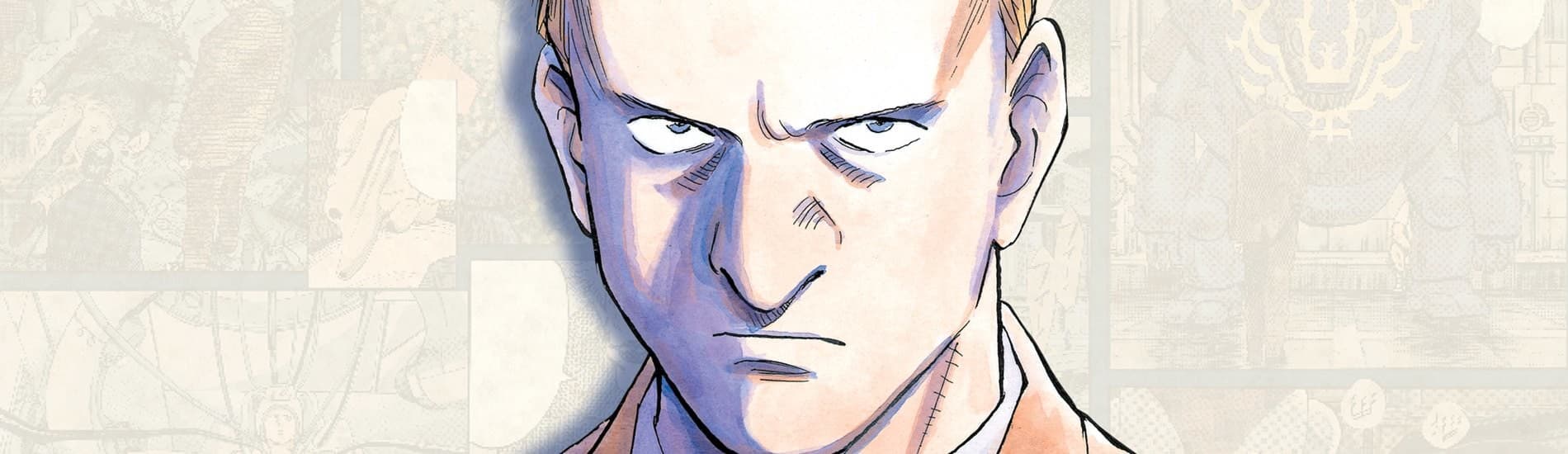
Pluto
a review by SciCosta23
a review by SciCosta23
Pluto is a manga that was on my radar for quite a long time. I'd heard a lot of good things about it and was looking forward to it. The manga is based off of the original Astro Boy by Osama Tezuka. After reading it, I found it to be a very well-created murder mystery. Urasawa is able to successfully conjure a thrilling plot in just a little more than 50 chapters. He does this whilst making sure the story isn't too rushed or too complex, and I think that's an achievement on its own.
To start off, the setting of the story is a world where man and robots coexist. Robots have become so similar in their mannerisms and appearance to humans to the point they just blend in with society! Enter Gesicht, Interpol’s top detective. Gesicht is one of the seven greatest robots in the world. He has been called up to investigate some mysterious robot murders that are somehow connected together. One robot that has been murdered is one of the seven robots - Mont Blanc. Gesicht later realises that he is one of the targets too! Over time, the story leads back to the 39th Central Asian war that took place between Persia and the United States of Thracia of which 5 of the greatest robots took part in.
One thing I want to elaborate on before continuing is Gesicht. I think he is a pretty interesting and underrated protagonist. The struggles he shows throughout the manga about his emotions and how always finds it difficult to show emotion when he encounters other humans throughout his investigation. That’s something in general that is portrayed in the manga. He struggles with empathy and sympathy, something that isn’t innate to robots. Gesicht also struggles with ‘temporary memory loss’ after having a portion of his memory being deleted.
Overall when it comes to the art of Pluto, you would think of it as bland but I think Urasawa’s artstyle is unique. He draws his characters in a realistic style while still keeping it as a manga. But sometimes at the climax of the story, the art is pretty laudable at times.

In the manga, there are many side characters such as the other six greatest robots in the world. They all have a prominent part to play in the story. A few are:
Atom is one of the seven robots. I could call him the deuteragonist of the story (as he ends up becoming the protagonist of the story). He is the brother of Uran. Atom looks like a child but he is an extremely intelligent robot that is able to portray emotions such as crying at the same level as humans. He plays an important part in the investigation. After Gesicht’s death, Atom is the one who ends up facing Pluto at the end (which has a bit of a twist).
Uran is Atom’s sister and is another of the seven robots. Like her brother, she is able to portray human-like emotion. She doesn't play a role as big as her brother but she does end up encountering Sahad and being a bit more present in the story towards the end.
Epsilon is also part of the seven prestigious robots in the world. He didn’t take part in the 39th Central Asian War due to his pacifist ideals. However, he still holds immense power especially in his fight against Pluto where he is unfortunately killed by Pluto. He has an immense love for children as he adopted children that were displaced after the 39th Central Asian War.
The antagonist of this manga is an interesting part about this story because there are technically three antagonists. The first antagonist is Pluto who is actually the son of the second antagonist, Abra. Originally, Pluto was Sahad. He was Abra’s son. During the 39th Central Asian war his house was destroyed probably by a bomb. As a result, Abra’s whole family was killed. Unfortunately, he was only able to resurrect his son. Thus he began his hatred for the United States of Thracia.
Hatred is a strong theme that is portrayed throughout Pluto. A main instance of hatred is through Doctor Abra. He recreated his son into Pluto - a weapon for his own genocide! However, Pluto (i.e. Sahad) is nothing like his father. He heavily contrasts his father’s revengeful and bloodthirsty urge for revenge with his peaceful and quaint demeanor. This all leads back to Gesicht’s quote:

Hatred and revenge won’t lead to anything except more hatred and revenge. These emotions won’t bring back what you lost, and you just end up losing yourself bit by bit till your hatred only encapsulates you.
Now you may be thinking about who is the third antagonist of Pluto. Now, this one’s a little interesting because this villain was the President of the United States of Thracia who was using this robot in the shape of a teddy bear. They were tracking down each of the seven robots in the world. However, there doesn’t seem a significance of how they connect to Abra’s plan.
One thing that doesn't make sense is the meaning of the ending. For some reason, it felt a little rushed. The way Brau-1589 killed the robot bear didn’t seem like a proper way to end it. Maybe it was something about how this would be Brau's last kill or something but honestly I don’t know.
Overall, I found Pluto a captivating manga that delves into societal issues with robots and the power of emotions. Especially these days where technology has started to become more prominent with there being problems of robots taking over jobs and that robots are becoming more common in households and are forming a part of our society. Pluto, in my opinion, is a certified Urasawa classic that’s definitely worth it!

35.5 out of 36 users liked this review
