K-On! (2009)
[SPOILERS]
K-On!, a show about The Light Music Club’s lighthearted adventures, packs a surprising amount of emotional depth into an overarching feeling of genuine fun. On the surface, it’s just enjoyable to share in the bonds of the friend group, but the more you unpack, the more life lessons begin to show. After recently watching it for the first time, I was shocked to discover it debuted 13 years ago. The detailed effort put into each character, each frame of animation, each unique song, and even the humor, all hold up to the point where it feels like it came out yesterday. Experiencing the wholesome nature of these high school girls reminds you that life is not always meant to be taken too seriously.
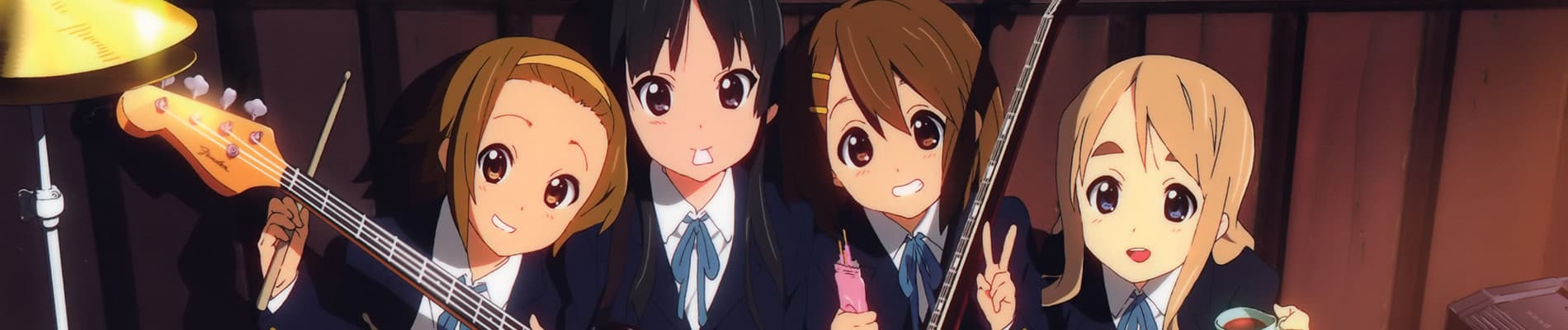
Traditional moe archetypes still feel refreshing as each character embodies their personality to the fullest. The main character, Yui, a spacey klutz, becomes so much more as she puts all of her effort into the things she is passionate about. Her aimless attitude early on develops as she discovers purpose in music and the friends she makes it with. This level of growth is apparent in all of the characters and is even mirrored by their respective instruments. The bassist, Mio, keeps the often unmotivated band members in rhythm while never wanting to be the center of attention. However, she still has to face her fear of the spotlight as she begins to do more vocals for the club. But even on a much more simple level, the characters break tropes in their day-to-day interactions. The dynamics between them feel so realistic. Expressed in not just their dialogue, but in the immense personality of their quirks and movements. Their different temperaments balance each other out without ever losing sight of the playful nature of the show.
It is difficult to express why the conversations and antics are so creative because they feel universally relatable. It’s the fact that they are so specific that you don’t often see them in similar stories. Simple things like jokes that are only funny when you’re exhausted at a sleepover or debating the ethics of sharing your food with someone, but them taking the best part. Even if these are not conversations you’ve personally had, there’s still a nostalgic sense that feels like you could have. They subtlety captures youth by highlighting the little things young adults focus on.
This extends further into the music. Although much of their time is spent drinking tea and eating cake, the music club is still a band after all. Their carefree nature comes across as they initially write catchy J-Pop tunes about cute animals and eating rice. As their bonds grow closer though, the music becomes more sentimental. Whether serious or not, the members never lose sight of the reason they are together in the first place – they love to make music together. This is magnified when the band performs, captivating the audience with their chemistry. You have a good time when you can tell the girls are having a good time. But the music itself stands on its own. Catchy choruses, shredding solos, and playful banter make for songs that I actually love listening to outside of the show. Even the score is exceptional with synthy jazz tracks that are reminiscent of old PS1 era games. The overall sound design also shines through detailed foley. Practice sessions come to life with sounds of repeating scales or playing chords on unplugged guitars. It’s a noticeable effort, involving the actual musicians recording stripped down portions of the songs, which elevates the believability.
Animation is obviously a key part to any anime, but all of the praise is usually reserved for high-octane action scenes. The animation of a slow-paced story shines in how believably natural it is. In the smoothness of flowing hair and strumming guitars, to the nuance of character expressions, there is a level of quality that can easily be overlooked. But even with basic plot premises, there is a surprising amount of action that keeps things interesting. Characters speak with their whole bodies and are exaggerated with great emphasis. The way hair swiftly waves and gracefully falls is particularly exceptional. What stands out beyond this, is the extra effort put into the secondary action of each shot. Everyone’s personality is on display not only when they’re the focus, but by their distinct behavior while in the background. This not only elevates the realism, but the situational humor through body language and expressions.
The detail and realism extend beyond the animation. Minor touches that still go a long way for me are things like having new outfits for each day that passes. Most animation does not go through the extra effort to design, color, and animate new clothes for each character, but here it allows them to express their personalities even further. As someone who has always really appreciated rock music specifically, it also adds a surprising amount of realism when all of the musical instruments are actually branded. Even the cymbals and amps are name brands that cover a variety of different tastes. Plus, when it comes to discussing their influences, the students rattle off real musicians like Jimmy Page and Keith Moon. Not only do these real references create tangibility, but so do the detailed illustrations of real places. Slice of life anime often excels in this regard, but it’s the inclusion of tiny things, like the tortoise and the hare figures ascending the school staircase, that feel uniquely realistic. It’s something you can imagine in a school while also serving as a constant metaphor for the overall theme of taking life slow.
All of the key components of the show, the realistic animation, the vibrant personality, the creative yet relatable attention to detail, are highlighted in a minor scene that still remains explicitly memorable to me. In episode 10 of season 2, the girls are out standing in the hall after getting caught passing notes in class. Mugi is expressing how excited she is to be getting punished because her gentle disposition never let her experience it before. Mio and Ritsu are discussing the more serious topic of how to help their teacher while Yui is seen in the background reaching on her tippy toes, trying to touch the room sign. Once she finally bumps it, Yui exclaims her excitement to the others, while completely missing everything they were talking about. It was in this moment that I realized how special this show is. In just an uneventful, 30 second scene, how does it still feel so creative and genuine? Each of the characters’ unique personalities are shown in not only what they are saying, but their actions. You may not have even notice Yui until she bursts with joy for achieving something so small, yet relatably childlike. I immediately found myself wondering how they came up with this interaction. Each shot is infused with so much character that reiterates how charming each girl is, in their own, unique way.
Unfortunately, at some point all of the good times have to come to an end. As the series approaches the finale, the looming realization that the characters will have to graduate and move on becomes more and more clear. It is most apparent with the one underclassman of the group, Azusa, who will be left behind as her friends go off to college. They assist her in recruiting new members for the club, but ultimately realize that their time is best spent enjoying it together while they still can. This is where the more sincere life lessons begin to reveal themselves. You start to see that the girls finding the fun in everything is more than just a lighthearted premise for a show, but a deeper message. It reminds you through realistic depictions of youth, fundamental notions that we tend to forget with age – like, life is for living, to value your downtime, and to enjoy the people and things you care about while you can. The show captures the feeling, that I’m sure a lot of people experienced in high school, that you don’t realize it’s coming to an end until it’s over. This is presented beautifully as the friends allow themselves to break down together after their final high school performance. After giving their full effort, it hits them all at once and here I find myself more emotional for these characters’ graduation than any of my own.
While a seemingly typical coming of age story, K-On! is packed with so much character and charm that it amplifies it to a truly standout journey. The personality shines through every aspect, from the eccentric yet genuinely authentic club members, to the meticulously fluid animation, to the colorful music. A low-steaks narrative manages to capture universal experiences of childlike joy, passionate friendships, and the uncertainty of growing up. It allows for a reflection on what you value in your own life, your passions, the people you care about, while reminding you what it feels like to be a kid.
62 out of 65 users liked this review
