SPOILER-FREE!
This review was originally written in July 2021, published as a YouTube video on my channel.
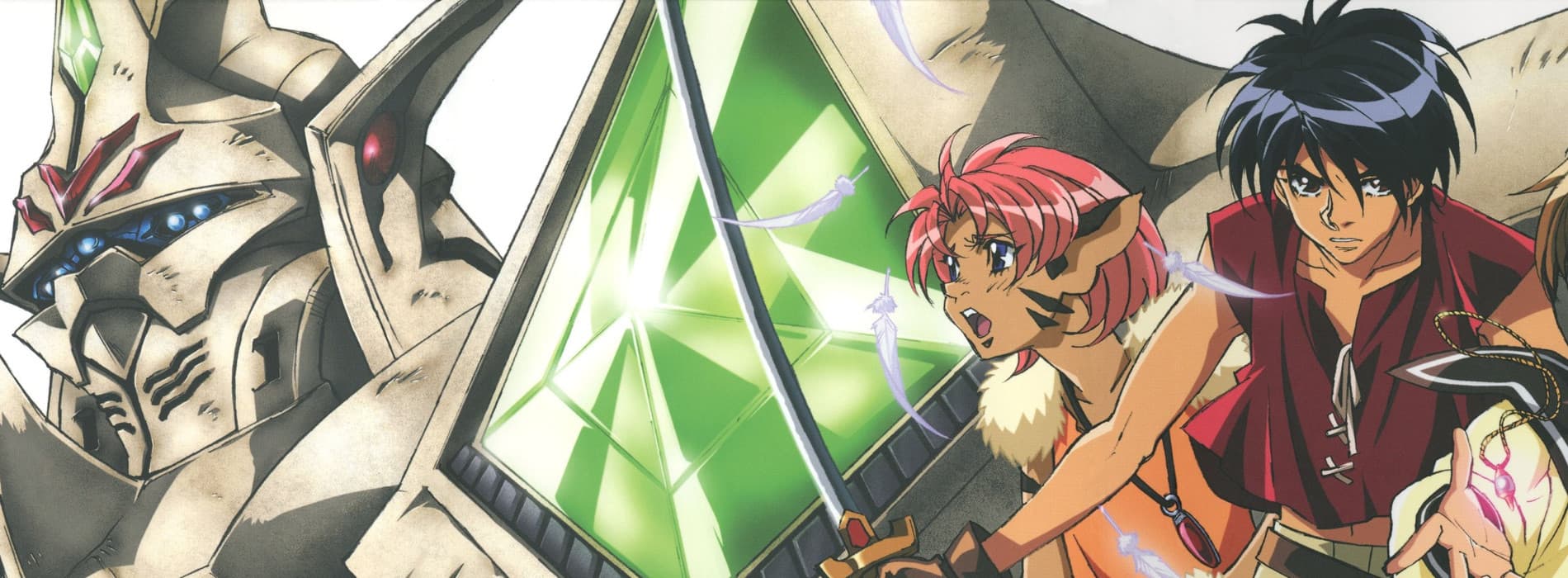
Kanzaki Hitomi, a fortunetelling girl on a high school track team, has a crush on a boy named Susumu Amano. One day, she asks him to give her her first kiss if she can complete a sprint in a certain time. Before she can complete the challenge, a portal to another world opens, with a boy and a dragon coming through and battling each other. Hitomi has a macabre premonition about the dragon killing the boy, and uses that to help the boy, named Van, kill the dragon instead. After that, she and Van are pulled through another portal to Van’s home world, Gaea, where both the moon and Earth are in the sky. While on Gaea, Hitomi and Van find themselves dragged into a large-scale military conflict that will cross magic, mechs, and swords with the Zaibach Empire. At the center are the mysterious Dornkirk and Folken of Zaibach, while Hitomi, Van, their friends and allies, and Van’s mech, Escaflowne, resist them.
The overall conflict takes place in a war, but the series is not dominated by action. In part because the story had to be compacted and the actual plot left largely unchanged, if there’s no action going on, then there’s romance to develop! No romance going on? There’s political gamesmanship at play! No political gamesmanship at play? There’s mythology to explore! No mythology to explore? There’s Folken and Dornkirk wondering what to do next. Vision of Escaflowne rarely sits down twiddling its thumbs; there is always something happening in the story even in its slower moments. Because of the nature by which all the elements factor into one another, each event that occurs carries with it importance and consequences for both the heroes and the villains.
And the heroes and villains together make for a wonderful blend of personalities and motivations. Both Van’s allies and the Zaibach Empire feature many characters that come across as either well-developed, or having strong enough personalities to carry their scenes and the overall narrative. Therefore, most characters and their roles are fascinating to see unfold. Dilandau is a wonderfully-sadistic character, Folken is mysterious, and Allen throws some great wrenches into the political and romantic aspects. Merle might stand out as the only character in the series who I can honestly say that I didn’t like too much, with her attachment to Van and antagonistic attitude towards Hitomi getting tiresome early. Thankfully, her actual role in the military conflict is pretty inconsequential, so when things get particularly hair-raising, she’s not too much of a bother.
The story in Vision of Escaflowne revolves around the show’s main theme of destiny, which while in and of itself is nothing new, is given a refreshing shift in how fate actually factors into the plot. Headed by Dornkirk, the Zaibach Empire’s main goal lies in using its unusual Destiny Prognostication Engine and other similar devices, working towards a future where there is no more war on Gaea, no matter how many people or cities need to be destroyed in order to achieve that end. As a gifted fortuneteller on Earth, Hitomi’s capabilities translate to using her pendulum, tarot cards, and prophesizing to foresee consequences, often dire ones. The series thus frames its military conflict against these two competing vehicles for changing fate. The actions taken by each side, either consciously or unconsciously, seek to create what they each perceive as a better future. As the series goes on and we eventually begin to understand precisely how fate is impacted by the characters’ deeds and thoughts, it makes for a compelling drama.
It’s because Hitomi’s powers are intimately tied to the conflict that she is, thankfully, a main protagonist who gets involved rather than simply being a damsel in distress. Because she keeps seeing visions of death or destruction, she takes an active role in helping Van and the citizens of Gaea survive Zaibach’s assaults. When Van is fighting with Escaflowne against the other mechs, called Guymelefs, she is sometimes right there by his side aiding him, or has done something that gives Van more of a fighting chance. Not to mention that there are times where she doesn’t put up with anyone’s attitude, which was so satisfying to see. Even one of her earlier defining traits gets referenced on occasion; her abilities as a runner come in handy, with one seriously-epic moment of her jumping across a giant chasm in a horribly-underappreciated scene for a female anime character.
Such moments are not limited to Hitomi, but are also shared throughout the series with its action scenes. The mid-90s aesthetic might move and appear rougher compared to the more-modern sakuga, but the overall sense of tension and thrills permeate. Watching Escaflowne slash its way through enemies was always great to see, and the series does not relent on showing some violent moments that, while bloody, never cross the line into gratuitousness. The music that plays throughout the anime, both during the action scenes and outside of them, was brilliantly handled with a plethora of styles utilized. The “Escaflowne chant” was delightfully haunting, while some battle music excellently enhances the weight of each encounter.
As much as I loved Vision of Escaflowne, it does have one noteworthy issue – its ending. The drama, though dense in its compressed timeframe, never felt like it got out of hand, as learning more about the world of Gaea and the characters personally, mythologically, and militaristically never tired me out. A combination of both short skirmishes and longer, more-grueling battles gave variety to the pace. In brief, I felt that most of the show was not terribly impacted by the reductions. But, unfortunately, it is not true for the ending. While the show may not necessarily add new plot threads that need to be resolved at the last-minute, there are still a few too many left to tie up. With only two episodes to get it done, the series hits fast-forward by having some of the final events and revelations come far too quickly and breeze by, leaving the show frenetic in its climax and resolution. For this particular time, however, it did not bother me nearly as much as it potentially could have.
Though rushed, it does serve as a worthwhile thematic conclusion to the series, bringing into perspective some of the overarching themes the series was attempting to convey, and even still managed to pull off some great portions nonetheless. As much as the ending might potentially come off as hokey, it was not nearly as infuriating for me as it possibly could have been. Your mileage will most-definitely vary on whether the rushed ending will cause the previous twenty-four episodes to feel like a waste of buildup, and truthfully, I fault no one for saying that it spoiled their enjoyment of the show. I’ll let you judge for yourself, but it was something too important to go unmentioned.
__________
Vision of Escaflowne takes the numerous features of the fantastical and weaves them together into a slow, but always moving, tale. If the isekai genre has tired you out, I would consider putting this series on your list. By dispensing with the usual power fantasy and taking so much time to create imperfect characters, engaging battles, political intrigue, and magical elements, it moves with a level of escalating grace that injects life into the story. It may somewhat botch the ending and not answer every lingering question, but even in its stumble, I can largely forgive it for providing a wealth of fantastic moments, such that it left me ultimately satisfied with the overall experience. One final note to bring up – while I don’t normally comment on something like this, I recommend avoiding the original English dub of the show. It has not aged well. To get the most out of the experience, see either the more-recent Funimation dub or the subtitled version.
__________
EDIT: This review was edited on 21 August 2024 after it was found that the first two paragraphs were based on information confirmed to be incorrect. My sincere apologies for the error.
27 out of 28 users liked this review