

I'm predisposed to like this not only because the people behind it but because it's a for-real, forward-looking sci-fi. As someone who casually consumes a lot of pop-astronomy content and likes to imagine what a space sci-fi could be if only it would let go of its retroism — the space race, Asimov, Clarke, Star Wars, Gundam, etc. — and synthesize current ideas of space travel, colonization, and an economy into a new vision of the near-future... I'm very much on this anime's wavelength. Isn't imagining the future what sci-fi ought to do? As our concepts of the future change, so should the genre.
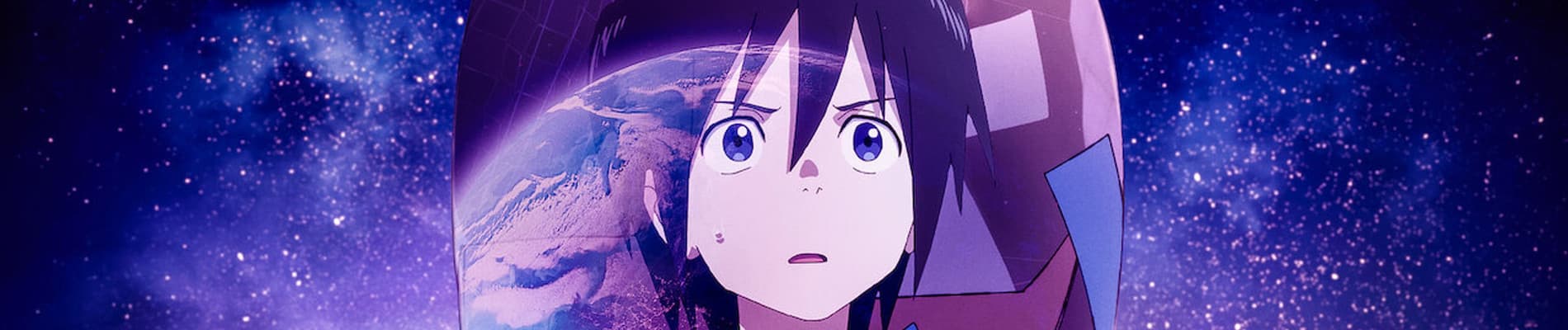
___Chikyuugai Shounen Shoujo_ (The Orbital Children)__ attempts, for better or worse, to be an updated 2001: A Space Odyssey. That sounds grandiose... because it is. It inherits much of the ambition of Kubrick's film, but also its unwieldiness. The first half concerns children trapped aboard a massive space hotel in a Gravity-esque disaster plot. Split into groups by happenstance, they race against the depletion of oxygen and heat, solving practical problems and engaging in some head-spinning action setpieces aboard the rotating space station.

This is where the anime is at its most approachable and fun with mechanical worldbuilding that shines — its inflatable space habitats and smooth 3D-printed gadgetry are counterpoints to the cold, battleship-like bulkheads that pervade other sci-fi. The series parades space habitation ideas as the kids MacGuyver their way from one escape room to the next. One of the kids, born on the moon and never having visited the homeworld, feels that Earthlings will never understand him and that space is his true motherland. He gets into Dennou Coil -like augmented-reality wizard battles with another kid who places him under arrest on behalf of the U.N. for his AI-hacking. Funneling these esoteric sci-fi topics through the adorable rivalries of children is a device that anime creator Mitsuo Iso once again employs to great effect.

Its second half entertains tech-singularity ideas such as a superintelligent AI and brain-computer interfaces. It's here that the story forms a commentary on man's relationship with technology. The U.N., representing the status quo, places limits on AI capability out of fear which the titular children have to incrementally circumvent. The functional villain of the story sees the superintelligent AI as an omnipotent god that must be worshiped; its words taken as scripture. The children, meanwhile, attempt a good-faith first-contact with the new life form sensing a fundamental misunderstanding.
This chapter of the story can be wordy and unwieldy. As a sci-fi it's plenty interesting — the tech. singularity is by definition the most difficult futuristic idea to represent — but as a work of entertainment, the script could've used more revisions to make something more emotionally resonant with fewer excesses of geeky exposition. But what it ultimately says through its scenario is at least something that rings true to me. The future is coming and we have to engage with it, lest we close our minds out of fear and pessimism, preventing us from conceiving a future we want to live in, pushing its development underground where the most dangerous forms of it will emerge.
The lack of popular sci-fi in today's media that properly envisions the future, rather than wades through apocalyptic dystopias or escapes into retroism, reflects our fear of technology and, by extension, ourselves. The economy will drive us to further disparities and there's no fixing it. The environment will be destroyed by global warming and there's no fixing it. The internet will unravel society and there's no fixing it. The tech titans will control every aspect of our lives and they cannot be dissuaded, and their AIs will one day come alive and kill us all, while the billionaires fly away in their space yatchs. This apocalyptic zeitgeist is incapable of producing something like Star Trek: The Next Generation which imagines a future, enlightened mankind exploring the galaxy. These days, we are served nothing but a feast of retro schlock and Black Mirrors because we refuse to imagine that we are capable of anything greater.
Chikyuugai Shounen Shoujo makes the optimistic case for technology, our problem-solving prowess and our capacity to bridge divides in an era that sorely needs one. It dares to imagine a future where mankind, overcoming its fears of uncertainty and embracing technology, takes the next step into the great unknown.