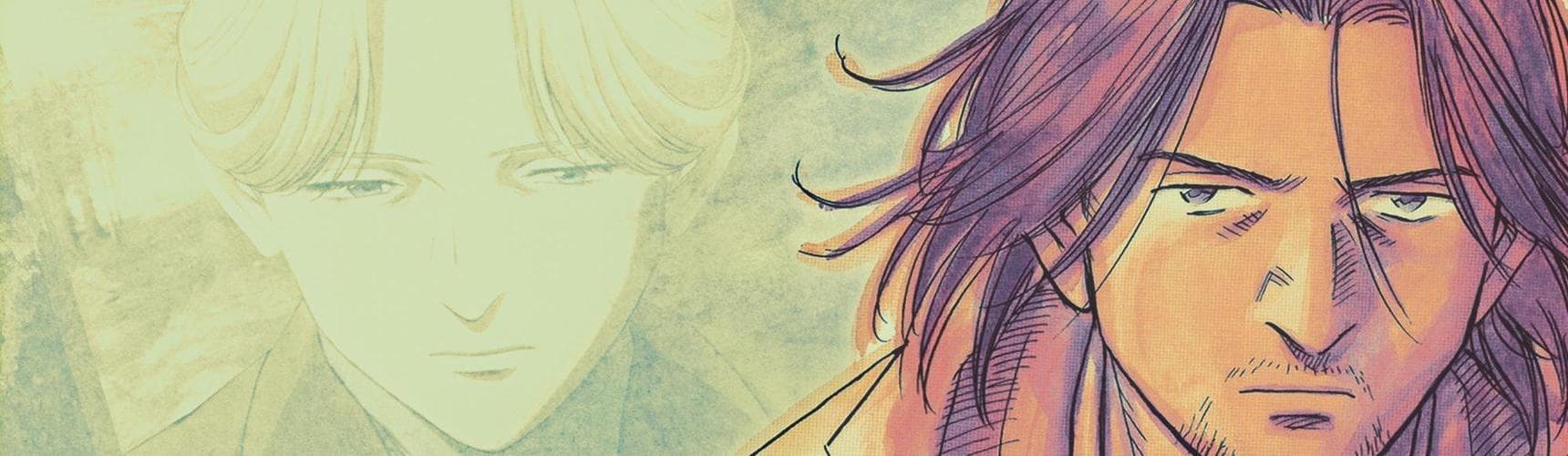
Welcome to my not-review of Monster. I say not-review because this is mostly an analysis of Monster's ending because I can't quite scratch the itch in my brain when I try to wrestle all my thoughts down into one or two twitter threads. That does this ending a massive injustice, and Monster deserves better.
However, if you haven’t read Monster and you’re clicking on this thread because you’re curious or you don’t care about spoilers, I, like the majority of people who have read this manga, encourage you to bite the bullet and go read it (or watch it, as from what I’ve heard the anime adaptation is an incredibly faithful one).
BRIEF TIMELINE RECAP IF YOU NEED IT
Spoiler, click to viewclick to hide
As a quick recap, here’s a brief timeline of the events leading up to the first few chapters of Monster. Nina/Anna, not Johan, was the one taken to the Red Rose Mansion where they carried out Bonaparta’s experiment on her. After the experiment’s conclusion, it’s presumed that Bonaparta poisoned his fellow scientists/party members due to the regret he felt over taking a child from the woman he loved. Nina escapes and runs home, where she tells Johan about all the things she’s seen. Viera informs Nina and Johan that they have to live on their own and the two travel across Czechoslovakia. Johan begins his plan of ‘the perfect suicide’ here, killing each family that takes them in for brief periods of time. Eventually they are sent to two different orphanages; Johan to the infamous Kinderheim 511, while Nina goes to a normal orphanage. Johan, of course, carries out the massacre on Kinderheim 511. Shortly thereafter, Nina and Johan are both adopted by the Lieberts, who are presumed to have some sort of knowledge of Bonaparta’s Red Rose Mansion experiments and Kinderheim 511. Bonaparta pays them a visit at some point, and the same night, Johan kills the Lieberts and asks Nina to shoot him. We know how the rest of the story goes.
Monster’s ending is infamously confusing and divisive and personally I’m in the camp of “I loved it!”. It summarizes the questions posed by Urasawa neatly and concisely while allowing the reader a chance to better understand what it was that was just so important to Johan to start him down this path. Johan’s ideology is summarized quite neatly by that banger of a quote, “The only thing all humans are equal in is death,” which juxtaposes with Tenma’s ideology that “all lives are equal.” But before we get to the ending, Iet's talk a bit more about Johan.
When Johan (or Tenma’s hallucination of Johan, depending on how you want to look at it) sits up and starts to speak to him, we finally get to peek at a memory he decrees painful, and is presumably the moment his “humans are not equal” ideology began forming. The moment his mother chose which twin to give up. This moment haunts Johan even to his trip to Kinderheim 511, and due to his harrowing experiences and the experimentation he undergoes at the orphanage, begins to adopt Nina’s memories as his own. This places the two twins in direct contrast to one another: Nina cannot accept that she is the original “monster,” the child who was ‘unwanted,’ and so Johan takes that pain from her.
I think it’s safe to say that Johan, despite his immeasurably twisted psyche, does love his sister deeply. To Johan, the greatest pleasure is death–he even asks what the point of living is if all humans die, and he believes that true equality can only be achieved in death. As a child he asks Nina to kill him because he believes that while they are alive they cannot be equal, and so by asking Nina to shoot him, he inadvertently says that she is worth more than him. After all, if there was only one twin, their mother wouldn’t have had to choose between them. And while at this point in their life Johan believes that he was the one taken, it is somewhat telling that Johan doesn’t fully “wake up from the dream” and go on to concoct his plan of the perfect suicide until after Nina corrects his memory to remind him that she was the one taken. I’m not fully convinced that Johan wanted to kill Nina as he continuously postulates to her throughout their lives that they are the one in the same; maybe he believes that when he dies, Nina could essentially fill the role of “Johan”, which would be easy enough due to the fact that ”Johan” is not the boy’s true name and therefore “Johan” never existed.
It’s why the question of “which twin did Johan and Nina’s mother want to keep?” is left ambiguous for the reader and Tenma. It doesn’t matter, because in the end a choice was made, and this choice implies inequality. It’s also why this doesn’t matter to Johan, because either choice means pain for him and Nina. So long as there was more than one of them in the world, neither one of them could live freely, or at least that’s what Johan thinks. But since they are the same person in Johan's mind, if one of them died this could spare the other from one of two things: the guilt of being “the wanted one” or the despair over being “the unwanted one”.
Johan cries when he awakens from his coma and reaches for Nina only to have her scream and faint in front of him, perhaps feeling abandoned by the “only other person in the world.” It is what makes this moment in Ruhenheim where Nina tells Johan she forgives him (presumably primarily for killing the Lieberts) so strong. For all his intelligence and eternally-calm-headed attitude, I think Johan is a deeply empathetic and sensitive character, and we see that crack through in this moment and in the last chapter especially.
The last time we see Johan, he asks Tenma which twin was unwanted with a clearly terrified look. Of course, we don’t know if this is really Johan or not, but it’s this question that makes it finally clear to the reader what ‘broke’ Johan and sent him on this journey in the first place. Their mother asks Tenma “who was the real monster?” while staring at her hand (the hand Nina was holding when she gave her up to the Red Rose Mansion). The important takeaway from this last interaction between Tenma and Johan isn’t whether or not Johan is actually speaking to Tenma–it’s that “the monster” is the creation of circumstances that led up to this one deeply traumatizing moment that sent Johan down this path.
We as readers are led to believe that Johan is murderous and cruel due to his time at Kinderheim 511 but Urasawa slowly unravels this thread over time: first off by telling us that Johan was like this before his time at Kinderheim 511, and then making us believe that perhaps he was murderous and cruel due to his time at the Red Rose Mansion. But then he informs us that Johan had never been to the Red Rose Mansion, and that it was Nina, who is a character who for all intents and purposes has not done anything wrong in her life. While Johan’s condition is greatly exacerbated due to the conditions he’s been placed in at the hands of people who want to use him and his family, it is this one small, seemingly insignificant detail in a very tragic life, that completely shatters him. This is the true monster of Urasawa’s story.
I don’t think it particularly matters if Tenma receives this revelation from the real Johan or from a Johan he’s hallucinating. If Johan was real, perhaps he escaped the hospital to try and carry out his vision of the perfect suicide once again. Or maybe he killed himself after learning his true name (which unfortunately we don’t get to hear, because it doesn’t really matter in the context of the story). Or maybe he escaped to try and live the normal life the others wish for him.
If Tenma was hallucinating this conversation with Johan, then Tenma’s quick dismissal of Johan’s question once again reinforces his humanitarian nature–he doesn’t give in to Johan’s postulating about inequality and is finally able to shed being haunted by “the monster”, proposing that the empty hospital bed being left behind is symbolic of Tenma relieving himself of the weight of the last ten years. Both options work equally (heh) well for the message Urasawa is driving home, and it is what makes this ending especially poignant to me. All in all, Monster is a story about morality and cruelty and what drives people to cruelty, and it does this exceptionally well.