Ashitaka was the last Prince of Enishi, a small, peaceful tribe living out their days in the Muromashi period of Japan. His tribe was already dwindling when fate struck them with a horrifying encounter. One day, a giant boar, corrupted by some mysterious demonic entity, attacked the village. Ashitaka saved the day, but at a great cost, as his arm was tainted by the demon. Permanently exiled from everything he knew, Ashitaka set out on a quest that would see him caught in the middle of an ongoing war between the deities of the forest and a contingent of humans who wished to claim the territory for their own. With the help of San, a young woman who was raised by wolves from infancy, can Ashitaka successfully quell the hatred surrounding him, or will it doom both sides as his curse dooms him?
Princess Mononoke was the last Studio Ghibli movie to be completely hand drawn, and thank God for that, because I don’t want to think about how many visuals in this movie probably would have been relegated to CGI if the movie had been made five years later. You just know they would have used CGI for the forest spirits, and while I could see that approach working(although CGI Ryuk would beg to differ) the thought of the demonic sludge worms being animated that way makes me want to shudder. That didn’t happen, thankfully, and it’s one of the few reasons that I personally consider this to be among the best looking Ghibli films ever made. Sure, as a drawback it wound up becoming the most expensive anime movie ever up to that point, but that money was well spent.
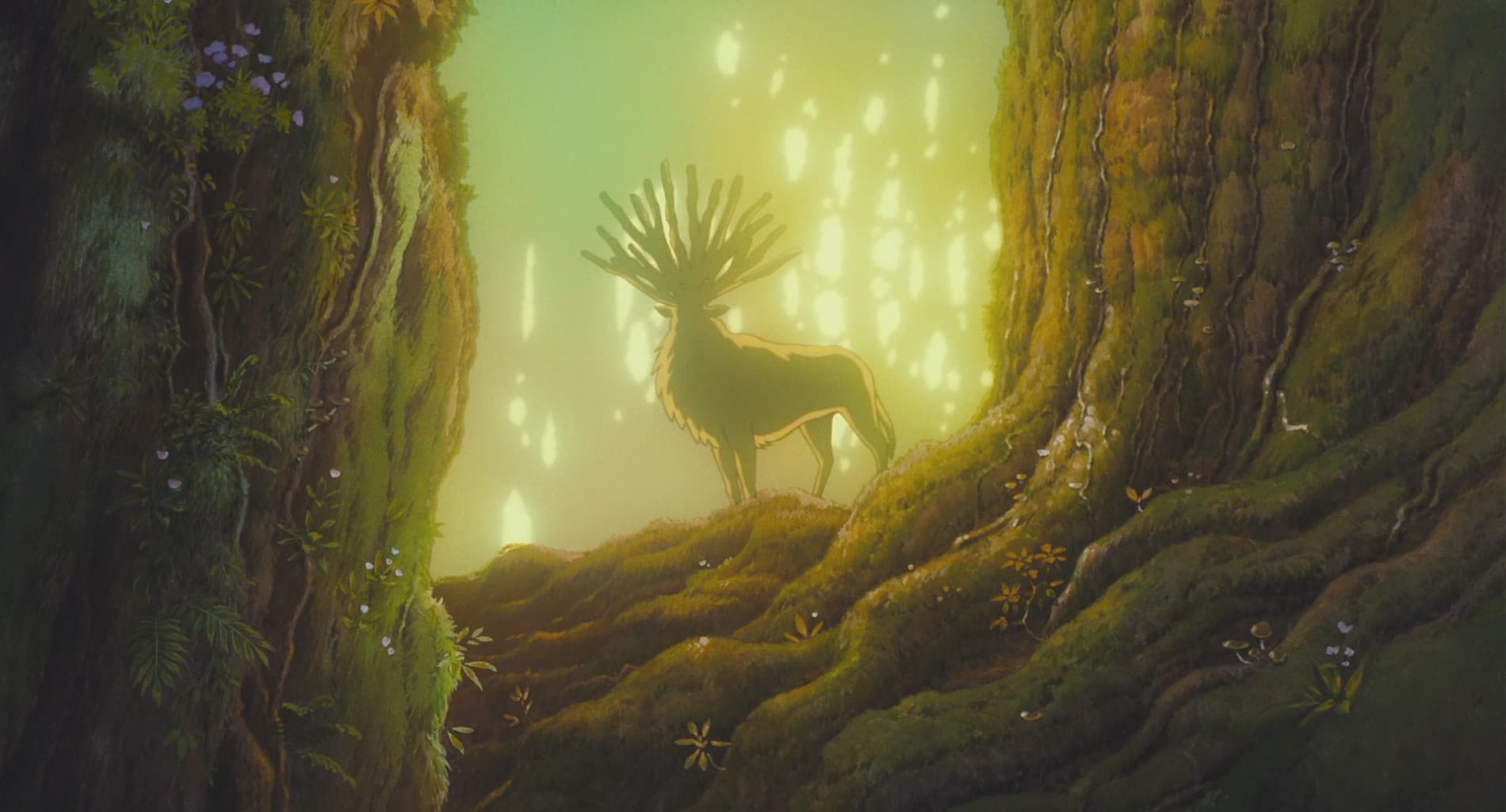
The animation itself is pretty much what you’d expect from Studio Ghibli... The movement of characters is smooth and graceful, every bit of motion feels alive and unhindered, and that level of motion lends itself generously to the numerous action scenes. As far as character designs go, they follow a samurai/feudal Japan aesthetic, but they do so with bright, vibrant colors that are thoroughly easy on the eyes. Miyazaki has always had a very large imagination, and while it was on full display with all of the strange and fantastical spirits visiting the bath house in Spirited Away, I like it a lot better here because instead of just cramming scores of random creations under one roof, his imagination largely extends to the forest spirits in this movie, and they all feel like the natural inhabitants of the world they’re living in. No matter how over-the-top some of the design choices get, I never felt like any of it was jarring or out of place, it was all just part of the spirit of the forest, living in their (super)natural environment. Giant animals with strange features might take a little while to get used to on a first watch, but even the weirdest of them grow on you in time.
And what an environment it is. It’s fair to say that most Ghibli movies take place in a handful of settings... This street here, this house here, this bathhouse, and so on and so forth. I don’t even know what to call the setting of Princess Mononoke other than an entire region. It’s not just the forest and the human encampment... It’s other villages, it’s different fields, it’s other forests, it’s too many battlefields to count, and as many as there are, none of them feel generic or repetitive, despite the fact that they all do feel related. Every area is intricately detailed, every frame a painting unto itself, and the whole region feels alive, rather than just the backdrop of a story. The setting of Princess Mononoke is an entire world... One that feels immense and invincible in the moment, but one that we know from a modern perspective CAN be conquered and transformed over time with the right resources. Best way I can describe it, this is what vast, untamed wilderness looked like BEFORE humanity had the technology for deforestation.
The English dub has a sort of complicated history, as it is technically a Disney effort, but all of the actual dubbing effort was done by Miramax, a company that Disney owned for a seventeen year period up until 2010. This happened sort of as a consequence for the way Disney butchered Nausicaa a few years prior. Miyazaki was rightfully pissed about that, and as a result, he absolutely refused to let Disney edit or cut Princess Mononoke for a family audience. Ever protective of its image, Disney handed the project to Miramax(Which I guess means it was too mature for Touchstone?) and to direct the dub, they hired... No joke... Neil Gaiman, and he took the project as dead-serious as he could. His adaptive script heavily altered the wording of the material to sound more natural in English, and while there are a few moments I personally found cringeworthy... One character’s introduction was far more rambly than it should have been, there’s a line that deliberately makes fun of the Forest God’s appearance before we even see it, there are a couple of shots that were supposed to be silent and subtle, yada yada yada... It is almost entirely for the better.
One of the benefits of Disney being hands-off about the dub is that there really weren’t any late-nineties pop culture celebrities thrown in there for marketing purposes, and come on, you know damn well Ben Savage and Melissa Joan Hart would have been the leads otherwise. Instead you have Billy Crudup and Claire Danes playing roles that could have very easily been boring and one note with a stunning amount of charm and sincerity. Minnie Driver rides a very fine line between inspiring leader and fearless sociopath, Billy Bob Thorton adds some very welcome likeability to a character that was previously just kind of soft spoken and sinister in the sub, and the Gods of the forest are granted an unearthly level of strength and wisdom from people like Gillian Anderson and Keith David. There seems to be some confusion over Gillian Anderson’s character, as the wolf Moro had a male voice actor in the sub, but the character is female. The Japanese just have a tendency of applying male voices to wolves, so, yeah, that’s a thing. It’s not a perfect dub, I do think the adaptive script does over-reach at times, but I still highly recommend it.
When you think of the average Miyazaki movie, one of the first qualities that comes to mind is that he makes movies for children, but adults can still enjoy them... Well, most adults, but I digress. This sort of puts him in common company with Disney, a studio he does have close connections to. What I find particularly striking about Princess Mononoke is that it seems to be the exact opposite... It’s a film aimed at adults, but one that children can still enjoy. There is a decent portion of violence throughout the film... It revolves around a war, and while they never shy away from the reality of people dying in war, going surprisingly far with dismemberments and blood, it never feels particularly gory or sensational. It’s used sparingly, and at least back in a previous decade, I could see it getting maybe a PG rating... You know, back when that rating actually meant something. And let’s be real, parents will take their kids to see ANYTHING these days as long as it doesn’t contain bare breasts.
There is a ton of depth and complexity to the plot that might fly over a kid’s head, but the plot itself is still clear and accessible, there’s a ton of fast and intense action, and most of the characters are likeable and interesting. I’m not going to pretend like the violence wouldn’t have been too much for me when I was really little... I couldn’t watch Alice in Wonderland because I found cards getting their heads cut off off-screen too disturbing, so I’m pretty sure the on-screen decapitations(plural) in this film probably would have scarred me too... But by the age of ten, I’m sure I would have dug the crap out of this. That’s saying a lot, by the way, because when I look at my two over-all favorite Ghibli films, Grave of the Fireflies and Only Yesterday, those two movies mean a lot to me, but I’m pretty sure they wouldn’t do anything for me if I watched them before my mid twenties at the very least.
I’ve made no secret of the fact that I’m not a huge Miyazaki fan. I’m more of an Isao Takahata guy. I don’t really buy into the magic and whimsy of Miyazaki’s work, and while I’ve never really had a good explanation for that, what I’ve kind of been realizing recently is that it just feels disingenuous to me. As much as people call Miyazaki a genius, I can’t help but look at all those stories that have come out about him being a massive asshole who’s really difficult to work with... Who publicly denied wanting to mourn the passing of one of his inspirations, and who can barely manage to even pretend to be supportive to his own son... And compare everything that’s publicly known about this man to the whimsy he keeps producing, and feel a distinct level of disconnect. I’m not sure how to put this, but there was a sort of balance to his work in the 20’th century. He made a few magical children’s movies, and he made a few action movies aiming a bit older, and while Nausicaa is kind of a mixed bag, these films just felt pure, like they were exactly what he wanted to make at the time. Then Princess Mononoke was successful in Japan, but didn’t do so hot over here, only hitting a handful of theaters.
And then came Spirited Away, the world-wide smash hit that turned both his name and his Studio’s name into hot commodities, and he’s been making strictly whimsical children’s movies ever since. Sure, The Wind Rises is the exception to this, but tell that to the people in charge of marketing at the time. I realize this isn’t a popular take, but there hasn’t been a single Miyazaki-directed movie since the turn of the millennium that I was able to fall in love with. I didn’t like Ponyo, I didn’t like Howl’s Moving Castle... I’m sorry on both counts... And while I did like Spirited Away and The Wind Rises, I've never loved them or considered them masterpieces like so many others do. Maybe I'm wrong, maybe I'm completely off base, but pre-2000s, it felt like he was making movies fir himself, and post-2000s, it felt like he was making movies for the audience. Modern Miyazaki movies, more often than not, have this cloying quality to them, a level of compromise that would be totally acceptable with most other directors, but with an auteur like Miyazaki, there are plenty of pre-2000’s examples of what his films look like when there’s no compromise involved whatsoever. Princess Mononoke is the prime example of this.
For starters, I mentioned in two of my previous reviews how Miyazaki sometimes has a tendency to direct through story-boards, focusing on animation and emotion above the actual story and plot, both of which he largely makes up as he goes along. That is not the case with Mononoke, a film he developed for over a decade before production even began. Unlike a lot of his modern films, Mononoke doesn’t just thrive on magic and animation, it has a tightly written plot, a well thought out story and themes that are explicitly explored not just as loose one-off morals, but with deliberate intent and sincerity. It doesn’t talk down to you, it doesn’t teach you life lessons with the vibe of a parent wagging his finger at you, and solutions to problems don’t just come out of nowhere. Relationships are developed perhaps a bit too quickly, but through understandable circumstances. You could argue the romance between Ashitaka and San isn't the strongest, but there is substance to it.
Likewise, Miyazaki has always had a fascination with environmental preservation, and while I don’t think he’s ever done a bad job exploring this topic in his films(although his commentary about polluting the ocean in Ponyo didn’t really go anywhere plot-wise), it’s still a breath of fresh air for any American who had to grow up having condescending shit like Ferngully and Captain Planet shoved down our throats. The plot of Princess Mononoke deals with a conflict between man and nature, and unlike most of the conservationist swill I grew up on, there’s no clear villain. Man-kind needs to grow and prosper in a world with limited space, nature needs to defend itself from destruction and deforestation. Each side has lost a considerable amount of lives at the hands of the other, breeding a blood feud based on both misunderstandings and hatred, and since Ashitaka was cursed as a side effect of this conflict, it’s up to him to find a compromise that you just know HAS to exist, but that neither side believes the other side is capable of.
Of course, having a complex conflict wouldn’t mean much if we didn’t also have complex characters, but luckily, that’s another area where Mononoke shines. The most obvious example is Lady Eboshi, the leader of the human city, and she’s presented as benevolent to the core. She hired prostitutes away from brothels and lepers off the streets and gave them far more safe and dignified lives aiding her in her efforts. She cares for her people, she’s aware of mankind’s reliance on nature... And yet on the other side of the coin, she’s a ruthless madwoman who will stop at nothing to dominate nature and trample it underfoot if it gets in her way. Honestly though, nature is no better, with the wolves and boars being just as proud and furious as their enemies. Hell, the men in Eboshi’s army and the wild pigs of the forest are compared to each other in subtle ways throughout the movie. It’s hard to get a read on the God Deer, as it only shows up a couple of times, but it does turn into a raging God of Death at one point towards the end, and the lake it resides in... The one touted as being healing and full of life... Has the bones of the dead scattered along its bottom. If that doesn’t tell you how dedicated this movie is to nuance, I don’t know what will.
I’ve heard people refer to Ashitaka as a mary-sue, and while I do kind of get where this complaint comes from... He is the only character who ever really comes off as preachy, being the moral center of the film who’s always screaming about peace and looking past hatred... It’s worth remembering that these aren’t his personal beliefs. He knows first-hand that hatred itself is the villain and he knows the conflict has to be brought to an end, because that’s what he was told was the cause of his curse. He’s not arguing for pacifism because he hates violence, he’s doing it because he doesn’t want to die, or worse, be transformed and corrupted like the boar he slew in the first place. He still gets angry, he’s still willing to kill if he has to, he just has knowledge that the other characters don’t. I guess you could make an argument for San being a bit simpler and less interesting than the rest of the cast, and while it is kind of true that she’s not that complex... I personally see her more as a symbolic character than anything else... She’s still really cool and likeable, she just doesn’t have a strong enough arc to justify being the namesake of the movie. I do like the way her arc is resolved, and no spoilers, but it reminds me of how they changed Mowgli’s resolution in the live action Jungle Book, which is the main reason I prefer it over the original cartoon.
There’s no easy answer to this plot. Neither side is presented as entirely right or entirely wrong, as they both have entirely understandable goals to achieve and grievances against one another. Compromise isn’t easy, but sometimes you have to set aside your differences and find a middle ground for the sake of the greater good. The only villain in this situation is hatred itself, which can turn a natural conflict into all out war, and which is destined to carry bloody repercussions. It sort of reminds me of The Lorax, both the original book and especially the old Chuck Jones short, because they presented an argument, told the audience point blank what the conflict was with an undeniable level of respect and honesty, and left it to the viewer to figure out the solution. The movie said ‘fuck that, trees are great, let’s blame everything on an over-the-top irredeemable villain instead of highlighting the real dilemma!’ And I think it’s obvious which approach Princess Mononoke took. In his prime, Hayao Miyazaki respected his viewers, he never talked down to them, and he never compromised his vision, and while that may have resulted in the movie being a bit too long... It’s over two hours long, and it kind of feels like it could easily been cut down to an hour forty five without losing much, but if that’s the biggest complaint I can come up with, that says a lot.
Princess Mononoke has been available from many different sources, including Miramax, Disney proper, and now Gkids. It’s pretty easy to find at any level of quality and price that you could possibly desire.
If I’m being honest, Princess Mononoke is not my favorite Hayao Miyazaki film. I still slightly prefer My Neighbor Totoro, but when I say slightly, I mean slightly, like they are neck and neck. That bias aside though, this is Hayao Miyazaki’s true magnum opus. It has depth and complexity, it explores important topics with intelligence and respect, and it just generally succeeds in so many ways that countless other films have failed. Its only serious failure is that it came to the United States at a time when Americans just weren’t ready to accept animation as a medium for anything other than children’s entertainment and immature adult comedy, and while it did add some legitimacy both to Japanese animation and the range of animation as a whole, it’s scary to think about how it might have faded into obscurity on our side of the pond if Miyazaki’s follow-up hadn’t busted down the door and turned the Ghibli brand into a house-hold name. There’s always going to be debate between a handful of his films, and there’s an argument to be made for each one, but for me, this is the movie I consider to be his masterpiece, not because it’s perfect, but because it feels like his last genuinely unfiltered, uncompromising passion project.
I give Princess Mononoke a 9/10.
79.5 out of 85 users liked this review