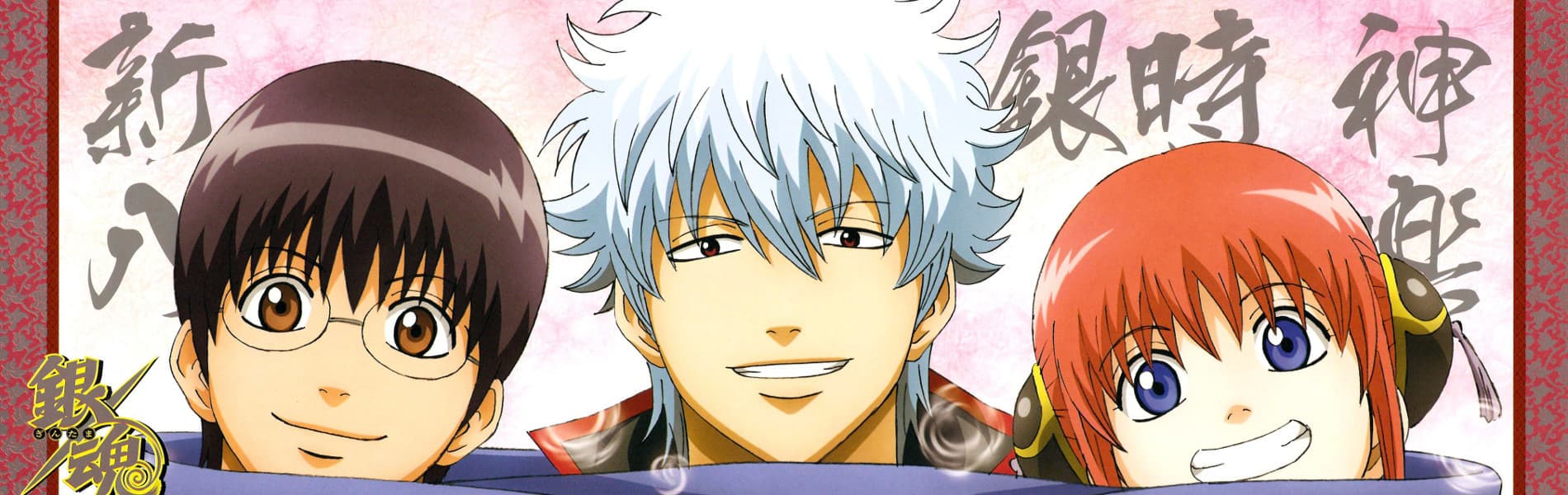

This review will obviously contain spoilers for all of Gintama up to the end of Enchousen, if you haven’t watched Gintama, I totally recommend you to watch it.
Ever since I started Gintama back in October of last year, I knew I would probably want to review its seasons whenever I had the time. My only issue with this was how long season 1 was, taking over more than half of the entire show’s duration, and season 2 also being fairly long that covering all that I wanted to would be a difficult task. But Gintama season 3 (or Gintama’: Enchousen) felt like the perfect starting point for this, because not only is it the shortest season so far, it’s also one of the best ones of this entire show.
So without further ado, let’s break this season.
What’s special about Gintama’ Enchousen is its ability to consistently tell continuous semi-serious and serious arcs in a way that never turns out dull. Thus far, Gintama managed to mix comedy arcs with some serious arcs in-between, this formula has worked wonders, as it managed to make the serious arcs much more compelling thanks to its brilliant way to develop characters in both types of arc storytelling. For example, characters who are mostly used for comic relief end up getting the bigger spotlight whenever they have serious or badass moments. This is majorly highlighted in Courtesan of a Nation Arc, which manages to put the Shogun at a much more different light than what we were adapted to, a character who turned into the punching bag of the show turns out to be a very righteous and compelling ruler who has gained the hearts of all of Edo. Or how Isao Kondo manages to once again become a serious and badass leader, features which were lastly seen in the Shinsengumi Crisis arc, and before that, the Mitsuba arc.

As I mentioned before, this season is a compromised segment of consistent storytelling, starting with the Kintama Arc, an arc where Gintoki Sakata has been replaced by its shiner and more perfect dopplegänger, Kintoki Sakata. This arc mixes pretty solid comedy from new Yorozuya’s attempts being foiled by the perfect Kintoki but also contains a pretty moving message that showcases the ideals behind a main character in a show. As a viewer you’re initially happy to see Yorozuya be so happy-go-lucky with their perfect leader, but soon the cracks start forming with the characters, as they slowly get more reminiscent of the strange figure they once knew as Gintoki. After the pretty comedic harem segment of Mantama, we’re left with the final message from Gintoki to Kintoki, who explains that all of the characters, flaws and all, make up the perfect character for the show. And ultimately, Kintoki ended up being the most flawed character out of everyone in his quest for perfection.

The Courtesan Arc is definitely the highlight of the show, this arc is probably the most important thus far, as it exemplifies the beginning of a major turning point in the whole tone of the show. It’s worth saying that politics in Gintama have been taken lightly for most of the show, ever since the Shogun was introduced to be a joke character despite his role being the most important of the show politically, this aspect wasn’t really its central focus. But Courtesan gives a much wider scope into this conflict, with the Shinsengumi and Mimawarigumi ultimately declaring rebellion against the former Shogun, further heating up the political tension that the premise has set up, as important Bakufu officers have been mysteriously assassinated inside the palace.
Courtesan additionally goes in-depth into Gintoki’s backstory, previously it was mainly fed into the audience through small fractions, most of the information you’d see during the openings of the show up to this point, going as far as Benizakura being the last arc that delved a bit more into the Joi war and the past. Here, they also explain what caused the Joi uprising against the Bakufu, thanks to their easy submission during the Amanto invasion, which threatened the way of life of the Samurai. Back to explaining the past, we’re also introduced to Oboro and the Tenshouin Naraku faction, which is explained that they were the responsibles behind Gintoki’s teacher, Shoyo’s murder.
The characterization is off the charts in this arc, as I explained before, the Shogun and Kondo being given a more serious spotlight works wonders to further develop their roles as leaders, with the Shogun ultimately ending as the deterrent of this whole conflict against Sadasada. The Mimawarigumi gain a massive development in Courtesan, reflected in its leader, Sasaki Isaburo, who was mainly characterized in Thorny arc as an elitist egomaniac, now characterized as a bit of a more selfless person. Similarly, Nobume is also given a bigger spotlight from her previous role as the reserved and poker-faced killer to a much more lively character who is willing to also fight for what she believes is the right cause. Additionally we’re shown that at the end, she’s shrouded in mystery as Oboro explains how she used to be a member of the Naraku like him.
Tsukuyo is also an important figure in this arc, throughout the Yoshiwara trilogy arcs we’ve been given pretty important pieces to realize what her character represents, with the Red Spider arc neatly explaining the burden of solitude she quietly carried. Her relationship with Gintoki also develops greatly in this arc, in Red Spider arc, Gintoki took the role of her protector, and here you can see how their relationship is far more natural and both cover each other's backs during their fights. But alone, Tsukuyo also developed as a protector of Yoshiwara, willing to go as far as confront the former shogun for justice for Courtesan Suzuran.
Even with the Courtesan arc being the highlight of the season, Enchousen continues the pattern of serious arcs with a more lighthearted toned one named the Beam Sword Style arc. With the premise basically being a full-blown parody of Star Wars, this arc manages to be a very emotionally driven story in its short three episodes of runtime.

What makes this story segment special is the insane character moments that occur in such a short amount of time. The spotlight goes into the very undermined character of Shinpachi and Otae, who have to quickly realize that their older brother figure Hajime Obi, has been in reality a robot manufactured by an galactic terrorist group to spark an intergalactic war that would destroy Earth in the process. Both Shimura siblings need to adapt to Hajime’s style of “crying and then smiling” which is genuinely one of the most heartfelt characterizations from both characters, who have been portrayed not very seriously in the past 260 episodes.
But what most struck in this arc had to be Gintoki’s sole moment of him begging the Shinsengumi to not interfere in this conflict and instead protect Shinpachi and Otae while he went ahead and fought Hajime alone. This happening right after Gintoki was being portrayed as sort of an asshole by ignoring both Shimura siblings’ request to save Hajime, the fact being that Gintoki had tried and fought his battle alone to try and save him away from them, so that they wouldn’t suffer. That right there is one of the most impactful characterizations from Gintoki thus far, and across the two aforementioned arcs, there’s an insane development on Gin’s behalf as a selfless protagonist who puts others’ wishes before his own, even if he does not mean it at first.
Sidetracking, on the technical aspect, Enchousen hits it out of the park as well, the animation in the fights continues to be superb. With the fights showing the weight of the blows and how every character fights, whether that is with or without the intention to kill their opponent. The soundtrack is also incredible, the highlight being the 13th opening, “Sakuramitsutsuki” and the Kintama opening showing the complete wrongfulness that the show is going through. Not much needs to be said in this regard anyways, Gintama’s openings have always been amazing, and most have captured the essence of the show’s wackiness and even displayed the tone that the segments will take.
In summary, Gintama’: Enchousen manages to put the best aspects of Gintama on the table in just 13 episodes of runtime. Enchousen pumps out great arcs consecutively which not only serve as major points for development for various characters, some of which were put under a completely different light, but also serves as the beginning of what seems like a major turning point in the whole show. The tones have most definitely shifted, and this combined with the incredibly developed chemistry behind our lovable cast of characters, what comes next may or may not be game changing.
95/100