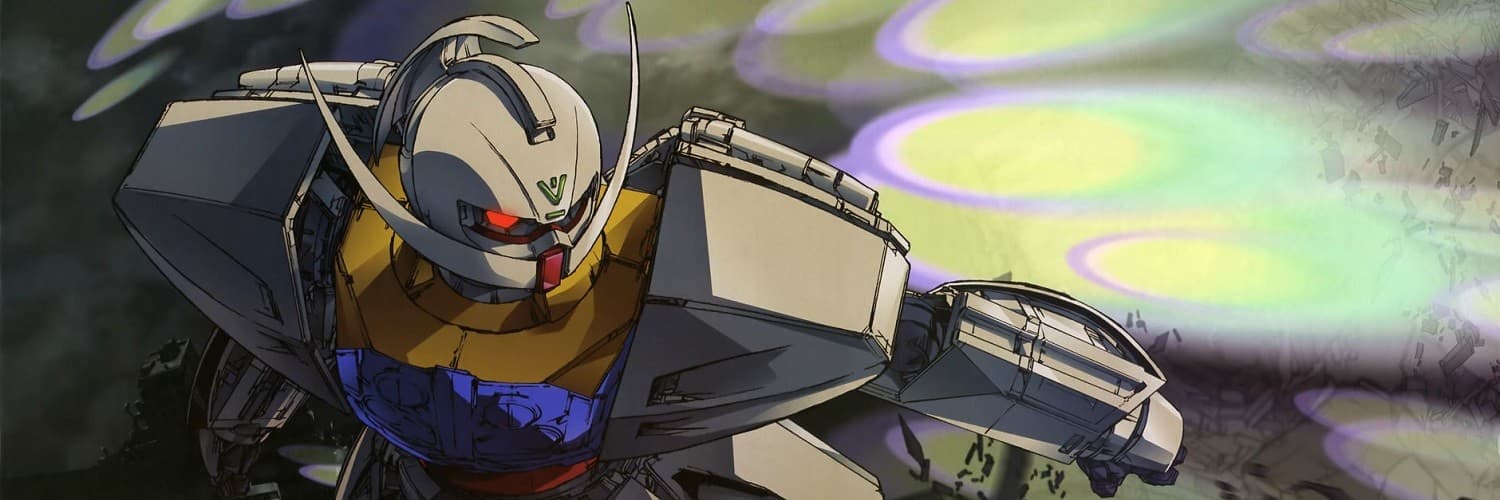
Turn A Gundam
a review by AtelierWeiss
a review by AtelierWeiss
When it comes to the Gundam franchise there are many problems that arise no matter what entry you're watching. They have a habitual issue of not being able to realise their full potential and usually the runtime is more a detriment than a strength as there are either clear portions of a show that is significantly better than the rest or episodes that feel like entirely pointless and, more importantly, dull. This even happens with shorter entries like 08th MS Team, an OVA that has a first half that's bombastic, a rich narrative, intense atmosphere unlike any other Gundam anime and an interesting underlying romance plot developing between two characters on opposite sides. In the second half, the high quality storytelling is lost and devolves into a messy albeit entertaining romance story missing the meticulous yet seamless narrative it once had (not entirely faulting it as the director famously passed away after episode 6 but it doesn't make it any less relevant of an example.)
I've been watching Gundam for a little over a year now and while it's definitely taken hold of my tastes in that duration I feel that besides War in the Pocket and Encounters in Space there's always something that I have a problem with or the runtime feels unnecessary as it rarely gets to do anything meaningful with it. The one other exception I've managed to find is Turn A Gundam, which not only is my favourite Gundam anime it might be my favourite anime period.
The thing about Turn A is that there is a hell of a lot going for it right off the bat. Between its setting meshing the mecha genre together with a victorian early industrial era, one of the most iconic video game character designers ever in Akira Yasuda who worked on Street Fighter III: Third Strike and Darkstalkers, Syd Mead's fantastic mecha designs famed for the art direction of Blade Runner and Yoko Kanno the composer of Cowboy Bebop, Macross Plus and Wolf's Rain to name a few of her highly impressive repertoire you have a show that's not only visually and auditorily enticing but carrying on its back 20 years worth of Gundam continuity while still providing itself as an accessible entry point or standalone series to the franchise. Turn A Gundam conceptually is highly ambitious as it attempts to intercorrelate all the preceding timelines into one taking place thousands of years after them all in an era that long since had giant mobile suits roaming the earth in bloody wars now replaced by the advent of automobiles, trams and jet fighter planes being the extent of technological innovation. That is, except for the Moonrace who have for thousands of years retained the advancements of humanity's darkest eras and ire to descend back down to earth to reclaim it as their birthright. This quickly turns into a battle between two sides of extreme technological differences akin to something like War of the Worlds. A battle of utter hopelessness and brimming with raw energy depicting something that we can only imagine in a fictional landscape.

Everything seems doomed until the ceremonial White Doll crumbles--from the shaken earth or out of a solemn duty, it's hard to say--nevertheless revealing a strikingly unique mobile suit with a distinctive mustache shaped feature, or an upside-down A, if you will. Piloted by chauffeur Loran Cehack, a boy who descended upon earth during a moon-to-earth orientation, the fight between earth and moon of which history has long since left behind continues once more. Turn A's strength lies in many aspects narratively. As a stark departure from the Gundam franchise, in the first episode there's zero combat or mobile suits in sight and instead focuses on the lives of the aforementioned Loran Cehack as well as his two other colleagues and friends Keith and Fran Doll adapting to the unfamiliar earth landscape and establishing their places in the world as well Loran's relationships with key characters that shape the war to come. It sets an atmosphere that's dissimilar to other entries, presenting a world that's far separated from the very idea of war, let alone journeying into space. At least on the surface. While Gundam tends to focus on both sides to present that it's not always as simple as good vs evil, in this case it's far more distinctive as both sides are full of people with good intentions only acting out of the human instinct to fight to protect. It's the antithesis in many ways to Gundam and mecha anime alike, where at times battling is seen as an excuse or means to an end - Whereas in Turn A, battles often feel like a last resort or due to a misunderstanding. Until it eventually devolves into a larger scale war in which the primary goal is to stop it rather than fuel it as a select few seemingly dedicate themselves to repeating the tragedies of ancient history believing their means will elevate humanity.


Turn A often gets the reputation of being light on action compared to other Gundam entries and upon my first watch that was the takeaway I had down the line. But after having watched it again I realised that this is a fairly overplayed narrative for seemingly no reason. Granted the action is less violent and there's more episodes without it altogether but all things considered there's quite a lot of it throughout the whole show. The difference is that the action is generally pretty disconnected from the scenes that come before it. Unlike 0079 this isn't a large scale war spanning across the earth and multiple space colonies where all actions are considered towards moving to the next goal that will inevitably lead them into battle. The battles that occur on screen are largely the extent of the war making for something far more intimate as we see what their actions end up causing for commoners and soldiers alike.
While on the topic of battles it's worth speaking of the animation. Turn A's action is the series at its most expressive and detailed, in many ways but beginning with the titular Turn A Gundam itself. Loran Cehack as a main character is a departure from a few things, one of them being that he's a pacifist and it's reflected in how he fights. As such he relies on using the beam saber or projectile weapons much less and more on hand-to-hand combat to avoid killing his enemies. It makes Turn A's form a lot more robust and fluid, utilising grab techniques, hand chops and kicking which is pretty rare to see in other entries. The animation for the Turn A is consistently fantastic and intricate, with perfect articulation and shading to it as well as other mobile suits.


Syd Mead's work on the mecha designs use sharper shapes and more considered shadows than usual which I imagine would've made for animation more difficult than usual to execute, yet somehow they nailed mecha movement perfectly. There's total sense of inertia and impact and the sound effects always do a great job at making everything sound and feel as weighty as they are. Taking place almost entirely on earth you get a real sense more than usual that they're massive machines of destruction towering over humans that can cause tremors just by punching the earth. The angles that the storyboardists frame the mobile suits make them appear massive and the high level of detail adds to that feeling of overbearing power. Tomino Yoshiyuki, the creator of this anime has stated before on the impracticality of giant mobile suits. While he is undeniably correct, it's nice that despite that he always has a desire to depict them with the realism he theorises they would be like were it conceivable.
Animation isn't just the singular visual strength either. As mentioned earlier Turn A's setting is absolutely stunning. It takes place in a late Victorian era aesthetic well into the industrial revolution where airplanes and cars are starting to become reliable methods of transport and where architectural establishments remind you of the historical buildings of London or France. Earth society as a whole is still quite young in this era though as cities like Nocis which contain buildings briefly mentioned prior aren't far away from farmlands of endless greenery and plains. Life in these cities is very similar to the era it represents, most characters represent the more common occupations you would expect back then. And high society gatherings involve the upper echelon at dance parties in lavish adornments with enough frills to curl you into a pretzel (that was a horrible joke ignore that). Turn A does an extraordinary job at immersion and establishing an atmosphere of a world that feels like it could've belonged in a historical book and yet separates itself from that with the inclusion of the highly advanced technology of the moon and remnants of what earth left behind long, long ago. And despite two vastly different technological cultures existing within the same space of each other, the characters feel so at home with whatever the show throws at them.


Akira Yasuda, more commonly referred to in the fighting game community as Akiman was the character designer and I think the most beautiful thing about it is how much it shows. As someone that's played hundreds of hours of all the Street Fighter games and a bit of Darkstalkers it just brings me so much happiness that such a fantastic artist created the character designs for one anime and that it was able to be Turn A Gundam. His artstyle has an ethereal quality, like his characters are made with a greater intention. It's funny to say that cause Street Fighter's plot is a fiesta just like every other fighting game but it still rings true even in that franchise. There's so much purpose and expression in their faces while also telling you that a character can't be determined solely by their appearance but by their actions. Dianna and Soriel's faces despite being so similar always have this feeling of duality, like they're championing each other's struggles. These are blanket phrases that all vary from person to person, but I really find his style to be a true work of art. The dude made Morrigan and Chun-Li man, I don't know what else to tell you. He's one of the best artistic talents Capcom ever had.


Speaking more on visual merits it's time to discuss the soundtrack. Turn A's soundtrack is as mentioned prior composed by the legendary Yoko Kanno, known for Cowboy Bebop, Macross Plus, Zankyou no Terror, Ghost in the Shell: SAC and many more fantastic shows. The woman's an angel and she creates magic after magic in every show she works on no matter the quality of the work it's present within. And yes, I'm being serious when I say Turn A's soundtrack is her best work. To put simply, it perfectly understands the source material. It feels like it belongs in Gundam so perfectly yet is so undeniably Yoko Kanno that it brings together something that really separates all of her other work from it while also creating many of her finest musical moments that speak to me as a musician. Compared to Cowboy Bebop or Macross Plus which display her varied style through jazz, art pop or trance, Turn A's focus lies more on the militaristic and ethereal qualities of the narrative and setting. It has an appeal from country bar music, bombastic orchestral pieces, melancholic string sections to even tribalistic choirs. The soundtrack perfectly captures the essence of the show. There are many motifs that make appearances throughout multiple tracks, one of the most significant being "Moon". A track considered by many to be the best in the entire series which also contains the military drum line which is a repeated element throughout the soundtrack. The way it's able to weave together otherworldly qualities that make you feel the breadth of thousands of years coalescing as well as the immediate sense of huge action set pieces and modest farmland makes the show connect with your immersion on a level that's unlike anything I've ever experienced. There are so many tracks that get used at particular moments and you know they're coming because they were made with that moment in mind. It invokes a degree of emotion that only my absolutely favourite shows can hope to get out of me.

Touching more upon the characters, the cast is varied and an absolute treat to watch. Turn A characters are complex but aren't executed in an abstract or pretentious way. It's a complex narrative and as such the characters involved have their motivations and personalities explored deeply so that by the end you know their ins and outs. I think one of the most evident reasons on why the cast is so liked by fans is that there aren't really any evil characters but people that all have varying good but flawed intentions. There's a desire for earth to remain autonomous from the moon as is the case on the other side, moon people who wish to fight for their right to land or vehemently oppose the descent to earth, earthlings who wish to take control of the moon's technology so that they can have the strength to fight off the moon should they decide to keep trying. Most characters don't have the desire for destruction, though certain plot points build up to that point that reflect upon the series and franchise as a whole. Turn A isn't about praying for the era where people can find peace and understanding without the need for battles, Turn A IS that era. The characters being slightly less animated compared to Zeta or 0079, slightly less exaggerated in their ambitions and more in line with real people that experience real horrors that aren't romanticised the way they usually are. A character's death in 0079 for example may be due to their ardent loyalty as a soldier or war accomplice. Civilian deaths are just a part of the endless trail of violence left in war's wake. Deaths in Turn A happen less between soldiers and shine light more on the people who don't fight to remind the characters and the viewer that the battle isn't about what you win, but what you lose. Soldiers can be replaced, but people can't. Turn A is about the healing process of humanity and the earth itself making every death feel regretful, like we're falling down our usual path of error.
I've talked about Loran Cehack before but I feel like I haven't given him and the main cast enough credit that isn't vaguely distributed on them. Loran is of course the main character in this show and the pilot of the aptly named "White Doll" or "Moustache" as it's called throughout most of the show. Personally I've always found Gundam protagonists to be a massive strength to any entry directed by Tomino Yoshiyuki due to their outspoken personalities that convey the heart, soul and salvation of war. Amuro Ray, Kamille Bidan or Judau Ashta always have consistently strong dialogue critiquing the actions of not just the side they're fighting but the side they're fighting for. They're soldiers that expect no thanks because they're always thrown into a battle they have no interest in fighting as they watch their loved ones and comrades die senselessly. Loran is the pinnacle of this style of protagonist and in addition to it innovates in a few ways. Loran loathes violence and desires to fight even less but unlike the aforementioned characters he's willing to put himself on the line to get his message across. The three Universal Century protagonists tend to repeat a few character arcs that involve them rejecting the war they're in until eventually realising or coming to terms that even if no one wants to someone has to be there to fight those battles, because in the end people are going to die and they had the power to make less die. What differentiates Loran is that he doesn't fight because he has no choice or because he's trying to save someone or a certain side, what he desires is for the violence to stop. Coming to earth made him realise how beautiful of a place it is but he still cherishes his homeworld on the moon. It's hard to execute characters that are neutral but endearing because you wish they'd just pick a side and defeat the other. But Loran's actions as well as the characters surrounding him make his actions feel like the right thing to do. No side is wrong, as opposed to the Earth Federation vs the Principality of Zeon where both sides had no interest in seeing eye to eye and Zeon was very clearly in the wrong at the start of the war. The moon race only fled earth as a necessity and those left behind were simply unlucky or not a part of the high society granted rite of passage to the moon. It's reasonable to believe earthlings aren't affable to a group that left earth for dead and attacked them upon their initial return.


The political discourse of this show is fantastic just for how much you hate that these two reasonable sides think that they have no choice but to fight each other. And Loran knows how bullshit it all is, which is what eventually leads him, Dianna Soriel & Kihel Heim into influencing the landscape of the war the way they do as characters change sides, gain new ambitions and eventually led down a path of understanding. Also as an aside to bring up it's also kind of great that Loran crossdresses a few times.


Dianna and Kihel are the other two characters that are central to the plot, possibly more so than Loran. While Loran does play an important part at conveying his message to the viewer, Dianna and Kihel are the ones who are able to spread their words to the masses. It can be easy to look at how Dianna and Kihel are handled believing that it's unrealistic for them to be able to portray each other so quickly but this is something that I actually respect the show for how it's executed. They're both given more than enough time to get to know each other and both take fairly prestigious positions. And besides that they do almost get caught in the lie, it's just assumed that there's no way a civilian would swap places with a queen.

The swap is one of the reasons why this narrative works so well and how it truly succeeds. 'The grass is always greener on the other side' or quotes to similar effect - What's believed to be an amusing little joke quickly turns into opposite sides dealing with the trials and difficulties that come with being in the other's role. One scene that I think really makes it clear with how good it is at making you understand the show is a scene during episode 10 that where Dianna instinctively reacts to a situation Kihel has been put in due to the past few battles in her place. Another similar scene occurs past the halfway point where Kihel speaks on Dianna's behalf on the current state of the war. Their growing deep understanding of one another is the main catalyst that brings the war in the direction it eventually leads - The people who wish for war to end, and those who wish it to continue.

I'd go further into detail and talk about Sochie and others but I feel that what they represent I've already touched on quite in-depth so I'd just be repeating myself. Instead I'd like to touch on Corin Nander, a minor character but a very strong one. Corin is the messenger of the past, having existed in an unknown time when war did ravage the earth and moon. He fears the Gundam and what it represents which is interesting. He refers to the Gundam as a war machine, which in context almost belittles the past efforts of Amuro and the others. It seems simple to take this information away but the way the story just tells you that hundreds of episodes of war, relationships and sacrifices amount to being nothing more than historical battles is seriously unsettling. Turn A very bitterly explains that the past actions were all pointless and only served as vessals of information to be relayed to future generations as the follies of humanity.

Turn A's final act is a form of divine or spiritual retribution. It represents many things; an end to Gundam, an end to Tomino Yoshiyuki's emotional journey of 20 years and a new beginning. A world that for the first time knows uncertainty. Corin's dialogue coincides with this idea being represented by the Gundam itself. Gundam may be a saviour or a hero to the victors, but to history it's merely a destroyer. We never know where humanity is going to go but simply being able to have a positive outlook can be enough to see the steps we can take together. Turn A Gundam is a show that shakes a person's empathy for the human race to its very core. At least, that's what it did for me. I know it's not a perfect show, and I accept that. But either way, for me it's something really, really special. It's a show that's near and dear to my heart. The fact that a pessimist and highly depressive person like Tomino was able to battle his mental health problems and create a Gundam entry that stated after all these years a response to earlier entries that there's something more to life than our stagnancy and reliance on war, hate and to remain ignorant of our past mistakes just made it resonate with me in ways I find hard to describe. People may tell you that being told our past mistakes should be reflected upon is a no-brainer, and yeah it is. But this show asks you that question anyway, because even though you know that the past involves many human errors there's a refusal to actually accept them because it's difficult to. People may also tell you that earlier Gundam entries are necessary for this show and I understand why people believe that. Without them, you lose the journey Tomino created. But I'm not gonna be the guy that puts a gun to your head to do things how I tell you to. Turn A Gundam is a phenomenal show solely on its own merits and it deserves a watch by anyone who enjoys mecha anime or simply wants a story full of adventure and visual creativity that represents many different aesthetics culminating to make something truly unique.


74 out of 77 users liked this review
