[The review covers both the first and second season of this show. It's not the type of story which gets ruined by spoilers, but just in case I have put a section of this review behind spoiler tags to hide a few important character details revealed roughly six episodes in for those who do really care about going in blind.]
One thing I was always amazed by while reading Hitoshi Ashinano’s beloved iyashikei manga Yokohama Kaidashi Kikou was its funky sci-fi cameras. Early into the series, the protagonist, an android woman named Alpha, receives a state-of-the-art camera as a gift in the mail, and quickly becomes inseparable from it. But Alpha’s camera is far more technically advanced than a contraption that simply records a photographic image of the environment in front of the lens. Instead, it acts as an effective conduit for Alpha’s very consciousness - biting on a cord and shutting her eyes, we can (literally) see her mind’s eye travel inside of the camera and see through the lens. Rather than just taking a photograph of what’s in front of it, her camera takes a snapshot of the mind of the photographer at the moment of capture alongside it. Photography, an already powerful tool for intimately personal exploration of memory, becomes something intoxicating, heady and overwhelmingly emotional. Revisiting the past becomes a way of not just revisiting a memory but revisiting a past self - adding not just the senses of smell, sound, taste, touch to that of sight, but adding a direct, perhaps uncomfortable encounter with a past mind, and with it a past self.
You might wonder why I’m using a totally different manga of a totally different genre by a totally different author to lead into a discussion of a totally different television show. But Yokohama Kaidashi Kikou has a lot to say about nostalgia and the desire to capture the fleeting emotions of a life once lived, and I think Honey and Clover isn’t too different. See, when I think of Honey and Clover, what first comes to mind isn’t a specific character, moment, or ‘arc’. I think of a lazily revolving ferris wheel dimly lit by the moon and the tiny, blinking lights on its cars pulsating in the gloom. Evening conversations leaning on the railings of a building roof blurred in a haze of wispy cigarette smoke. Inner monologues punctuating the otherwise fraught quiet of a night-time stroll down the riverside path, returning from a long day of art-making to the familiar, ramshackle but homely complex of student flats which our cast call home. Thinking about these things yanks me straight back to the moment, to the feeling, in a way I didn’t expect to later feel and feel so vividly when I was mid-show. I can tell an image is powerful when I can almost taste it, I can almost smell it, I can almost hear it, I can almost feel it. When I can feel myself seeing the me I was when I watched it. More than any other anime or manga that’s immediately coming to my mind, Honey and Clover crafts stirring imagery not just through its authors’ visionary eye for image alone, but in a manner as if soured and sweetened in the recesses of memory, to become at the point of delivery to the reader itself nostalgic. It's enveloping, comforting atmospheres can be sublime.
And I think talking about this show more than most others demands speaking in a bit of an abstract and esoteric way like that, to tease out a lot of information on the shape of its personality and character as a work in a way drily recounting a synopsis or series of plot points or its technical qualities can’t. This is because I think it’s a challenge to put into words what makes Honey and Clover tick - it’s a contemplative, introverted work where the emotional essence beneath is difficult to submerge to by simply rattling off facts about its surface. But it’s also because at the surface it might seem unremarkable, and as such is difficult for a reviewer to find their route ‘in’.
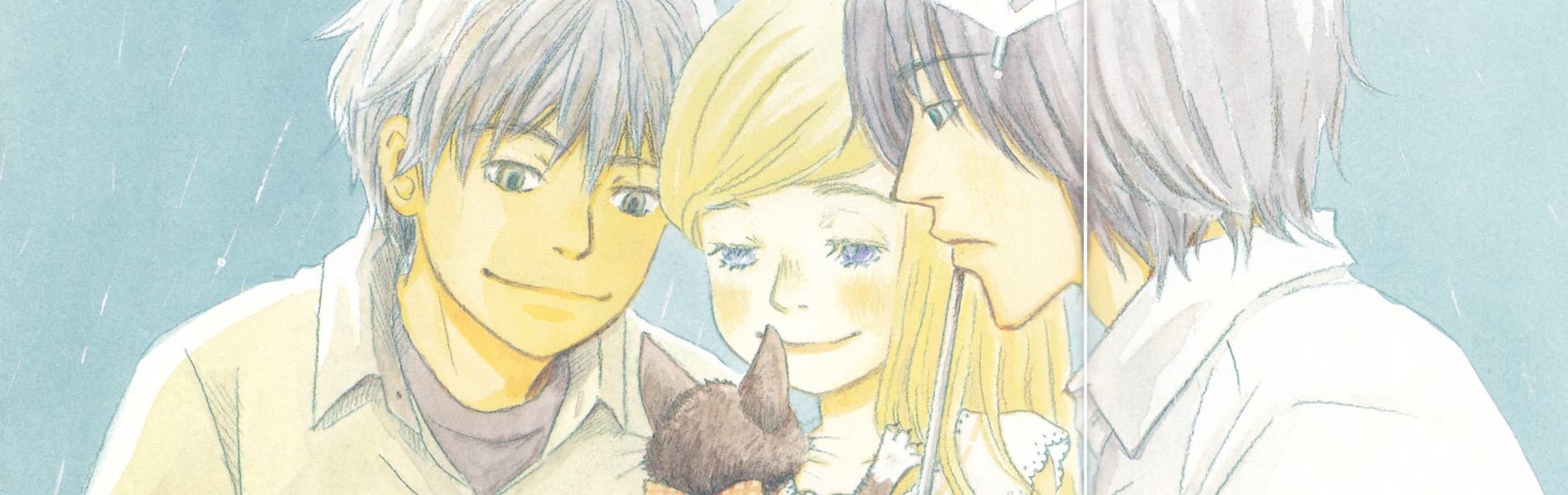
The basic premise of Honey and Clover is that it’s a slice of life series about the lives of five students at a Tokyo arts university, an art lecturer they’re all close friends with, and a small handful of close acquaintances working as designers in local architectural firms. It tracks these five students - not kids anymore but not quite adults either, all with a lot on their mental plates to chew through - as they grapple with their futures and finding their ‘place’ in the world through precarious, shifting relationships, through family, through grief, through disability, through first loves, unrequited loves and love triangles (...actually quite a lot of love triangles).
But I think the angle to better funnel a reader in on what Honey and Clover does is through its structure. It's a show that uninterested in typical structural form in two fascinating ways I'd like to delve deeper into:
First is how it structures its cast. Quite atypically, it’s difficult to point to a ‘protagonist’ of the series. The closest, you might argue, is Takemoto, as the person most often given the reins of narration and from whomst the narrative perspective of the story is filtered. Yet, in terms of raw screentime and character development, and being at the ‘centre of the story’, Takemoto arguably gets the least attention of said five for at least the first half of the opening season. Admittedly, he does get some fantastic, touching character development in the latter end of the first season, a current carried further through the second season, and he has one very memorable early-ish episode in season 1, helping to balance this out in the long run. But what I'm trying to get at is that Takemoto comes across to me like a side character of his own story. I was quite surprised to see him for much of the show sit as little more than a bystander on the edge of character arcs such as those between Rika and Mayama, Ayumi and Mayama, and Hagu and Shinobu, which consume much of the attention of the first season - both as an unassuming, quiet person who rarely takes the stage of his own life, and as someone literally not too personally entangled with at least the first two arcs mentioned. The show could relatively easily just exist without him - which is a pretty strange creative decision! But I think in practice it’s actually refreshing. I thought it worked well, especially when I feel the work never had any pretenses of being ‘Takemoto’s story’ and instead wanted to be ‘Hagu, Shinobu, Ayumi, Shinobu, Takemoto (and I’d also argue Rika’s, Nomiya's and Shuuji's) story’. It’s decentralised in a manner not at all dissimilar to Baccano!
Second is in how it structures its narrative. One thought that strikes me both in this show and in March Comes In Like A Lion (March, herein), the manga Umino created after she completed Honey and Clover, is her glee, almost, in bucking traditional narrative convention. Honey and Clover’s anime starts basically in medias res, but doesn’t particularly care to fill in much of the ‘before’ beyond contextual cues. It feels as if we are a couple episodes into an existing story - Takemoto is already a second-year, Ayumi's already head over heels for Mayama, Mayama's already head over heels for Rika, and they've been like this for a while now. Instead, the springboard the show leads off with is the entrance of Hagumi ‘Hagu’ Hamamoto to the university. She's a supremely gifted yet quiet and anxious young girl and the cousin of Shuuji Hamamoto, the gang’s art history teacher, friend and coffee/smoke break buddy, and a friend that he sees like a daughter. Takemoto and Shinobu immediately fall head over heels for Hagu and spend most of the series realising and reckoning both with their feelings for her and how to express them. The mysterious absentee and overall goofball Shinobu is aloof, finding fun in teasing her and making a fool of himself, while still working in his very on-brand mysterious ways to bring her strange gifts while acting as if he’s more emotionally detached than he is. Takemoto takes a more direct approach as a friend looking out for her at every turn and an emotional pillar she can cry on. But the development of feelings between the three, acting upon them, and the shaping and reshaping of their bonds is a very slow burn that plays second fiddle to a very slice of life, almost nichijoukei sensibility in places. What seems to be more of a focus of the opening cour of the show after a few episodes comes into focus as the relationships between the students Mayama and Ayumi, and Mayama and Shuji’s ex-university buddy and architectural designer Rika, which really feels like the major thread here that’s been observed partway in. From the start the tensions that define the love triangle - Ayumi’s deep love for a Mayama that only has eyes for a Rika herself with a gaze fixed elsewhere - are defined, set in stone, and effectively finalised months before the opening scene.
And more broadly, character development feels unmoored by sensibilities of discreet ‘arcs’, or the convenience of suiting a certain ending in mind. It seems largely uninterested in typical ‘big event’-based pacing and building towards specific ‘goals’, aspiring to be the twisty, meandering river flow of interconnected lives rather than a straight railroad. As such it feels like an estranged sibling to both the nichijoukei and iyashikei spirits, absorbing fundamental principles from both. What comes through is a philosophy focusing solely on building a character as their own entity and bending everything else in the writing process around that priority, whereas in most other anime and manga you’ll find rather the opposite approach taken - bending a character around an initial idea of a poetic setpiece, battle or conclusion, etcetera. Character development, because of this, is startlingly… natural? Characters- Ayumi, Rika and Mayama all come to mind for this - are at once endlessly stubborn and set in their ways, yet you can see once one snowball falls change avalanches as an individual blossoms, sometimes rapidly, into a new version of themselves. It feels genuinely real and refreshingly honest, as if this is an actual life rather than a story attempting to grasp at an approximation at one.
As a brief but important tangent, I believe it’s why Umino’s writing is so regularly littered with such profound quips and insights a character has about their surroundings - you can almost feel the dozens of nights spent in front of the desk, mining their headspaces for the tiniest, most simple details about not just who they are as a person, but how that translates into the way they experience their lives at the most basic, elemental level. And I think THAT ties right back into Umino’s talent for symbolic storytelling through striking abstract imagery I mentioned at the start - that eye for the ways other people might think about the world that’s informed by more than a few spoonfuls of unconditional, all-encompassing radical empathy. It’s not just the use of imagery to sublimely craft atmosphere, but the use of symbolism for both complicated and emotionally immediate storytelling - the sea of Hagu’s ‘boxes’, an ocean of ideas locked in her mind, that she recognises can't be fully excavated even in the space of several lifetimes, establishing just how differently an artist experiences time itself; Takemoto’s bike wheel, representative of his journey as a revolving (ha) motif throughout the show; and the ferris wheel (which I think is also meant to evoke the bike wheel), as the centrepiece of the first season’s ED and visible in certain shots of the city skyline, and later explored in further detail as a physical setting in one of the most vividly memorable scenes of the entire show.
It all comes together to give the impression of an author who takes you straight into the tall grass rather than following the forest trail… to a fault. I think March is a great point of comparison, as a work by the same person with many of the same stylistic fingerprints. From the very beginning of March, it makes itself clear that it’s a story of Kiriyama Rei, his mental health, his complicated relationship with professional shogi, and of the power of found family to pull him out of a pit of despair, focusing attention on the games he plays, his walks around the city, his room, the glowing, abundant warmth of the Kawamotos' tiny house, and the thoughts he has about them all. It’s only really in the second season, and in the unadapted manga following on from it, that it mostly takes the approach Honey and Clover takes instantly - to send you deep into the bushes with no map or compass. Apologies for overly labouring the metaphor, but I think Honey and Clover taught Umino that it’s better to get lost only after you’ve journeyed a little down the path and made your viewers feel comfortable enough in the forest to want to wander endlessly with the friends that made along the way, paying no heed to the destination.
I feel in the above I’ve done enough to give a sense of the broad strokes of what Honey and Clover is and what makes it tick, so for a little while I wanted to talk more specifically about detail. So I’m going to spend some time talking a little about my favourite interlocking dual character arc, one that's really stuck with me over the six months or so since I completed the show. Spoilers for reveals in episodes 4 and 6 for the rest of this section, so I'm sticking it all in a spoilerbox:
It’s astoundingly delicate and empathetic in a way that should crumble upon touch, yet just doesn’t. Mayama’s internal struggles to control his overwhelming feelings for someone not yet ready to love once more, the way it plumbs the mind of a Rika living under the weight of crushing grief, and the way in which the show finds him tracing his fingers down the cracks of her splintered glass mind, unable to look away, struck me with its poetry and beauty. The way it explores her experience and her psychological adaptations in the face of grief are powerfully raw, delivered in a way I can only think of Clannad After Story and last year's Heike Monogatari of weebshit I've seen that I found similar in both theme and affect.
I could point to a lot of reasons why I think it works so well. One is its tight control of theme: the show has a lot to say about the process of moving on, slowly building to a point you can forgive yourself, and slowly building to a point where you can even fathom loving another person. Another is the way in which Rika and Mayama's relationship evolves so naturally, fitting both Rika and Mayama's outwardly restrained and disguised but internally howling feelings they don’t know how to process or control, with the show just intrinsically understanding the act of reflexively responding to seeing yourself feeling as a way of knowing yourself. Another is that it really gets how relationships, especially particularly fraught ones such as Mayama's quest to dodge his way through a minefield of the rawest of traumas, can be a game of cat and mouse, of false faces and boundaries and walls to butt against that aren't necessarily representative of the true, but sometimes buried feelings of those who establish them.
In fact it could have very easily ended as a really uncomfortable, wince-inducing story had it simply wobbled off the tightrope - from Mayama's obsessive watchfulness that occasionally lurches to the borderline of actual stalking, to his treading and nudging of Rika's emotional boundaries. Furthermore, it could have easily come across as exploitative of Rika's vulnerability, once contextualised in the fact Mayama's chasing so desperately after a woman who really is unwell, scarred with survivor's guilt and trauma, a hollowed-out woman living for little more than obligation. It's a very different story, but it brought to mind Nadeko's arc in Monogatari Series Second Season in that it’s eager to dive into what could easily turn problematic but survives and thrives due to the cleverness of its navigator. In both the unflinching curiosity of a writer eager to explore the deepest of complexities of how human minds think powers its storytelling, a curiosity that seeds a resounding empathy and refusal to oversimplify or stereotype.
Somehow it works, and works perfectly. And the reason, in my opinion, stems back to my earlier point that this is a show about lives, a show that to a fault obsessively builds its characters as if they were real people and structures itself foundationally to fit it. As such no action feels unbelievable, unjustified, or beyond understanding or forgiveness, because the show is so empathetic, it represents problematic and flawed actions from a place of tenderness and understanding rather than for condemnation or a voyeuristic glee in exploitation. What's essential is that its written with such heart and empathy. It visibly comes from a place that insists against the framework of 'good' people and 'bad' people, instead arguing we're all somewhere in the murky grey, that most people will at some point do something questionable or hurtful, but always for reasons that we can deconstruct, historicise, contextualise and then examine and understand in context. It resonates because it's a philosophy I not just deeply agree with but think is essential to grasp how people and the world at large operate, and a principle I always try to apply to my personal politics. It all comes together to make a """"romance"""" (it feels strange to say here) unlike any other I've ever seen. It's characterisation at its most delicate, navigating some quite heavy and sensitive subject matter with impressive deftness.
I admittedly talk about Chica Umino here for an outsized amount of time in this review. This isn't a manga review after all, it's about an anime adaptation. However, I feel justified in doing so for a couple reasons. I'm very familiar with the quirks and idiosyncrasies of Umino as a writer and find them both immediately recognisable and deeply important to how her works function, even when 'once removed' from her hands in adaptation. Finally, I think its 'faithfulness' and lack of much identity in its adaptation lead me to to its source rather than into researching the anime project's staff to speak to the show's spirit and identity.
I just want to expand on that final point in particular, because I think it leads into a really important point about Honey and Clover the anime adaptation, as opposed to Honey and Clover the manga. I felt as an adaptation, it doesn’t have that distinct of an identity for itself. Admittedly I found some of its art direction to be really striking, particularly in its first OP (blockily coloured live action stop-motion dancing food replicas?) and its much less ambitious but none less memorable first ED, but for the most part it's simply passable, it’s just 'fine'. In terms of its cinematography and direction, it doesn't turn any heads. Again, it's simply serviceable enough not to become a hindrance, rather than standing out as a strength. I can't help but think of the ingenious direction, punchy storyboarding and iconic art direction (from backgrounds to colour usage to character design) from the adaptation for March, dart my eyes between the two, and feel disappointed. March is a show that absolutely compels the name 'Akiyuki Shinbo' to your lips in the same breath as the name 'Chica Umino'. Comparatively, I feel no such compulsion with Honey and Clover.
Before I conclude, I wanted to round up a handful of miscellaneous points I couldn't find a good spot to fit elsewhere:
Honey and Clover is a strange show that won't be for everyone. Hell, I wasn't the most fond of it myself at first, and Umino is either my favourite or second favourite mangaka. Issues with the first season had me feeling a 6 or 7 mid-watch, settling at a 7 by the end. Fast-forward half a year and I think of it fondly enough that I had to bump it up to an 8, ending up in the same tiering rung as its sequel.
It's off-kilter structural whims may be off-putting for some; its characters take a little while to 'get rolling'; Takemoto is an oddity of a protagonist choice in spite of being quite well-written, that for some I'm sure will not click; its animation is pretty limited and very unambitious and its storyboarding is pretty static to suit.
But in spite of its issues it's still a really fascinating character study and romantic drama, one with quite a unique setting, and one that does a fantastic job of exploring the psyches of not-quite-adults unsure of who and what they are or where they’re going. It's a connoisseur of ~quality vibes~, gazing longingly out over rivers at night, watching the reflection of the moon through clouds of cigarette smoke.
I hope you'll give it a shot, giving it the chance to wrap you up in its nostalgic web of little lives.
17.5 out of 18 users liked this review