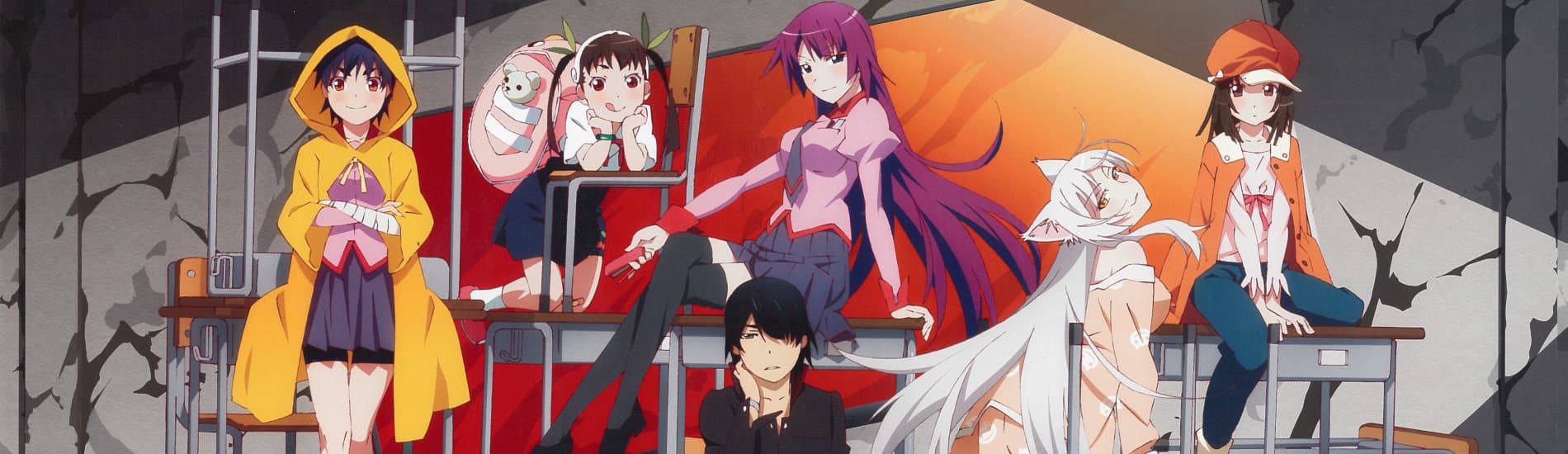
Bakemonogatari
a review by Wilza
a review by Wilza
#####This review is spoiler free.
Anime, or more specifically episodic anime, is often bounded by constraint. Shows do the best they can with what they’ve got. Corners are cut and animations are optimised in a certain way. A budget is a budget. All in all, this corner-cutting has created a global style for anime that we take for granted and this is not at all a bad thing. Bakemonogatari, however, feels totally unbound by constraint. Bakemonogatari is a show that just looks and feels ultra modern. Animation feels silky smooth and the fast-paced editing is a delight for the eyes.
The show feels like it was free to leave every corner uncut, but it’s really hasn't. It just cuts different corners. So, in a glaringly obvious sense, it’s these choices that seperate Bakemonogatari from other anime and make it stand out so much.
It’s very easy to show two characters walking down different but very normal streets talking over the phone. The urban landscape is so familiar, a viewer doesn’t even notice the trees, cars and lampposts that the animators have populated the scene with. A scene comes to life when these basic details are included and would feel weird without them.
And it’s not difficult to imbue such a scene with meaning. Perhaps one walks down a road lined with with trees and bushes. The other walks down a busy street vibrant, busily so, with colour and noise. Now the physical separation of these characters is punctuated with an environmental separation.
What’s difficult, though, is throwing this out the window. It’s a damn phone call. The viewer has been following the main character, they know where they are and what’s going on, so what’s important is the other character. So how do you show that? Go.
A shot of the character in a park, not a tree in sight, the swing-set is solid red. The character walks down the road, cars rush past, every one of them the same, white with a black roof. A shot of the electrical tower, wires and cables running like branches - the trees of this urban landscape. Cut to intertitle: black. Cut to shot of the character leaning against a chainlink fence, the lights of cars rush past behind her. Cut to shot at a seperate location; a construction yard - messy and busy with signs and warnings - with writing on the screen, it’s the main character’s simple response to the caller. Cut back as the character crosses a busy road, all the cars are identical. Cut to intertitle: black. Cut to character standing on an overpass, rows of cars behind stuck in traffic, they are all the same. Cut in, close up of the cars. Cut back, close up of the character. Cut to shot of her phone. Click.
Pause. Go back two minutes. You just missed all the dialogue. You were too distracted, but not by something else. “I watch anime, how did I just miss all the subtitles?” you ask yourself. Two minutes pass. You’ve watched the scene twice and enjoyed it twice, once for the style and once for the dialogue. It’s easy to miss things when both are so damn good. But keep up. The show won’t take it slow for you.
And it is exactly this pacing, on top of everything else, that I love about Bakemonogatari. Everything from the writing to the editing is snappy. Dialogue is clever, but not bloated. Where many shows would use exposition, making sure to not lose anyone, Bakemonogatari uses it as a last resort. Instead, it expects you to keep up. They explained this once, if you missed it: tough.
This snappiness can be contextualised by looking at where Bakemonogatari’s approach diverges to a very common trope present in a lot of anime that unfolds as follows:
Boy: “Oh you know I was talking to Joe about this.”
Girl: “Oh, Joe… what did they say?”
Cut to flashback of Joe and the Boy, showing what Joe said, as it was shown earlier in the same episode.
Boy: “Uh, they said… [paraphrase of what Joe said]”
This means we hear the same dialogue said three times. This is slow, much too slow for Bakemonogatari. In a typical anime, the writers want to make sure you know exactly what Joe said, but we do know what Joe said, we saw it already. So how does Bakemonogatari address such a situation?
Boy: “Oh do you know this thing about Joe?”
Girl: “Yes I do. But why are you asking about Joe?”
Cut to intertitle on which it is written “Time passes”
Girl: “Ah, I see.”
Efficient, simple, good. While it’s obviously not revolutionary to skip the flashback, the aversion to repetition is taken a step further by cutting out the paraphrasing. This really adds to the quick pacing that the show spends so much time establishing. And really, when anime is so rife with flashback and over explanation, not doing it feels refreshing - the first time this happened I smiled because I felt respected as a viewer.
This trick of Bakemonogatari is really the centre of why the show is executed so well. The intertitles are such an interesting and unique choice and they are used to such a great effect. Often in anime, the problem of needing to show a number of things very quickly, but very cheaply is answered by not animating them, instead just drawing them. Single image. Cut. Single image. Cut. Single image. Maybe add a bit of motion and parallax, but otherwise leave unanimated. Easy and cheap.
Bakemonogatari takes it a step further and exploits the intertitle. Don’t even draw it, write it. And this follows the same valuable ideology behind dramatic writing: be conservative - if you don’t need it, don’t write it. Does this absolutely need to be animated? No? Don’t, then. Instead, Bakemonogatari just shows a blank, potentially coloured, frame with writing on it. While a picture says a thousand words, it takes time for your eyes to read the picture. And it takes but a moment for it read a line of text, and then they can cut again and keep up the pace.
The intertitle is exploited as an extra aspect of the medium to great effect, and Bakemonogatari’s successful use of it can be largely attributed to the self-awareness the show has about itself. The intertitles are self-referential, often numbered (e.g.: “Animation No. - 94”) or merely labeled as “black” (“kuro”). Even the title card for each episode includes information about the font and formatting it uses.
Beyond the intertitle, Bakemonogatari creatively pushes boundaries by incorporating many different mediums into the animation of the show. Most strikingly, perhaps, is the use of photography, which is often deployed to create a feeling of unease. The show liberally uses CGI, and too a much less jarring effect than is common with 3D rendering in other anime. And it seamlessly jumps from this into small pop-art-esque comic book gags or into to watercolored animation or to hand-drawn sketching. And in of itself, the myriad of styles is deployed so seamlessly it adds yet again to the fast paced nature of the show.
As a short aside, I would like to take a quick moment to talk about how much the creators of the show clearly love old cinema. While I could write for hundreds more words about it, really getting into the weeds about niche references to cinemascope and other classic cinema, I will keep this section short. As such, I think above all it is worth mentioning the work of Jacques Tati, particularly his landmark film Playtime. Bakemonogatari’s landscapes and sets are filled with visual references to Playtime. Grey repetitive buildings and identical cars create soulless streets for a grand satirisation of modern consumerist life in Tati’s work. And in Bakemonogatari the same visual motifs are used to creates a brutalist and lifeless world in which the characters inhabit, the result is not satire (although the show does draw upon satire at times), but rather a bleak background to an urban fantasy.
For the sake of making this review readable, I will put a pin in my thoughts on Playtime. However, if you enjoyed how the world of Bakemonogatari looked, I would recommend Tati’s masterpiece, with the caveat that it is not at all similar in any other regard to Bakemonogatari. Much unlike Bakemonogatari, Playtime is slow and features minimal dialogue.
While much of this review has discussed where Bakemonogatari steps away from the crowd of anime, it is important to finish with a discussion of an anime that it is stinkingly similar to. Aside from the visual style of Bakemonogatari, Rascal Does Not Dream of Bunny Girl Senpai is a very similar to show. While Bakemonogatari is unambiguously a more stylish show, it’s difficult not to notice that Rascal Does Not Dream’s plotting is more dramatic and the romance and characters feel more compelling and believable.
In Bakemonogatari, the writing is very good but characters speak in these somewhat unrealistic ways. It works incredibly well with the pacing and style of the show, only adding to the uncanny and unlifelike feeling of the setting. It has very effectively written dialogue for what the show wants to be and in that regard it’s hard to fault it. But. It also makes the characters less relatable and less compelling. So when comparing it to Rascal Does Not Dream, Bakemonogatari can feel like weaker show. From a purely visual perspective Bakemonogatari is leagues ahead of most anime I’ve seen, but it also has to tell as story and I’ve seen the same story done better. With that said, I think if you have watched neither Bakemonogatari nor Rascal Does Not Dream, watch Bakemonogatari first.
So despite this minor criticism, I want to reiterate: Bakemonogatari is a feat against constraint. The show is phenomenal and gorgeous and a million more words. I truely cannot recommend this show any more. Do yourself the favour of watching it.
82.5 out of 93 users liked this review
