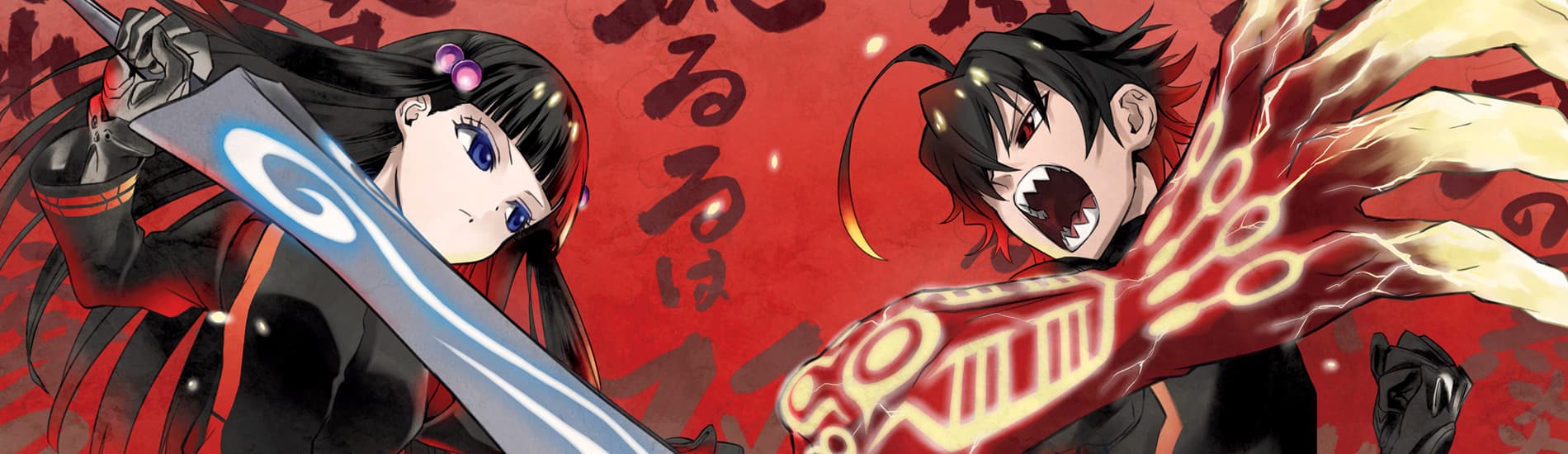

What exactly is a battle shonen expected to be? To generalize, a majority will contain, at minimum, elongated fight scenes, power systems, and transformations; elements that help demonstrate the action and elevate the battles. That said, romance isn’t typically the most notable part of a battle shonen. Sure, some protagonists have a love interest but these kinds of character relationships are rarely dynamic, in any sense of the word. To be fair, these manga aren’t a part of the romance genre—they are action series—and romance is just a backdrop. But, what if that wasn’t always the case? What if a battle shonen came along and treated romance as something pivotal to the overarching story, character motivations, and even action?
Twin Star Exorcists is that manga. If you’ve ever wanted to see a battle shonen that uses the relationship of two characters to drive the story forward, Twin Star Exorcists lives up to that. No longer is the love story a backdrop to battles. Instead, both halves are given equal attention. Additionally, the relationship between its two main characters is used as a fundamental part of its narrative. For once, romance is the key ingredient. This is how Twin Star Exorcists is one of the few manga to turn a battle shonen into a romance. (Also, my artwork was retweeted by Sukeno, so my word is basically the undeniable truth.)
This opening section isn’t specifically about Twin Star Exorcists, but bear with me—it will all be important for the discussion going forward (have this cute Rokuro and Benio art to tide you over). To offer a bit of contrast, it would be helpful to first understand how romance is often treated in battle shonen. If I were to give an anecdotal view of how these manga pace their romance, it’d be something like this:

When condensing this graph down to only romance, the full span of these manga dwarfs the time spent on the romance. Despite taking up such a small percentage, it’s pretty common for romance to be a long-term subplot. The basic structure is to introduce a love interest early on, one likes the other for easy-to-understand reasons and, by the end, they end up together. For extra credit, maybe they have a kiddo or two. Point is, natural progression isn’t much of a thing. Feelings might get confirmed or the idea of romance is teased, but it usually isn’t until the end that any semblance of a relationship comes to fruition.
To use a straightforward and well-known example, Naruto took so long to confirm the inevitable that it didn’t even happen in the manga itself. Plenty of fans were let down after waiting for years only to receive an answer they didn’t want. Naruto didn’t market itself as a romance but, whether justifiable or not, a significant number of fans still deeply cared about who Naruto’s significant other would be. It gave enough of an allusion to romance for fans to care but not enough attention to satisfy.
When romance isn’t at the forefront of a story but is teased for the entire time, readers might end up creating more romance in their head than what is actually on paper. This is part of what results in so-called “shipping wars” and why fanfiction so commonly depicts relationships between characters. If the creator won’t give it to you, then why not make it yourself? In reality, most battle shonen are only going to splice in small hints of romance between the stuff that truly matters to their stories. The problem is that Naruto, and most of its contemporaries, are not love stories. For some manga, a relationship that blooms at the end of their story is kind of a formality—and I mean that in the least cynical way possible.
I want to clarify, there’s a difference between a character having a crush and two characters actively deepening their romantic bond. That is the difference between a hint of romance and romance being a primary genre. A majority of battle shonen fall into the former category, not to say that is inherently bad. If anything, what I’m trying to say is this: Often, battle shonen don’t offer compelling or dynamic romance—much less romance with a focus—and that’s the nature of the beast. Naruto, or any of these others, didn’t necessarily need additional romance and some fans might have been turned off if there was more than what already exists. Nonetheless, that’s why Twin Star Exorcists stands out among its peers and could appeal to those who do want more out of those romances.
A common story trope is the chosen one—a hero destined to save the world. This goes far beyond manga and has been around for about as long as storytelling itself. Twin Star Exorcists does use this trope but it turns it on its head a little. The main characters, Rokuro and Benio, are tasked with being the prophesied Twin Star Exorcists. The catch is, they aren’t as special as you would think. There have even been Twin Stars before them that have failed to fulfill their duty, quite a few actually. Their true task is not to save the world but to give birth to the prophesied child that will. This requires them to fight for various reasons but, ultimately, the final battle is not supposed to be theirs. What’s cool about this premise is how the story immediately demands these two characters to develop an intimate relationship but it can never force them to.
Rokuro and Benio do not like this idea at all. Not only do they not want to rely on a child to end the war, they initially dislike each other. Regardless of the pressures being asserted unto them by the story, it cannot assert romantic progression. Destiny itself tries to tell them to be together and other characters try to enforce that destiny but, because they oppose the very notion, their blooming relationship feels more organic. The story forces them to be in the same proximity or occasionally fight together, but it isn’t the source of their eventual romantic feelings. They find their own reasons to start liking one another and, after some time, they choose to pursue a relationship of their own accord.
It helps that their chemistry is believable. Both Rokuro and Benio have fairly standard characterization but the ways they bounce off of each other is what makes their relationship so convincing. On a surface level, Rokuro is hot while Benio is cold. For instance, Rokuro might say an inadvertently rude comment and Benio will respond with a remark that cuts like a knife. The two have to learn how to live together without their personalities clashing. This takes time as neither one knows how to handle the other’s personality. Some of the most enjoyable chapters of the manga are the moments in between all the fighting and story progression. Rokuro and Benio are simply lovable characters with hilarious running gags, quirky character flaws, and cute interactions. Twin Star Exorcists and creator, Yoshiaki Sukeno, do so much to build good faith between Rokuro and Benio, both as a couple and as characters for the reader to like.
Even if it’s a prophecy, watching them learn how to tolerate their situation and slowly start to like it is endearing. By the middle of the first major arc, 3 volumes in, it’s kind of amazing how much their relationship is already beginning to change. I’m not joking when I say their relationship progresses at a more reasonable pace than most romance manga.
Rather than endlessly hinting at romance only to suddenly pair them together in an epilogue, Twin Star Exorcists allows their affinity to flourish. This is accomplished through multiple arcs, in which they spend time together and discover mutual love. Affinity doesn’t immediately come out of nowhere but it also doesn’t take forever to get rolling. Not to delve too deep into where their relationship currently stands or exactly what has happened to them (of course, I don’t want to spoil exactly where their relationship is currently but, in my reading experience, I was always excited to see where it went next), but I can confirm they are one of the best duos in battle shonen. I might even be inclined to say they are my favorite romantic pair in any manga.
None of this is to say the story has no role in their developing feelings, however. Truthfully, if Twin Star Exorcists were just a romance manga, I’m not certain they would have stuck together at all. What makes the evolution from disdain to genuine affection so seamless is how battles and key story events play into their relationship. In being a battle shonen, fighting side by side and supporting each other in combat, their relationship progresses in meaningful ways that are concurrent with their at-home life. By sharing their weaknesses and vulnerabilities throughout the story, they grow to care for and, maybe more importantly, understand the traumas of the other. This creates a duality where their relationship is built in and outside of battle.
As expected, Twin Star Exorcists is at least a decent battle shonen, but it’s how it can mix romance into its action and use it as fuel for conflict that results in a story more texturally unique. I don’t know that it would be a favorite of mine if I were to isolate its romance and action because it doesn’t exactly wow me as a traditional battle shonen. But that’s missing the point because that’s not what it is. I care about the battles because I know what it means for their relationship and I care about their relationship because of what they endure in their battles. It’s a cycle that feeds into itself.
The greatest example of how action and romance intermingle in Twin Star Exorcist is their ability to use resonance. Not totally unlike Soul Eater, an emotional connection must be made between two characters to unleash a powerful attack. But, in this case, it’s an exclusive attack for Rokuro and Benio—a unique ability for the Twin Stars. This leads to some incredible moments of sheer awe but what should be appreciated most is how it is activated: The two have to hold hands and attack as one. Even when they attack independently, there’s always a hand waiting for them—a hand reaching out for their loved one. What makes the resonance strong is that they are unconditionally there to support each other. No matter the enemy or situation, they stand together. It’s a simple but heartfelt way to unleash devastation upon their enemies. Resonance isn’t just some awesome powerup or transformation, it’s a confirmation of their willingness to stand together until the bitter end.
Twin Star Exorcists doesn’t thrive on action—the literal conveyance of movement and fight geography—but that applies to a large number of battle shonen anyways. Naruto’s fights are driven by emotional stakes, Hunter x Hunter’s by adventure, and JoJo’s by outlandish concepts. Yet, none of those have the best action either. The battles of Twin Stars Exorcists are driven by interpersonal relationships, romantic or otherwise, practically making it no different than the others.
Because of that, it doesn’t pain me to admit that Twin Star Exorcists isn’t the greatest action manga ever. How it conveys movement isn't stellar, but, on top of the romance, the varied cast of characters offers a lot of cool and fun personalities, the conflicts have emotional weight, and Sukeno’s art is quite excellent. (The latter is partly thanks to Twin Star Exorcists being a monthly series published in Jump Square, along with the likes of other manga you might recognize.) Notably, his character designs have a balance between being cool and cute which does help create a synergy between romance, or really any of the cuter parts of TSE, and action. One moment a character is a total badass and the next moment they’re making your heart skip a beat.
Until after writing this review and looking through all the previous volumes, I didn’t realize just how much I love Twin Star Exorcists. To begin with, I had to be convinced to read it by my girlfriend, who is an even bigger fan than me. At the outset, it doesn’t look like a manga that’d break the mold and the anime adaptation is just… not good. Least to say, my interest was not natural born and I probably would have never read it if not for her influence. Eventually, I had to give it a try and, while it took a while to grow on me, its mix of endearing romance and solid battle shonen action came together in a way that was infectiously lovable. The term, “the whole is greater than the sum of its parts,” is the best way to summarize Twin Star Exorcists. Maybe it isn’t the perfect romance and it certainly isn’t the best action manga. Yet, that doesn’t stop it from being pretty awesome in its own way. There’s so much I still want to say about it, but my only goal for the moment is to pass the torch and convince the next person to give it a shot.