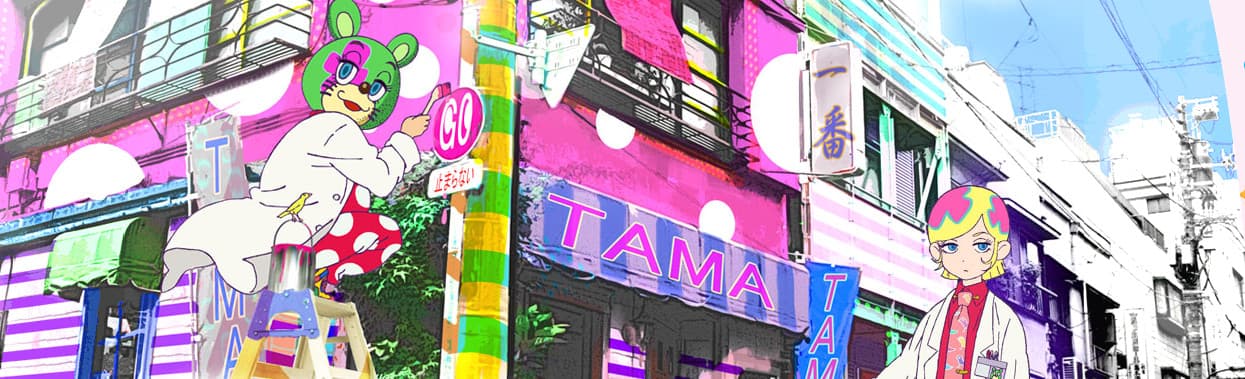
To say that Irabu's office is odd is quite an understatement. "Welcome to Irabu's Office" is a trippy episodic tale that explores problems of mental illness/disorders. If you've seen atleast one scene or clip from this show, there's a good chance you might have felt that it looks off or weird. It's an odd but meaningful experience. Once I started to understand what the show aims at, it became really easy to go with the flow of the show and I think, you should give it a try too. And I'm gonna share my experience.
Irabu's office doesn't have a single art style it sticks to, and constantly switches between these different art styles. You have your traditional 2D Hand drawn art style with it's colorful touch, you have 3D/CGI objects scattered around everywhere in the backgrounds, you have mob characters that straight up looks like cardboard pieces made by a kid for their science exhibition, you have rotoscoping and more than anything, you have a real 3D waifu named "Mayumi". Not your usual 2D waifu that doesn't exist, but an actual waifu that does exist! Oh mY GoDDDD!!!
(OK. Ignore the last part).
What I'm trying to say is that it's an explosion of all these different art styles that keep on switching or blending in the Anime with a clear logic and symbolism. The switch between each art style is used to represent the psychological state of a said character in the show. As for what that symbolism is, is strongly connected to each character that gets explored in each episodic story of the show.
#Characters and the bombastic "Symbolism"
There's no sane character in this show. Pretty much everyone of em is insane, with each of em having some sort of mental disorder or psychological trouble. Irabu himself is quite the oddball. He sometimes a kid, sometimes an adult and most times, a talking anthropomorphic being. And he's the psychiatrist of the show. And Mayumi (the 3D waifu) is a Kuudere that has not much of purpose, other than giving shots and fan service (which I'll get to it later), and finally there's "Fukuicchi". He occasionally appears at the middle of every episode and gives a vague idea of each problem by directly addressing the viewer (yeah, he breaks the 4th wall). And the rest of the cast are your patients that look like they need some medical advice, since their mental health is very unstable. The symbolism is what sold me to this show cause, as surreal as that might be, it represents the mental problem using animals.
The entire theme & main aspect of the show is "Therapy". I'm not really sure how IRL ("In Real Life", for all you boomers out there) therapy sessions work but in Irabu's office it generally goes like this and it's this formulaic approach you see in every episode.
Step 1 : Relax!
You can't think properly if your mind is filled with unnecessary thoughts. So, it's always important to relax before working on something. In Irabu's office, the characters will be relaxed by Mayumi's vitamin shot, while she exposes her body. Again, I'm not sure if a vitamin shot works in IRL but it worked (Maybe fan service is the main point here (´-ω-`)).
Step 2 : What's the problem and WHY?
The "why" is the important question here. Each character share their experiences to Irabu as for what might be their problem. OCDs, Phobias, Addictions, Instability, Insecurity, PTSD etc. all have an origin for their problem. The aim is to find out what's the problem & why it's even a problem in the first place. And after that, you go to the step 3.
Step 3 : Solve & "Implement"
The characters in the show, as weird as they might look, are actually humans. Smart ones actually. They are smart enough to find a solution to their own problem, it's just that they are blinded by their overwhelming emotions. Maybe because of their fear or maybe because of something else, they just turn their eye away from following the right path and just adjust to their current state, which is generally where the whole problem lies. And Irabu just does that. He helps them to follow the path they're constantly ignoring.
And there's actually an interconnection between each individual episode (kinda like an overreaching plot). Each episode actually starts at 16th of a month and end at 24th of the same month. So, you start to see another session happening in the background while also following the current episode. I kinda thought, it really doesn't have a need to interconnect these stories. It doesn't add anything too important to the episodic format, but I don't hate it, so it's not really problem.
43 out of 45 users liked this review