#In a Shellnut
The wind has always been a part of this world. The earliest men built windmills to harness the divine breeze, and from there only built larger; Industries rose on revolving vanes and only time stood between them and the skies. Great airships rose, settlements in the sky, and the ground eventually followed as well as they sent giant islands up among the currents. A powerful civilisation thrived, hovering above the earth, but as all things do, they fell. Quite literally.
Now, even the legends of the floating islands and the fallen civilization they carried have faded with time, and only one last tale remains. Few believe in Laputa now, but a there are still some who pursue it -be it for greed, for power, or for curiosity- and the key to it all is a girl who would rather see that terrible past buried for good.
#Strong Points
It's very pretty, the backgrounds especially, and the atmosphere is great. The intro is also very well made and it must have taken forever.
The characters are great and set the tone very well in the scenes they're in.
The lore is simple but quite pleasant, with a constant and well-communicated theme throughout.
There is some really good music here, at least three tracks explicitly caught my attention.
#Weak Points
The ending is somewhat hasty and I would have appreciated a bit more resolution.
It's a children's show, so the story is basic and forgoes potential conflicts to cater for the audience. Also both main characters are 13 year old orphans who just sort of take care of themselves, which is slightly unrealistic, I think.
Perhaps this is a cultural thing, but the main female character is often approached by significantly older men, so that may bother some. I did not find it offensive, but my friend was weirded out.
Nausicaä of the Valley of the Wind by Studio Ghibli,
This is their first film and shares many thematic similarities.
Any other movie by Studio Ghibli
#Elaboration
This is very similar to their first movie (Nausicaä), but it is different enough that it isn't an issue. They share similarities in theme, narrative, and social commentary, but this one is somewhat less violent (at least in terms of upfront person v. person violence), though both were kept very child-friendly.
The violence in this movie was tonally muted very effectively. Despite the combat and generally war-like nature of the narrative, no-one is ever explicitly dead and no attention is drawn to it. Instead, you have to actively consider the events and logically conclude that a character died, which is a good way of making it harder for the children watching to notice it while still allowing the story to seem realistic to adults.
One thing I find funny is the mixed Biblical and Hindu symbolism, which is used once out of the blue. I've heard that the Japanese see it as being this foreign, monolithic thing that immediately grants a subject a very mystical and otherworldly nature (which is a common theme throughout the movie) and that is exactly how it was used in context, so I am inclined to believe it. It reminds me somewhat of Evangelion in that sense.
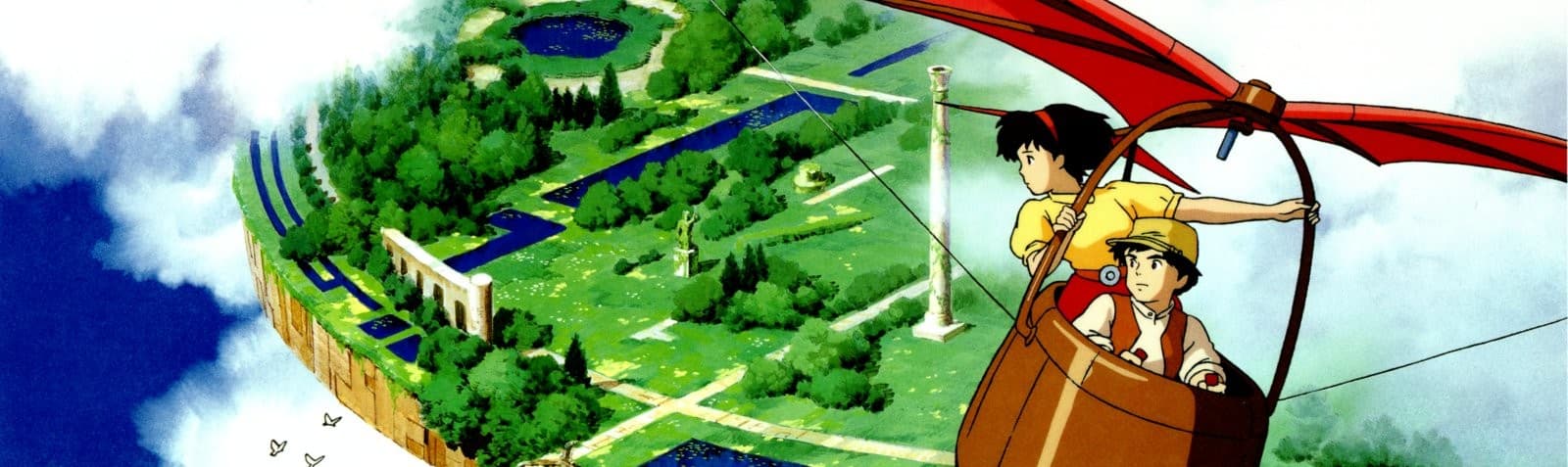
The artwork really stands out to me here. I feel like modern animes often focus a lot on characters and their designs, relegating the background art to being more functional than visually pleasing; This movie, however, really merits being called artwork. There are several scenes that I still remember and the amount of effort that was put into drawing pieces that would only be used for a few seconds is honestly astounding. It really gives off a labour of love vibe that has undoubtedly contributed to the cult success of Ghibli's films.
#Spoiler Section
I quite like the robots in this movie. Unlike in Nausicaä, they are more human (one of the last functioning robots takes care of birds and small animals as well as tending to an ancient headstone) while retaining the same terrifying, futuristic power. Once again, they fire lasers that can destroy any modern weaponry and are near impervious to anything that the army can throw at them. (Except perhaps several massive naval cannons, which put the robots at the same level of combat capability as a warship). I especially liked how the robot was destroyed by burning up on the inside like a magazine as well as the other robot that jingled as it walked.
Post-war era symbolism makes it's return again in this movie and it's very much one of my favourite aspects of these movies. It's a pervasive thing that pops up every now and then -such as in the scene where Muska shows off the power of Laputa by firing a nuclear bomb laser thing into the ocean below- but it's always there. One of the core messages is a cautionary tale of how man is abusing it's power over nature and how they are the ones who will ultimately cause their own demise. The antagonist is a man himself, but the real villain is what he seeks, a foreign power that could wipe out modern society with a little effort and very little warning, and I think that must reflect pretty well how Japan felt about the United States after WWII.
The villain is rather standard fare for a kid's show (Power seeking, doesn't care about human losses and even relishes in it, will do whatever to further his own megalomaniac desire, etc. etc.), except for one thing; He's actually the rightful heir to the throne of Laputa. Often you'll see the villain being a false pretender to the throne with the main character being the rightful heir, and the story is resolved with the correct successor being put in power (which is a weirdly pro-monarchy stance that few people question). Here though, the villain is actually correct and would have been considered right in taking the power (had anyone been still alive to acknowledge it) but he is stopped by Shiita, who is also the rightful heir and chooses to destroy her inheritance, so that was pretty cool.
There is a lot of subtle visual story-telling, and two in particular struck me as being rather clever. The first is when Muska picks up the necklace at the destroyed fortress. He states that it points directly to Laputa and the light shines directly at his head. It's a stealthy way of saying that the Laputa that he fantasizes about and has been searching for is a construct of his imagination and not necessarily what the actual island is, which ultimately turns out to be true as he fails to seize world-ending power and it is destroyed by a word. The second is when the two main characters join the pirates to go to Laputa. The scene shows Pazu's hometown in the distance and after a quick shot of them looking on, it returns to the hometown slowly being covered by clouds, which is a neat way of showing how they're leaving behind their old life behind (well, not Shiita I guess) to go off into the sky in pursuit of their goals.
22 out of 23 users liked this review