#####This review is mostly spoiler free. Spoilers are marked.
Young me loved mystery animated tv. Scooby Doo was awesome. And the slightly more obscure The Adventures of Tintin was one of my favourite shows of all time. I used to read mysteries too. My mum's old copies of The Secret Seven (which, in turn, must’ve predated her) were fantastic! Oddly, I never read Sherlock Holmes as a kid. I think I was too young when I first tried to read them, and bounced off. Too hard! I probably went and read Harry Potter instead.
But I’d forgotten how much I loved mysteries. Hyouka reignited that love.
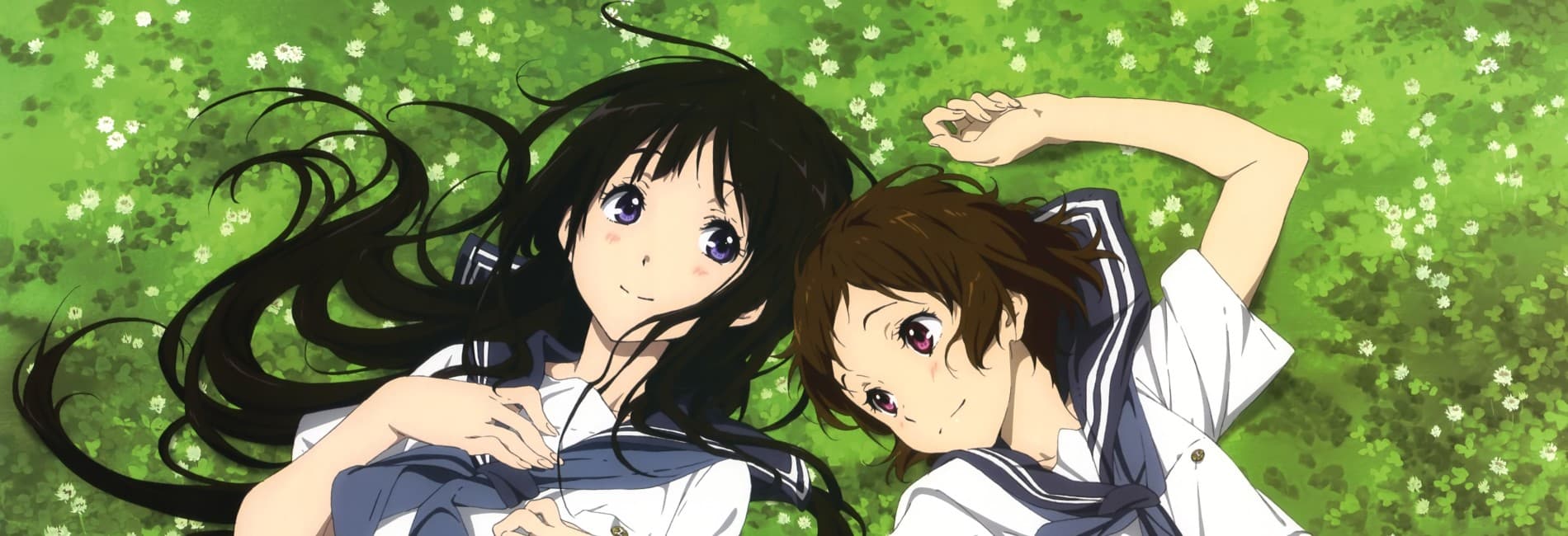
Hyouka, at it heart, is Holmes meets high school slice of life anime. Our protagonist, the energy conservationist Oreki, does whatever he can to avoid extra effort. But after his sister forces him to join the Classic Literature Club in order to keep it from disbanding, Oreki meets the ever curious Chitanda, who constantly pushes Oreki to solve the mysteries the club face.
Hyouka, then, is about these mysteries and the Lit Club trying to solve them. Episode by episode, the club tackles these mysteries and it’s just… delightful. It’s a really fun show. The mysteries are all really clever and feel both perfectly in genre for mystery and precisely low-stakes enough for slice of life. The show is well written, and the production is fantastic. The soundtrack is outstanding. The only flaw to be raised against Hyouka is it’s ending that felt out of place for the rest of the show.
Hyouka is episodic, although there is a minor thread of character growth throughout the series. The show splits its time between multi-episode mysteries and single episode mysteries.
The single episode mysteries tend to be less involved with the characters. Episode seven, for example, was a mystery set in an inn the group visits and had no noticeable impact on the lives of the club members. Comparatively, the mystery behind the anthology which runs from episode three to five is a big deal for the characters and the solving of the mystery remains relevant as the show continues. As a result, the multi-part mysteries feel a lot more important, which is great because a lot more time is spent on them, so you’d hope they were important.
And while there is notable variance in the quality of the single episode mysteries (for example, episode six felt particularly weak, while I thought episode seven was fantastic) I actually think varying the show between multi-episode and single-episode mysteries helps the flow of the series significantly. Each of the more complex multi-part stories are given space to breathe. I enjoy sinking my teeth into the meaty mysteries. But I also enjoy the lower stakes, small mysteries.
Really, though, the multi-episode mysteries is where the show shines. Allowing for a mystery to build over a number of episodes obviously allows for it be more complex and interesting. The first such mystery into the Classic Literature Club’s anthology is executed exceptionally; the way the mystery is unraveled is so well done and felt so in genre. The show, here, really felt like a Sherlock Holmes novel just with high school stakes.
The multi-part mysteries also have the added benefit of stretching out the drama. It’s difficult to build a lot of drama in a single episode because there is significantly less time to hit dramatic beats. In this, it’s difficult to fault the single episode stories on such a comparison. Rather, it’s something remarkable about the multi-episode stories.
To speak generally about multi-episode stories; they can often fall into the trap of lacking individual conclusions. Rather than feeling like three linked episodes, shows can often present a story broken up into three parts, without any conclusion in the first two episodes.
Hyouka, however, excels at drawing out its mysteries over multiple episodes while still providing each episode with a conclusion. The multi-part stories don’t feel like a broken up story that feels incomplete until the final episode, but rather like three complete episodes with a common mystery running through them.
In part this is due to what is perhaps my favourite feature of these multi-part stories: the cliff-hangers. A good cliff hanger is one of the most powerful tropes one can exploit in the mystery genre. By it’s nature, the cliff-hanger requires a conclusion to twist, so it becomes necessary for each episode of a multi-part story to have a partial resolution. This is not to suggest that each episode of the mysteries end with a solution that is immediately disproven, but rather we are presented with the key to a lock and then shown a second lock.
And I just love a cliff-hanger to end an episode. When it’s done well, which it consistently is in Hyouka, I am nothing but excited. The dialogue of the show reaches new highs on these cliffhangers, there are some banging lines to finish an episode on throughout. My favourite, to list just one, was in episode 4; “But then why did I start crying…?” is such a cracking way to end an episode after everyone thinks the answer has been found.
Hyouka, takes an interestingly constrained approach to romance. The show is explicitly not in the romance genre. However, throughout the series it’s communicated that Chitanda and Oreki like each other (and to a lesser extent, as do Fukube and Ibara).
The constraint, then, was that it is more part of the world, rather than a part of the show. Just as Oreki doesn’t own a mobile phone, he likes Chitanda. And there’s nothing more to it than that. He can’t help himself from wanting to help her, because he likes her. But it’s never about liking her. Oreki being into Chitanda is just not something the show focuses on, instead it is part of the character’s motivations, almost a background element that comes up to motivate the plot.
I personally liked this approach. It meant that Hyouka could just be a slice of life/mystery, a refreshing break from the typical romance of the slice of life genre. If you are expecting a romance story in Hyouka, then you will be sorely disappointed because its just not a romance. And the fact that it’s not was a really great part of the show.
However, it must be noted that this is merely the general approach of the show. The final two episodes were stand alone stories each focused on the two relationships of the group. So the ending deviated from the formula in some effort to tie up these phantom loose ends. And the result was that the ending for Hyouka was perhaps its weakest point.
Primarily, the fact that it didn’t finish with a big, dramatic multi-episode story shocked me. But that the episodes ended up spotlighting something that wasn’t part of the show otherwise disappointed me. I loved Hyouka for being a cross between a detective story and slice of life high school show and the ending simply didn’t capture this.
Ultimately, I think the end struggles with the fact that the anime adapts four volumes of the light novel. It can be difficult to bring a show to a concluding point when the source material doesn’t. The show desperately needed the prospect of a second season, as it would have allowed for the loose ends that the final two episodes awkwardly try to resolve to remain loose. But without enough material left for another 22 episodes, the anime ended up falling a bit flat at the end. Our only hope, then, is that more of the Koten-bu Series gets written.
The production of Hyouka is essentially without fault. The animation of the show is great. I particularly enjoyed the use of alternative animation styles, often to depict theories or answers put forward for a mystery.
There are a number of moments from the show that were exceptionally good, such as the first time Chitanda tells Oreki that she’s curious. This scene in particular is probably the best from the show. It’s a great moment in the story that is emboldened by visual story telling. Oreki becomes enthralled by Chitanda’s curiosity and this is visual represented by him becoming entangled in her presence.
That said, I felt that these exceptional scenes were just that, exceptions. The animation of the show was great, but rarely outstanding like in the above scene. I don’t think it’s fair to fault the show for not going all out more often, so this is a bit of a non-criticism. It’s great animation. Just not, masterpiece good. And that’s fine.
On the other hand, something that was consistently incredible was the music. The classical pieces throughout it work so well. Bach’s haunting Cello Suite No. 1 and Sicilienne by Gabriel Fauré are two stand outs from the soundtrack. At just the right moment, these classical pieces come in and elevate the moods of the scene. The mystery is elevated so well by these songs being placed at just the right moment.
Ultimately, my criticisms for Hyouka are minor. Hyouka is a fantastically written and highly enjoyable slice of life. And it’s a smart and dramatic mystery. It married these two things together perfectly, and the lack of a romance plot through the show was an important factor to this. If you love slice of life as I do, you will enjoy Hyouka. And if you enjoy mysteries, like a younger me did, you will love Hyouka.
45 out of 47 users liked this review
