Ranking of Kings
a review by arzene
a review by arzene
Contains very minor spoilers. Anything relatively major has been tagged appropriately. As always though, this review isn’t suitable for those who want to go into this anime completely blind.
I don’t think I was the only one who’d never even heard the name “Ranking of Kings” until the day this show started. Even as an avid manga reader and someone who likes to keep up with new anime announcements, it just wasn’t something I’d ever even heard of in passing, let alone actually stumbled across.
So why, as we’ve all started to wonder, has this anime suddenly become so huge? How did it manage to cement its place in so many people’s favourites before it’d even finished airing? How did it get me so invested in its characters and world within the first 15 minutes of its pilot’s runtime?
It achieved some insane feats during its run, so I hope you'll join me as I go through them one by one.
We witness the story of Bojji, a deaf, mute, and almost completely powerless prince who is the first born son of Bosse, king of the Bosse Kingdom and #7 in the rankings. Bosse is widely acknowledged as the strongest man in the world, and Bojji dreams of becoming like him despite his weakness and disability.
The whole kingdom openly ridicules Bojji for his ambition, but Bojji is always able to put up a smile through this and never fights back. One day, he meets a creature called Kage, the final remnant of the wiped-out shadow clan, and, after a few hiccups, the two become friends. Kage is touched by Bojji’s kindness, its genuineness reaching him because he himself had been exploited and abused for most of his life, and swears to become his loyal companion.
Sounds interesting already, right?
Ranking of Kings presents us with a setting and a premise that I dare say is almost impossible to not get invested in. Even in the first episode we’re given such an in-depth impression of the show’s world and how it’s built, even though we’re hardly given any specifics about its history or wider cast of characters off the bat. It builds this intrigue through its immaculate execution of this factor, and ropes us all in through its storytelling and quirky series composition.
The plot, of course, only becomes more and more interesting as more of its mysteries are unravelled. I’d been following it since its pilot, and week on week it consistently had me at the edge of my seat, always disappointed when episodes ended and excited for what next week would bring. What truly made it so interesting to me personally was its unpredictability, as every single character has a different set of motivations and unseen sides to their personality that contribute to the wider narrative, and it slowly compiles all of these different threads of the story into one big plotline before we reach the series’ climax, which, by the way, has some of the most nut-worthy episode and animation direction I think I have ever seen.
Without saying too much and wandering off into spoiler territory, the narrative of Ranking of Kings is one of my favourites possibly of all time just because of how well it handles its world and characters. I love stories that slowly reveal background information and the reasoning behind a greater conspiracy throughout the plot itself, and this anime did that absolutely perfectly. The way it loops back around to different plotlines right as you think they’ve been forgotten? Immaculate. The way it keeps world aspects such as the rankings relevant without constantly shoving them down our throats? Divine. Even the blatant tone shift we witness in the show’s second cour doesn’t feel unnatural because of the amount of build-up we’d gradually been fed throughout the first.
Ranking of Kings was nothing like how I’d expected it to be after coming out of episode one, but I mean this in the absolute best way possible.
I do have my complaints though, which I unfortunately have to add after watching episode 22.
I’m going to avoid individually reviewing any of the characters because really most of the fun comes from discovering them yourself through the show, but you can absolutely take my word that it’ll be very difficult to hate any of them by the time you finish episode 23. Even the most initially evil-seeming characters become understandable by the time you learn of their pasts or watch them walk in their futures ready to atone for their mistakes, and this is what makes them all feel so human despite the fact that a solid chunk of them aren’t even humans at all. They’re perfectly imperfect and their struggles are so relatable sometimes that you just want to reach in and hug them through the screen, and don’t even get me started on the bond we witness form between Bojji and Kage because I am never going to admit that I got emotionally invested in a fucking black blob so hard I was crying by the end of the second episode, nuh-uh.
Ranking of Kings is ultimately a story about empowerment, but through its characters it also gives you this feeling of perpetual forgiveness and the sense that it’s not too late to become and live as a better person even if you can barely forgive yourself sometimes. And this, I think, is what makes it as beautiful as it is.
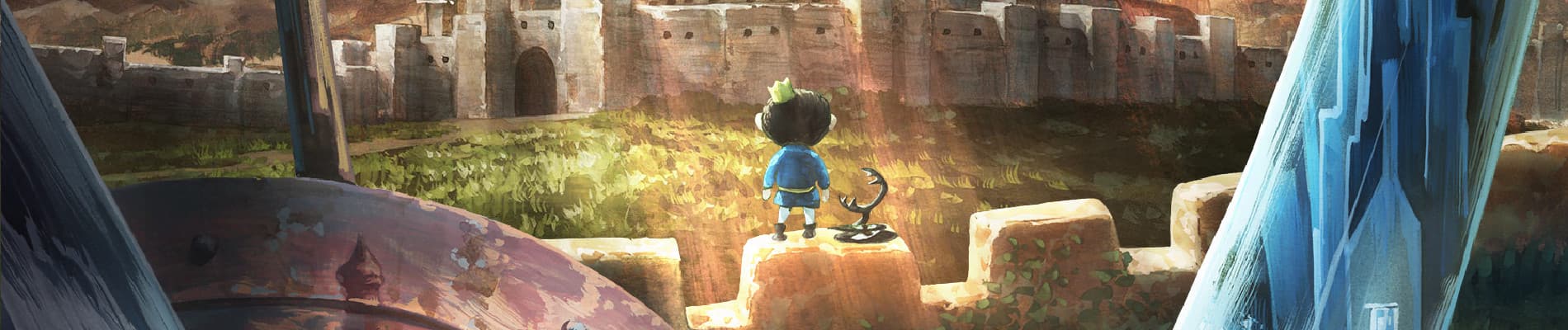
Ranking of Kings is an example of an anime that really doesn’t look like an anime at all in a traditional sense, and is stylised to look far more simplistic and fairy tale-esque. It looks like it’s jumped right out of a story book you read in second grade, which might be off-putting to some, especially considering some of the substantially less story bookish themes it covers through its story.
But honestly? It works for the kind of show Ranking of Kings wants to be.
The simplicity of it almost accentuates the horror of some of its gorier scenes and serves to be a surprisingly good contrast to its darker narrative. As much as I adore more realistic and detailed art like Urasawa’s or Miura’s when it comes to series that deal with more serious themes, Ranking of Kings’ simplicity actually serves to contribute to how serious it can get at times, and, despite my initial tentativeness towards its visuals, I never once found myself thinking “this would look so much better if it was drawn in a more typically anime style” while I was watching. Mixing darker themes with what looks like a stereotypically childish art style actually works supremely well here, and it creates a lasting impression as well as a new kind of naive atmosphere around the show, which reflects its tone immaculately.
The animation is also beautifully fluid, which is something we perhaps need to thank the simplistic style for, and some of the fight scenes the show pushes out are honestly on par with if not better than those you can find in mainstream shonen anime. It’s clear that a lot of care has been taken around composing the art and tonally allowing it to fit into the narrative, which is true in a visual sense as well, because the show has this certain aesthetic to it that holds true for its entire run. Something I adore specifically is the watercolour feel of the backgrounds, since it compliments the cartoonish animation and style and really does make Ranking of Kings feel like the tale of a young prince.
I really can’t fault it, so I just want to say to any people here who are as tentative as I initially was about watching this anime because of its art that it’s worth it and is absolutely something you’ll grow to love.
I remember going into Ranking of Kings wondering how they were going to go about handing the voice acting performance for a deaf character who can’t really speak—I’ve only seen this done once before and I don’t think I need to tell you what movie it was in—so newcomer Minami Hinata’s ability to encapsulate Bojji’s speech as she does came as a pleasant surprise to me, and once again showcases how much care and thought has been put into this anime from all angles. I have no idea if it’s particularly accurate to real life, but it still felt oxymoronically true to me and is an endearing contribution to Bojji’s overall realism and lovability as a character.
The other character’s voices are equally amazing, emotional in all the right places and all perfectly fitting their respective characters in terms of pitch and tone, and I think it’s wonderful that such a diverse cast came together to bring all of these beloved characters to life and contribute to making them as beloved as they are.
The first opening, King Gnu’s BOY, fits the initial character of Bojji absolutely perfectly. It’s a banger of a song, and it’s coupled with some beautifully-composed animation that allows us to explore the world through the eyes of Bojji and Kage. It’s a rare case of a song being so carefully constructed around a series without outright being about the series that it just feels genius, and I’m glad the band put so much into making it so for the sake of this anime. And, once again, it fucking slaps.
The second opening, Vaundy’s Hadaka no Yusha (or “Hero Laid Bare” in English) is one that blew me completely away the second I first watched it. I remember saying to that same friend immediately after I’d watched it that it was going to be the best opening released in 2022, and so far I still stand by that. It is absolutely immaculate. The animation is Kaikai Kitan levels of pure, uncontrollable sexiness and at this point I think it’s impossible for me to ever skip it, I just have to watch it the whole way through every time it’s on so I can fawn over how pretty it is. It conveys the series’ tone shift onto its more dark narrative beautifully, and also represents the change in Bojji’s character as he’s wrapped up in all of these conspiracies. The song itself is also just the type you’d want to loop for hours to cry and/or headbang to because it’s Vaundy and Vaundy is incredible.
I have substantially less to say about the ending themes and OST because I’m both a chronic ed skipper and a voice actor hyperfixator, but I really can’t find much flaw with either of them either. The softness of the endings in contrast to the action-packed openings is beautiful and encapsulates the anime’s gentler themes perfectly, and the OST is subtle enough to not intrude upon emotional, voice-heavy scenes while still being strong enough to build tension and poignance where it’s required to.
On the whole? The music is utterly fantastic. All of it is very fitting for the type of series Ranking of Kings is, and the theme songs are some of the best I’ve had the pleasure of witnessing in a while. Full marks.
There were a lot of shows that were released last year and very few of them stood out to me like Ranking of Kings did. It’s fresh and new and unafraid to deal with themes every other mediaeval kingdom fantasy anime tend to shy away from, and it’s this aspect of it that immediately makes it stand out in the best way, though of course this would mean nothing without its incredible narrative structure and cast of wonderfully-written characters. Not even a slip-up near the ending could ruin this show for me, and I’m a critic at heart if that puts into perspective how much that means from me.
I would recommend Ranking of Kings to absolutely anyone (as many of my friends know because I have been incapable of shutting up about it to them for the past few months) solely on the basis of the messages it conveys, because I just think many of the themes it explores need to be touched upon more in anime and, honestly, media as a whole.

Thank you for taking the time to read my review, I hope you were able to get something out of it!
322 out of 354 users liked this review
