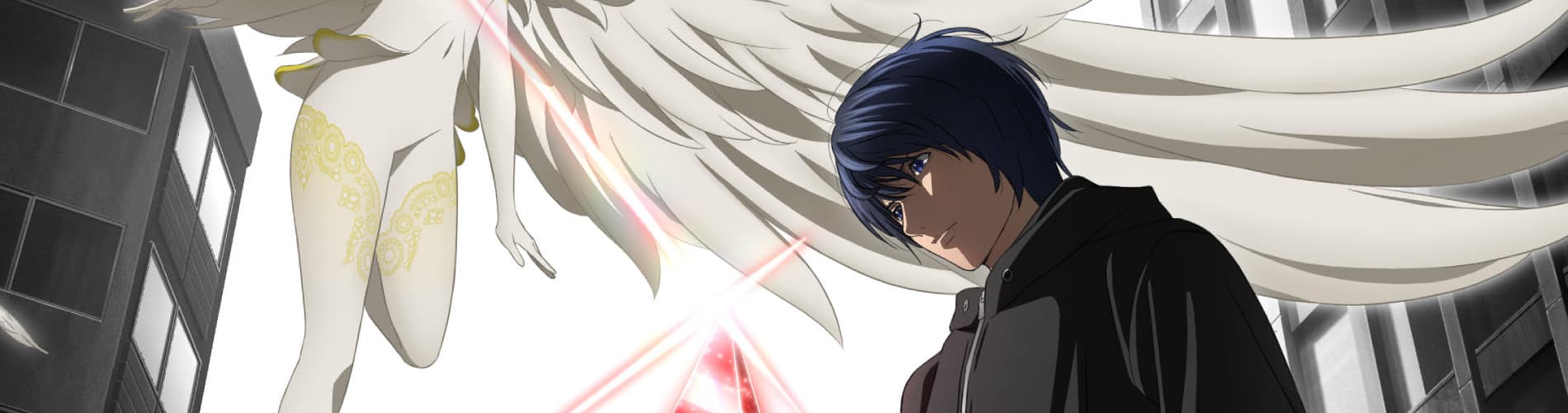
Platinum End
a review by ZNote
a review by ZNote
SPOILER-FREE!
Dark storytelling is a gamble. On the one hand, it allows you to explore aspects of the human condition, action, or philosophy that affords a great wealth of interpretations and territories to explore. On the other hand, with such a giant sandbox to play in, it becomes all the more important to keep your vision in scale, and to probe the various treasures in a way that is both intellectually engrossing and digestible for the audience. It is indeed possible to be given an unpleasant subject, but still be drawn into the material.
Platinum End was a two-cour Fall 2021 anime concerning gods and a candidacy trial that came from the original manga by Ohba Tsugumi and Obata Takeshi, the same duo responsible for Death Note. With such an acclaimed property as part of their output, I was intrigued by what could potentially result from another one of their collaborations. Nevertheless, I was mindful that this series is to be judged by its own merits rather than have a forced, undeserved expectation placed upon it.
________
High school student Kakehashi Mirai, after enduring the death of his parents and the abuse of his aunt and uncle, throws himself off a building to commit suicide. He is saved however by Nasse, an angel who selects him to be a candidate for becoming the new God of the world, as the current God is dying. Gifted with wings, a Red Arrow that can force people to obey his commands, and a White Arrow that allows him to kill anyone in an instant, Mirai must fight in a battle royale style contest with the other God Candidates, and strive to attain happiness in his life. Among them include the mysterious Metropoliman, who will seemingly do anything to get his way, and Hanakago Saki, the childhood friend Mirai loves.
With such a backdrop concerning God, life, and death, among other things, it makes it all the more important for your main character to be an interesting enough vehicle to have these themes center around. Because we are introduced to Mirai at his absolute lowest, where the very idea of continuing to live is considered too painful, it sets up the notion that his rescue by Nasse will help steer him in newer, more optimistic ways. The fact that he’s roped instead into a royale is therefore an effective bait-and-switch, showing that despite his rescue, Mirai’s problems have only just begun. Especially when it dawns on him what he’s capable of with the Red and White Arrows, the show paints early on just how grim Mirai’s place now is, and his desire to be happy seems like a worthwhile goal.
However, the switch between Mirai being understandably and sympathetically at that low point and the new Mirai that we follow over the course of the story doesn’t coalesce. He makes the decision early on to never use his White Arrow to kill if he can help it, saying that killing in order to obtain happiness is not justifiable. Even taking that ideology into consideration, the show goes out of its way to show just how far Mirai’s philosophy will not buckle. Taking this course paints Mirai less as a praiseworthy saint and more as an insufferable monster of a different sort, someone who would be willing to let the other God Candidates allow the worst of the worst to transpire because of the naïve hope that a non-murderous third option exists.
His resolute desire not to kill anyone is egregious given that certain characters perform actions that would be, putting it kindly, worthy of locking them up forever. It would be one thing if he were indeed dealing with regular humans, but God Candidates and their willing and unwilling accomplices are also involved, and that changes things. One remarkably-unsavory character was formerly imprisoned for murdering her female middle school classmates, and later after being released from prison, uses a Red Arrow to start raping and murdering middle school girls all over again. According to Mirai’s entire philosophy, this is a character who, despite all the horrific things that she has done, should not be killed.
And in the moments where the people in the royale do end up getting killed somehow, Mirai is never the one who actually does the killing itself. Constantly wiping the protagonist’s hands clean reads more as a cop-out to keep his worldview stable rather than allowing it to become appropriately-jaded. He’s still an accessory to the killings even if he’s not the one who “did it,” but any potential shakeup internally that might result from these instances are too minor and glossed over.
While one could reasonably argue that it is not important for that internal shakeup to be presented so explicitly, there is little evidence in the course of the narrative that hints at such a development taking place, or at least to the extent that it has a lasting value. Rather than actually delving into the nitty-gritty of these nebulous, conflicting ideologies and events, Platinum End is all too happy, so to speak, to handwave them away. The story is paralyzed by its own main character not really growing and developing, or any growth or development coming too late to carry the serious weight it demands. It may be an ensemble show, but as the main person whose story we follow in the plot, Mirai cannot muster a fascinating-enough character or motivation.
The few times Mirai is appropriately challenged in his philosophy include Metropoliman, who primarily does so by virtue of being an antagonist (and his motivation for God candidacy is quite laughable), and Mukaido, a terminally-ill character who is more proactive in hunting Metropoliman down. Because Mukaido sees himself as a dead man walking, he places a different perspective and emphasis on his own sense of happiness. He clashes with Mirai in ways that directly respond to the present circumstances, both to himself and to the world at large. But Mirai’s status as the central character allows him to keep proselytizing about how dying and killing is bad, and his sentiment on finding happiness is echoed so many times and fleshed out so vaguely that I came to dread its inevitable appearances.
And speaking of appearances, the actual aesthetic of the series is quite wanting. Platinum End is attempting to explore some of the more-pessimistic, darkest aspects of human existence, yet the amount of detail put into the visuals make it seem like things were hastily put together. The color palette was so oddly bland and absent stark contrasts, while stylized line work was almost entirely a no-show. The series seemed to keep that artistic stylization only for moments of particular intensity which, while making sense on paper, does not translate to an overall-engrossing experience. The tone of the entire series is one of a despairing, melancholic pathos, for which the aesthetic fails to commit to wholeheartedly. I recognize that this level of commitment is taxing, especially in the anime industry’s current climate, but stories that require it should be able to deliver. The soundtrack is the only element that feels true to this conviction, moving into a thicker, atmospheric nuance when the situation arises.
But most damning of all is that the show does not have the tact or intellectual wherewithal to have the discussions it seeks. Platinum End relies too heavily on outrageous edginess to carry out its discourse rather than broaching the ideas with seriousness. Suicide, murder, and religion are not concepts that should be ruminated upon lightly, yet watching these twenty-four episodes, I questioned whether there was just a complete lack of self-awareness regarding this. The other Candidates’ worldviews or perceptions are so thinly-probed that the arguments, and the characters speaking them, read more as caricatures or imitations. One character introduced in the latter half uses his powers for the purposes of granting other people their suicidal intentions, and eventually his own, with unapologetic nihilism. The fact that this character on a nihilistic downward streak is temporarily talked out of that by a “friend” of a main antagonist is beyond infuriating, and the justification for the shift is even more silly in context.
The discussion problem is worse than it would initially seem since none of the Candidates are religious to a discernible degree. If Platinum End wants to have dialogue about ethical, moralistic, religious, or cosmological ramifications about God’s death and appointing a new one, it is baffling that no Candidate adopts the genuinely-religious position. Even if it were not argued particularly well, how could that character not be there? By not including this element, the series effectively states that an earnestly-religious position is not worth having, thus depriving itself of an easy source of genuine tension between the Candidates. This omission is hair-pulling.
As hair-pulling as the show could get throughout its run, it managed to do so one more time with the ending. It was one of those occurrences where, even if I understand what it was attempting to do, it did not equate to liking it, or even finding it a suitable finale when all was said and done. Thematically, it poses a rather fascinating angle on nearly everything that we saw concerning life, death, and God. But as presented in the greater framing of the story as a whole, it felt so out of left field and had no time to develop into something more meaningful, despite the last lines of dialogue insinuating that such potential was there. It left me out in the cold, though not in the way it intended.
As has been insinuated in the course of this review, Platinum End is very dark; it resides in misery at the structural level. As I thought about this series, a thought had occurred to me – one sentiment that sometimes gets expressed in online discourse is why do people reject dark stories when they supposedly want them? Why run in the other direction when a dark story is presented? The answer is that a dark story is not a given that a story is good. To find a dark story engaging is to ask yourself what the material means, implies, and how it engages with itself and yourself alike, and enjoy that exercise. It still has to resonate in a manner that proves satisfactory to the viewer, even if the viewer disagrees with the ideology or event depicted. Dark does not automatically mean an unpleasant experience either, but when this series tried to demonstrate what it was capable of, that was what it became. Perhaps it is true that fiction should more often address aspects of humanity and living that others would sooner run away from. But, just doing that isn’t enough – it needs to be maturely handled.
_________
Platinum End is an unpleasant, self-aggrandizing mess. It wants to have philosophical musings, but lacks the nuance and intelligence to have them meaningfully since its roster of characters are not compellingly-written enough. With a main protagonist too engrossed in his own obstinate attitude, much of the events that unfold are more aggravating than intriguing. The overall aesthetic is screaming for a more-visceral stylization, only having brief touches of that coming through in particularly dramatic moments. With an upsetting ending, this is one dark story that left me shaking my head in disgust rather than clutching my chest in anticipation. At its best, it had flashes of possibilities; at its worst, it was contemptible. What it always came across as, however, was sanctimonious and disappointing.
155 out of 165 users liked this review
