As time's gone on, I've increasingly realised just how much interest I find in art that explores the creative process and experience in one form or another, and in this sense, I'd argue that Keep Your Hands Off Eizouken ends up being one of the strongest examples of how such a story can be told right. What truly sets it apart for me is the way in which it delves into the whole concept of naive optimism clashing with harsher elements of reality without ever feeling as if the stakes of the situation are raised to any particularly high levels. This not only allows the series to maintain a very chill, comfy atmosphere, but it ends up being utilised as a tool to strengthen the personal motivations of each character instead, reinforcing the whole idea that the protagonists are doing this for the sake of their own artistic expression as opposed to needing to do it based on an outside force pushing them towards it all, focusing instead on the intrinsic rewards many experience from being able to express themselves in one way or another.
What truly makes me appreciate what's done from here however, is the way in which this moral argument is used to further refine and add nuance to what is being conveyed, which is where Kanamori's character comes in as essentially a way of forcing the naturally optimistic characters of Asakusa and Mizusaki to further consider their approach to situations. Having a character so entirely uninsterested in the process beyond how it can lead to monetary gain is interestingly handled with how she's framed against the rest of the cast. Typically I would find such character traits in a series like this to be framed entirely antagonistically, a sort of foil that attempts to stifle creativity or force an artist to commit to something they're unhappy with, but by making her instead be yet another friend who helps them along, it paints the idea of needing to be realistic, compromise and curbing one's own ambitions as a positive and natural element of the workflow. Rather than trying to paint an endless amount of unstoppable creativity and drive to craft something around all of your interesting thoughts as an absolute virtue, it's framed as an important thing to keep in check if you want to actually get anything done, and I feel that this theme is something that can be carried through to the dynamics between Kanamori in general, she's stern and completely disinterested in the art side of things, and yet she's nonetheless integral with the way she brings reality into the overblown dreams of those who surround her.
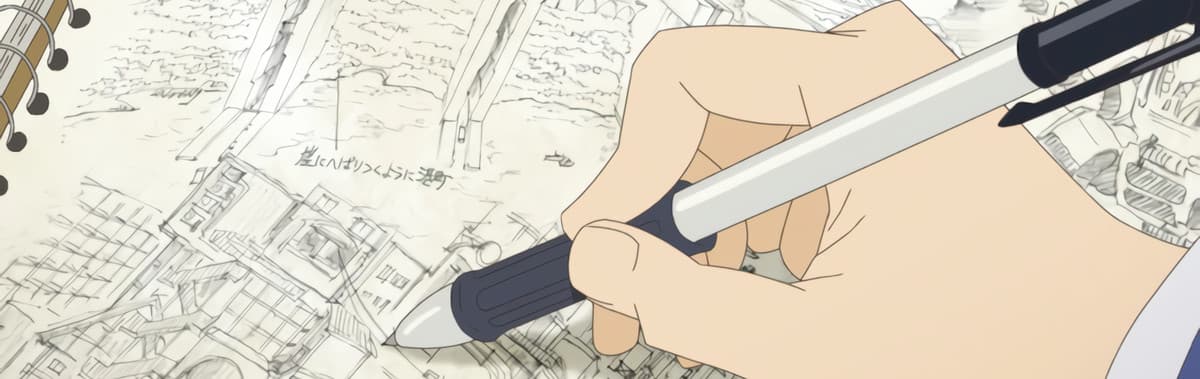
Even putting aside the fact that I love how all this is handled, I'd be remiss if I mentioned a Masaaki Yuasa project and didn't touch upon the fantastic art. The character designs in general are so wonderfully unconventional, with the artstyle definitely contributing towards this, with the characters all looking a bit strange and angular, along with the animation often tapping far more into cartoonish aspects that aren't afraid to be constatnly going entirely off model to further sell the sense of expression that comes across. Just watching this completely removed from any of the narrative is a joy in its own right, with the idiosyncratically construcated setting promoting the idea of finding beauty and wonder in even the most innocuous things, and doing this consistently throughout basicallly the entire 12 episode run. The sense of beauty is further displayed through the sections which represent a sketchbook, everything becoming far more messily composed while retaining the key details required to get the point across, and overall leads to so many moments of amazing spectacle in a show that's for the most part as chill and down to earth as it is, with even the more ridiculous elements being played completely straight as if it's nothing to really need to pay attention to at all. Overall this is a fantastic watch that I highly recommend, especially for those who appreciate a good story about artistic passion and all that goes along with it.
17.5 out of 18 users liked this review