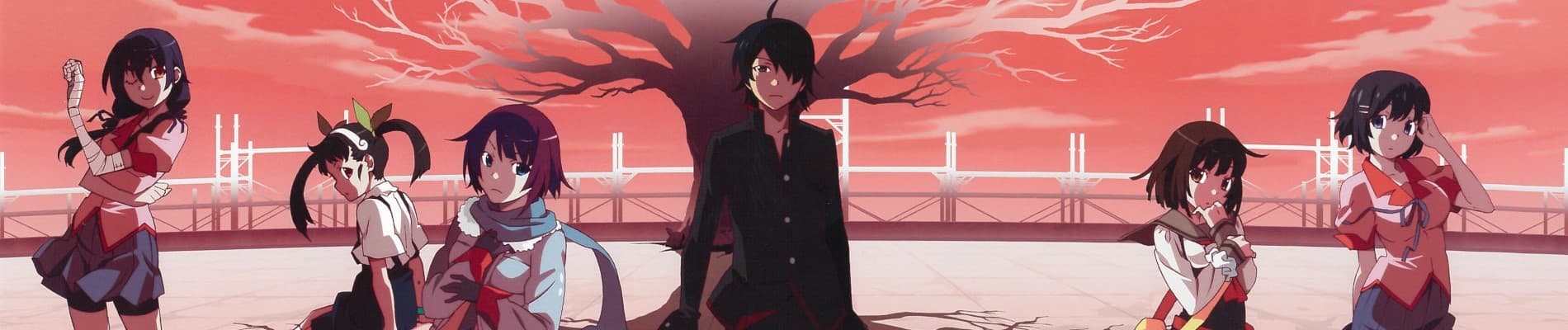
I did not truely understand the obsession and passion fans had for Monogatari until until Monogatari Series Second Season. Bakemonogatari floored me. It’s truely a work of art. When I finished it, I craved the next hit.
But I was left somewhat disappointed by Nisemonogatari. It was good, but for the sequel to Bakemonogatari, it simply didn’t feel like one. The prequel, Nekomonogatari Black, was great, but treaded old ground. The hit was there, but it didn’t feel the same. I didn’t get the rush.
But Second Season is the real sequel. I don’t know what those two other series are supposed to be in relation to Bakemonogatari. And I don’t give a shit. Second Season is everything I hungrily craved after finished Bakemonogatari. It was the hit I desperately needed.
And what a hit Second Season is. This series is truely, truely remarkable. The writing is just outstandingly clever. At some moment when watching you pause for a second, you take a step back and see how all the puzzle pieces of the plot have fallen together. My god, it’s genius. Everything, absolutely everything in the series is so clever. It takes Monogatari way further than Bakemonogatari did.
But, oh how does it feel like Bakemonogatari too. The electric pacing is back. The wit, the meta humour, the mystery. It’s all here and it’s so… it’s so fucking good.
Bakemonogatari ’s writing was incredible. The plot was great and the sharp snappy dialogue really set it apart. But Second Season goes all out. The dialogue is just phenomenal. So smart and punchy when it needs to be. The meta and self-reference humour that was sprinkled throughout Bakemonogatari features prominently once more. This series was seriously funny at times. But the plot writing is simply masterful. Every single arc was fantastic and expertly worked with the foundations of the first season.
Second Season seeks to build-upon, perplex and complicate everything that has been established about the characters so far. From revealing the simple conflicting thoughts of characters - such as of Shinobu’s conflicting desire to run away and be found during the Tsubasa Cat arc of Bakemonogatari - to discovering the deep emotional complexities of characters. As much as I’d love to discuss every single moment of this show, I’m going to limit myself to two arcs, Tsubasa Tiger and Nadeko Medusa. The first arc of the series, Tsubasa Tiger, seeks to explore Hanekawa, and masterfully bases the exploration on the foundations already established in the first season of Monogatari. Likewise, the Nadeko Medusa arc investigates Nadeko Sengoku, exploring her perception of self and of others through the lens of ‘cuteness’, her victimhood and self-victimisation and her repressed jealousy and anger.
All throughout the series, the stakes are upped, yet it never felt ridiculous. Even the Mayoi Jiangshi arc which had time travel, an element that always runs dangerously close to jumping the shark, felt perfectly executed. The conclusions, pay-offs and twists felt so clever and dramatic. It can be safely said that this is the best written series of the show thus far.
Tsubasa Tiger is one of the best character explorations Monogatari has presented yet. The result of being the most interesting and focused on character the show to this point allows for Second Season to really complicating things. And even though this series progressively ramps up the stakes as it continues, it really starts with an impressive bang.
The discussions between Hanekawa and Senjougahara about Hanekawa’s nature and her likeness to Araragi invites a deeper look into Hanekawa, building on what was presented in the Tsubasa Cat (Bakemonogatari) and Tsubasa Family (Nekomonogatari Black) arcs. Senjougahara talks about how Hanekawa is pure and righteous, more so than Araragi. Hanekawa and Araragi both do the right thing, but as Senjougahara says, Araragi grumbles when doing so.
But, as we learn, Hanekawa is more complicated than that. She suppress the negative parts of herself to be pure. Black Hanekawa is not merely a manifestation of Hanekawa’s stress boiling over, but a manifestation caused by the suppression istelf. The tiger, Kako, is another part of Hanekawa’s suppressed self, her envy.
Hanekawa is not purely good, nor purely evil. It’s not as simple as having a dark side. She is a complex person. She is envious of Senjougahara’s house or of her parents reconciliation, just as anyone could be in a position like her own. But she also has positive emotions that conflict with this. Just as you may be both happy and jealous of a friend who did better on a test than you have. But Hanekawa presents herself a pure; as white. In her pure representation of herself there is no envy, stress or jealousy.
But she learns that she can’t be white, because the black still exists. And this is shown literally as the arc concludes with the white and black aspects of converging, striped like a tiger Hanekawa is black and white. She is complex. She can envy something without wanting to destroy it.
Now, what follows is not to say any of the arcs don’t go hard in Second Season. The Nadeko Medusa arc is where this series just absolutely started to blow my mind. It’s the part of the show where the writing just enters a league of its own.
Again, this arc builds of what it established in Bakemonogatari. Before Second Season we understand Sengoku to be a somewhat feeble young girl. She’s shy, quiet and unassuming. Second Season then rips her open, exposing what is beneath the surface. Sengoku is someone who resents the perception others place on her, but equally is one who will exploit it. She is selfish, incredibly so, and when given the power of a god and driven insane, this manifests in her desire to kill the three people she is most angry at.
The arc is rich with symbolism. I particularly want to note her transformation into a medusa in the context of Sengoku’s resentment for how people perceive her as cute as contrast with the outburst she at school. Her transformation into medusa can be read in two ways. Under the classical understanding of the myth, Medusa is transformed as a punishment for her beauty. Sengoku becomes medusa as her own punishment for being cute, in her hope of atonement.
Of course, it’s much more complicated than that. The whole arc, it is revealed, was seen from the eyes of an unreliable, delusional narrator. The hair-tie she’d been talking to was nothing more than that, and instead her own delusions had recreated this god.
So, instead, Sengoku becomes medusa as the manifestation of an angry, jealous self. She is angry at Koyomi and his unrequited love, at Shinobu for being Koyomi’s companion and at Senjougahara for being his girlfriend. So it follows the another, modern (feminist), reading of medusa as a symbol of female rage; willing, no, forced to destroy all that it sees.
And as her story continues into the Hitagi End arc we see her from a different angle. Now a god with a temple, we see this cuteness again. She is stupid and insane. And she is as powerful as a god. She remembers little of her past, only knowing her grudges and her promises.
This cuteness is something she cannot escape, and even in godhood it hangs over her. Her visual depiction evokes that of childlike innocence, matching her stupidity and ignorance. And the ultimate conclusion of her story is breaking free from the perception that kept her boxed in and afraid to express herself through making manga.
What is so fantastic about this show is that as these complex stories are going on, a step below is just a deep layer of complex mystery, unanswered questions and happenings outside the viewer’s sight. Who the hell is Ougi Oshino and is she part of ‘balancing’ things like the specialists? Who on earth is this Izuko Gaen and how does she know everything? Where the fuck is Meme Oshino? Why is Episode here? WHY ARE ALL THESE PEOPLE IN THIS TOWN? WHAT ARE THEY DOING?!
Oh, but I love not knowing so much. The fact that this show has made such a complex web of characters feel like it’s part of a world that is equally if not more complex is a feat to behold. These are just the problems of some high schoolers. They’re pretty insane problems, but of course we’d think that. There’s actually other stuff going on and that stuff is much more important. Presumably. We don’t really know because we only see the edges of it.
It ain’t a new trick by any means. The example that comes to mind is when Gandalf does it in The Hobbit. He just leaves the party on Wizard Business™ part way through the book and comes back again at the end. But it’s such a great device. This cool person who is cool and great? Yeah, they have something better to do right now. You just, ya know, do whatever they were helping you with, and they’ll be around later at some point probably. It gets you thinking though. What could be more important that slaying the dragon of the Lonely Mountain? Well, whatever it is, it must be really important, and that wizard must be special too!
And Second Season manages to do this with, like, four characters. It’s never confusing as to who these characters are, despite so little being told about then. You don’t ask, “Sorry did I miss something? Who is this?” You ask “Damn, what’s up this person!?” And equally it never feels like these characters are deus ex machinae, conveniently unoccupied at the last moment just to swoop in and solve the issue at hand.
God, enough about the writing already! We’ve got to talk about the production. Second Season, unlike everything that has come between Bakemonogatari and it, really really feels like a sequel. It captured that distinct feeling Bake- had. The first series felt so important, so breathtakingly fast.
Take, for example, the intertitles. Bake- used them all the time. Every scene was heavily punctuated by them. Nisemonogatari, on the other hand, was more relaxed in using intertitles. But, god I love them so much better when they’re used to a point nearing excess.
The frequent use of them acts to cut each shot faster. It was an essential element of Bake-; the key to the visual pacing. One my chief issues with Nise- (and Neko-) was that it lacked the quickness of Bake-. And the visual pacing of Bake- is what gave it so much immediacy, why it felt so busy and rich, so alive. As a viewer, every moment felt important because you could miss so much just by looking away. And even with your eyes glued to the screen, stuff would slip by.
Second Season finally recognised this. It recognises a lot of what makes the Monogatari Series so visually distinct. And it built on it too. The animation of Monogatari has always been about acting as a platform to showcase the dialogue. Bake- did this through a uniform brutalist setting, which I have been a very vocal fan of. As the show has evolved, it has moved away from this and has mastered a more detached visual world.
This shift has been in pursuit of something that I think has only truely been mastered in this series: fundamentally, the animation is completely secondary to the dialogue.
Monogatari has always unquestionably a dialogue-driven series. While there are a few visual motifs through out the series used to communicate meaning (Araragi’s hair is the most obvious example), generally characters communicate how they are feeling through the writing. Thoughts are conveyed through spoken dialogue, non-spoken dialogue (i.e. internal thoughts) and through text (the intertitles) rather than through emote or “acting”.
In this the animation is a platform for the dialogue. The job of the animators, then, is to make it the best platform they can. And Second Season looks like a piece of art. There are some really striking scenes throughout the series.
Among my favourite scenes were the conversations between Senjougahara and Kaiki in the Hitagi End arc; scene two of Episode twenty-four if I had to pick just one. Monogatari has always been great at animating phone calls and this was no exceptions. The warping carpet of the hotel room was fantastic, but one of my standout shot of the entire series was of Kaiki gazing out his window at the giant digital display of Senjougahara while talking to her on the phone.
This shot perfectly captures the nature of a phone call, in that you can not physically see the person you are talking to, but still being able to visualise them. And the refusal to cut to the other caller in phone conversations places soul focus on the main character. This story is about Kaiki and his relationship to Senjougahara, not the other way around.
Another highlight was Epsiode 18 and scrolling ukiyo-e-style (the iconic Japanese woodblock style) retelling of Shinobu’s first minion. Backstory can be a dangerous game, but the constantly scrolling animation evoked the feeling of a great tapestry, and the art-style worked perfectly with the time period of the story.
Second Season is not just the best of Monogatari, but some of the best of anime. It truely understands and has mastered its format. It exploits every tool it has available to it, and makes something that exceeded the masterful artistry of Bakemonogatari.
The plot-work of Nisioisin in Second Season is truely remarkable. It is genuinely some of the most impressive writing I’ve experienced for a while. And the animation is just constantly so breathtaking. The music is always so great. The voice acting is beautiful. Everything came together so perfectly. If this is their magnum opus, Shaft and Nisioisin should be damn proud. Because what a feat this series is.
44.5 out of 46 users liked this review