
The Plot
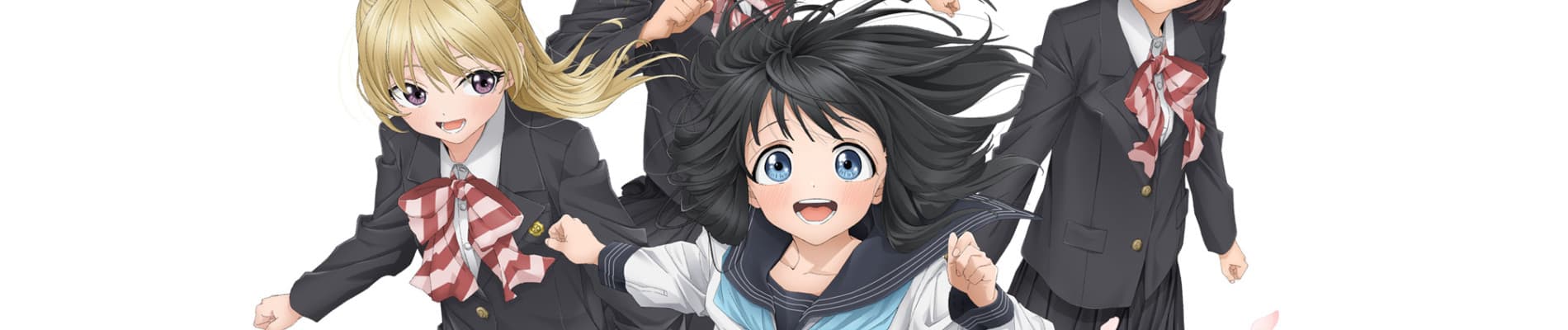
It was Komichi Akebi’s first year of junior high and she had her heart set on one thing: Robai Private Academy’s sailor uniform. As the next chapter of her life got closer, she dreamed of all the exciting new experiences she’d get—school lunches, classes, club activities, and of course, making lots of friends! With her favorite outfit on, Komichi felt ready for anything. However, it turned out that the school had a new dress code. What could be learned here, then? Maybe it’s important for parents, or legal guardians, to confirm the school regulations before the entrance ceremony? No, since the school allowed her to go to school in that attire, in favour of tradition, something greater presents here. As a country proudly having its very own unique culture like Japan, the lesson here is that appreciating tradition must be top priority, even in the case of breaking the current regulation, without a single doubt. You kids had better take it into account.
The Characters
Life is kind of stressful, even for the kids, not to mention the aforementioned institution is a prestigious private all-girl school. Therefore, the children must have been through unimaginable pressure, in order to pass the entrance exam, and as a result, there were quite many lifeless souls, who were in lack of either confidence at themselves, or motivation to fit in the new environment, or questioning their current place in life. As such, ever since the encounter with the energetic, friendly, prominent girl in the unique sailor uniform, who was capable of doing mostly anything, they had gradually grown attracted to the young Kenobi...I mean Akebi. The more (skin) contacts they made, the closer the characters came to each other, and the more new things they learned, the further they reflected upon themselves, and hence, found more room to grow. A girl gradually grew proudly of her feet, as well as her body, and got interested in photography, in order to capture the beauty of human. Some felt confident at befriending, since Akebi had shown them the way. A musically talented kid got the courage to perform in public. Another began learning the basis of guitar, in order to play it to her precious friend. Hope she would become a self-taught bassist as big as Paul McCartney... Hell, even Akebi wanted to get used to the spotlight, so she had joined the Drama Club. Their interaction had gently become the driving force of their self-improvement, and the consequent growth is definitely a symbol for the beauty of friendship.
More characters developments
Spoiler, click to viewclick to hide


Other Symbolisms
+ We all know the infamous meme regarding to anime, even though Hayao Miyazaki never explicitly said so.
>You see, whether you can draw like this or not, being able to think up this kind of design, it depends on whether or not you can say to yourself, ‘Oh, yeah, girls like this exist in real life.' If you don’t spend time watching real people, you can’t do this, because you’ve never seen it. Some people spend their lives interested only in themselves. Almost all Japanese animation is produced with hardly any basis taken from observing real people, you know. It’s produced by humans who can’t stand looking at other humans. And that’s why the industry is full of otaku!.
As a form of rebuttal against the criticism, the anime dedicated an entire episode for the characters to observe the surrounding, and more importantly, human behaviours, since ‘objective observation and record’ is such an efficient way to learn about unfamiliar things. As a result, we have learned that a short girl in middle school couldn’t reach to the top of the vending machine, which was nearly 3m tall, because Japanese female at that age have an average height of 1,52m. Certainly, it was Mission: Impossible, so such knowing is common sense. Then we were given the knowledge that, in order not to interfere in the research object’s activities, and to avoid any failure in putting the slightest details of its behaviours in the record, the observer must be expert in hiding his existence and blending in the environment. As such, the girls had collected quite the amount of information regarding to their classmates (without gathering much attention?), and befriending, socialising, as well as drawing animals and people had then never been easier. Now, do you have any objection, Hayao Miyazaki?

+ Friendship is indeed, pretty important to one’s life, and on the perspective of a person ‘seeking for something genuine’, it has to go through the challenge called ‘hardship’. When a member lost her cherished childhood memento, the group decided to search for it together. Ironically, when they thought they had found it, as if the God of Chance’s joke, it got further away, right in front of the poor girl’s eyes. It seemed all hope had lost, as the owner reached out into midair, aimlessly, eyes devoid of expectation, but other girls didn’t let it be. They determined to be the launcher closing the gap between the thing and their friend, and when the girl got a hold of her memento, her profile was once again lit with joy. The audiences got a plentiful spoon of happiness, to the point of suspension from the fact that the bookmark was placed inside a closed book, so even if it had been dragged outside by getting hooked to the notebook, such tugging sensation would have immediately drawn attention. Nevertheless, the power of friendship is so broken, that we have to adjust how the world functions, in order to obtain it.
Final Thoughts
In a perfect world, the artist, and the accompanist, successfully finished their long awaited performance. Such performance was welcomed with a thunderous round of applause, and my mind went exploded. I had never seen such beautiful crossover between L Chitanda and April is Your Lie. Tears dropped from my eyes, and it has gotten into my mind, that regardless of complaints about fetishes, sexual objectification, et cetera, as long as they aren’t addressed in my review, ignorance is totally acceptable. Therefore, I will halt my pen here and cut into the conclusion. Akebi-chan’s Sailor Uniform is Komi-san 2.0. A masterpiece by default. Must watch.