After giving us Goodnight Punpun and (much, much worse) A Girl on the Shore, Inio Asano finally just sat down and watched K-On. It was an experience. Here was something he enjoyed that did not summon depression, sex, or homicide. “Reality is tough,” the mangaka proclaimed, “so read this manga about cute girls and feel better.”
He started Dead Dead Demon's Dededede Destruction in 2014, which he promised was going to be a nice escapist slice of life story with minimal pain, minimal suffering, and cute girls doing cute things. A break, you know? From everything we know him for. Hhahahahsg. Some of us believed. I believed he was going to create something that was not all… all this. And what is this? How to describe it? Cute as his girls are, this is no iyashikei buffet. I mean, sparingly it is, but it’s also everything else: a wild tragicomic hysteric postpostmodern slice of life soft sci-fi sociopolitical commentary with an ending that goes so far off the rails that I can’t decide if it’s disastrous or brilliant. It also has a bad title. I still don’t know what’s going on there. But that doesn’t change the fact that this confused thing is a step forward for Asano that is, if not the mangaka’s best, surely his most expansive, challenging, and ambitious work to date. I've a lot to say about it. Spoilers for the second half of this review (I’ll put a warning).

The overall theme for the 2000s felt like stagnation, but it’s obvious that at this point we’ve entered the end of the world. The world isn’t going to end soon; it’s already starting to end now. The question is how to live in an age where the whole world is spiralling down, down, down…
But this manga isn’t about what’s actually going on. Not right away. It’s about how we live in spite of it. Our protagonists are Kadode and Ouran: high schoolers making friends, planning their future careers, having their first crushes, so on and so forth. They’re trying to live normal lives as tragedy strikes around them, their futures dissolve piece by piece, and the hopeless mundanity of their lives withers within an intergalactic battlefield that pits humanity against an army of harmless Doraemon-inspired aliens.
Ouran is the star of this manga, and for good reason. An insane, hysteric, misanthropic gamer obsessed with ruling the world, she shows the best way to reconcile absurdity is to fight fire with fire. Her antics are hugely entertaining, but she’s a lot more than a degenerate gamer girl mascot. She is a friend! A really good friend, actually, with a lot of love and empathy for those close to her. She is the beating heart of this manga from which heartfelt chaos spills out.
Kadode is less explosive. The straight man, from time to time. More of an audience stand-in. She is lovely and a lot more relatable. Her friendship with Ouran is a joy to read. I will say that, venturing away from the main duo, the other girls are a bit of a letdown, and they never really approach all the personality or chemistry they maybe could have. The rest of the cast do pick up most of their slack, treating us to a funny, resonant coming of age story… among other things. Apart from that teacher. Ew. Miss me with that ironic lolicon shit.

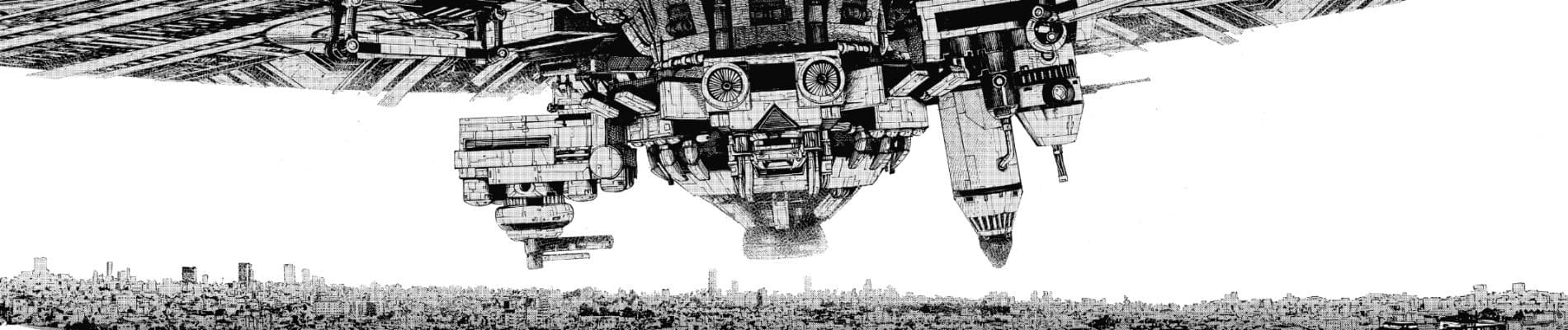
We cannot forget about the disorientating backdrop that is that big ass spaceship parked in the sky, looming over day-to-day interactions in the incredible paint job that is Inio Asano’s artwork. The perspective shots. They have always been a strength of his, I think, and they serve to paint an annihilating juxtaposition between cute, anime-looking girls and the metropolitan battlefield around them. Asano has stuck a lot closer to realism in the past, but working on a little manga called Ozanari-kun showed him how fun it can be to use less realistic, more cartoonish art. In DDDD he has combined those experiments with his usual photorealistic cities, meaning his style continues to evolve in exciting new ways—and he was already one of the most impressive manga artists working today.
I’m getting side-tracked. That spaceship! Asano doesn’t let us forget about it. Even from early on, he gives a window into the political and pseudo-scientific inner workings of the ship and humanity’s ridiculous plan to take it out. Let me just say: I didn’t like these bits. They’re boring. But (and perhaps I’m giving Asano too much credit here) I think that’s what you’re meant to feel. Because we’ve all had the experience of watching the news, listening to these stupid politicians and having our eyes glaze over, knowing we should care but struggling to muster up the strength against rampant disillusionment.
Although Asano said he wanted to turn his brain off and write an enjoyable manga, this is the most socio-politically engaged he has ever been. There is a lot of stuff here! Political overlords drunk on violence and ineptitude. Social activists that are all words, no actions. Alternative cults that run off to the countryside, making clowns of themselves. Conspiracy theorists seeking out alien life despite a literal spaceship parked outside. Not all of it is done well, but Asano also nails this creeping feeling of dread that only intensifies as the series goes on, involving more disturbing themes, more despicable political dealings—the ever-expanding dysfunctionality of a world that leaves you constant fear that something awful is going to happen to the girls. So effective! DDDD involves the friction between cuteness and violence, between mundanity and turbulence, between conspiracy and reality. I’ve seen people saying this is “light” compared to Asano’s previous work, but it is really the heaviest, most arguably pretentious thing he has ever written, even if it has so much humour mixed in.

I’m trying very hard not to call this “postmodern” because no one actually knows what that means even after fifty years, but it ticks all the boxes if you want to sound extra white. Those grand metanarratives we’ve structured our lives around (faith, progress, happiness) are all fading into a fuzzy, irreconcilable mess. DDDD slaps us in the face with a world which has become oversaturated with information (the internet especially “poisoning” our young protagonists’ minds), using irony, parody and intertexts (texts within texts) scattered all around. I did not soak it all up in one read. Some of it I couldn’t be bothered with. This is echoed in Kadode, who carries around The Happy Youth of a Desperate Country by Noritochi Furuichi, an acclaimed book of sociology which her teacher lends her in exchange for a manga. It’s meant to explore Japanese young people and their attitude towards the world, but you know what? She never gets around to reading it. Too boring. Too long for her munted attention span. You and me both, girl.
Broadly, this manga questions how we reconcile the world with an absurd, postmodern pallet. I suppose that makes DDDD pretty cool; and indeed the only thing that keeps me from recommending this to everyone I know is its deep-rooted connection to manga tropes and archetypes. Inio Asano has never been this relevant. He does go on those long characteristic philosophical tangents that sound wholly unrealistic coming from high schoolers, but I think we can forgive him for once.
But I also note DDDD is not all that accessible. It is eclectic and all over the shop, and not always in a good way. We are smacked with seemingly inconsequential characters, long scenes of political technobabble, and pages upon pages of “Isobeyan” (oh boy, I’ll get into you in a sec), which is pretty dull to read. The plot is there, just paced oddly, moving at inconsistent speeds, veering unexpectedly into tonal shifts as the story goes on. Asano’s earlier work, even if it is more depressing, is a lot more straightforward. DDDD is worth the effort! That I can say for sure. Frustrating as it can be, this takes readers to a location beyond existential fluff, depressing nihilism, psychological horror, and all the other past Asano destinations. This is somewhere much harder to pin down.
Okay. It is difficult to talk about this manga without mentioning that it is a very committed Doraemon parody. I wanted to ignore this part, because Isobeyan is odd and uninteresting and I always wondered what it did to deserve so many coloured pages, let alone a paragraph of my review. But it becomes more important as time goes on, unpackaging the ethos of Doraemon and what could be realistic consequences of a naïve middle schooler obtaining the cat’s gadgets. For those in Japan, this reference is a lot easier to access. It is unfortunate again as I try to recommend this to those who live elsewhere, because a Doraemon-less childhood is just another hump we will have to get over to fully get DDDD. Not that you absolutely need to. The general tone of this manga is good enough, following these young girls as they go about their lives, negotiating a disintegrating world that is familiar to us all.
This manga could have continued in that direction forever, really. If it did, It would allow me to cut the discussion, labelling this terrific and relevant albeit a little confused, leaving off there. But Asano won’t let me. He has to complicate things!

Spoilers from now on! Also, mentions of suicide and genocide and other things (jesus christ inio asano lmao). I’m starting off with a quote:
Asano: Reality is tough, so read this manga about cute girls and feel better. I realized how important that is after watching K-On! (laugh) Girls having fun is cute, and cute is something that needs no explanation — that’s what’s so great about it. That’s all I need, I’ve decided.
Interviewer: But to people who know Punpun and read that, it all sounds like one giant build-up: make them think it’s an Asano version of K-On!, and then partway through the series…
Asano: The K-On! characters kill someone or something, yeah. (laugh) Now that’d be a shock. Even I would hate that. But then again, my personality is still basically what it’s always been, so if people start going on about what a fun manga it is and how I should keep it going forever and ever, I could always just make it all come falling down like that. (laugh) But I feel like maybe this time, I won’t do that sort of thing if it’s not what the readers want. That’s where I stand right now, in any case.
Interviewer: I’d like to hear what you have to say about it by the time you’re at volume 3. (laugh)
Well (laugh) I suppose I shouldn’t be surprised.
I’ve always maintained that, barring a few exceptions, time travel sucks. It ruins good plots—tears them to pieces! I was trying to be optimistic here, because this is already an absurd, unhinged story, and surely a bit of time travel can’t piss me off too much. It’s also so into Doraemon that there had to be a time travel gadget somewhere. This gadget comes in the form of the invader’s spaceship, which is capable of sending your consciousness back in time and spawning multiple timelines. We learn that our protagonists have actually used it in the past, and there’s a dark backstory that they no longer remember. Uh Oh, A-Sa-No…
If you’ve forgotten, here’s a summary: After saving an invader and gaining access to their Isobeyan gadgets, Kadode goes full on Light Fucking Yagami on the masses, becoming an agent of justice and murdering “evil” people. Only she isn’t a sociopath, so she kills herself from the guilt. This leads to the alien becoming disappointed with humanity and it tells its friends to piss off. But then Ouran goes back in time, becomes the deranged character we all know and love, and changes the course of history so Kadode stays alive and the aliens don’t piss off, indirectly causing the proper invasion that destroys the world.
There’s the Inio Asano we all love and hate. The soul writes what the soul wants to write, every time, and his soul wants to write kids killing themselves and indirectly wiping out humanity. This is recursive and devastating. I wasn’t ready for this! Yes, I know they were foretelling ragnarok for a while by this point, but that’s different. I was expecting the cast to be obliterated in some Akira-esque explosion (which does of course happen, and I will get to that in a sec). What I was not expecting was the girls’ childish innocence to be sullied, turning them into characters I can no longer blindly love and relate to.

It’s kind of brilliant, really. Asano has always liked this edgy stuff, but it hits so much harder here and completely changes the story, making it even harder to pigeonhole. Anyway, things go further off the rails from then on. We start leaning more and more into the sci-fi apocalypse that has been buzzing in the background from chapter one, but has always been possible to ignore. Not anymore. The spaceship breaks down. Ooba fails to deactivate it. Big boom. Almost everyone dies. The art is gorgeous. I seriously think this huge genocide might be the best I've read, and for some reason I've read a bunch. But then we jump forward to a post-apocalyptic future, and guess who wakes up? Kadode’s dead(beat) dad! He's our protagonist now.
I’m not adverse to big tonal shifts. But this isn’t just a shift in tone. It’s a shift in time, perspective, everything—and all done very quickly. The whiplash is a tad severe, compounded by the fact that Kadode’s dad was never particularly interesting or likeable, and he does not seem intent on changing that anytime soon. We follow him through a post-apocalyptic wasteland which is brutal and dark, along with these two girls that die without me caring enough to locate their names.
Asano speculated DDDD could go on forever and become his life’s work. I kind of wish it did. Instead of a fast-moving, abrupt conclusion…
Sighhhh. I can see what he was doing here. He says it himself in that one interview—that this manga wasn’t planned in the slightest. He allowed himself to be “lax,” just taking one chapter at a time. In some ways that worked. I can even pardon his inevitable decision to make the girls murderers, because it was fascinating to reconceptualise their characters and give an explanation for why Ouran is the way she is. But when this train veers completely off the rails and becomes a serious post-apocalyptic thriller, disconnected from the slice of life, from the humour, from the protagonists we care about… I can’t help but feel that we’ve wandered too far from where we were meant to be. This future is scary, sure, but it left me numb. Especially because (and this is why time travel annoys me) there’s always the feeling the characters can just travel back in time and erase all their mistakes. I will say that, if Asano did want to explore the post-apocalypse through Kadode’s dad, he needed to give himself more time to do so. Certainly more than like ten chapters culminating in the abrupt moment where dad finds his way back to the time machine, enters the time-travel matrix (the art is still gorgeous, maybe even more gorgeous?? this guy is so good), and then—
We’re back. Not everything is as it should be. Isobeyan is gone. The invaders are gone. Hiroshi is fit again, Ouran uses feminine pronouns and Kadode actually got with her teacher (ugh why), but all is mostly what we would have expected. Kadode and Ouran have grown up. They are still close. Life is resumed its usual pace and yet… here’s Isobeyan, appearing through some gap in the time-space, or perhaps through the improved time machine that the future gang were developing. The girls check it out and the story (ignoring an implied sequel) ends.

Let’s backtrack just a little. In this future, Kadode is in the manga business, and she pitches an idea for her favourite parody-Doraemon mangaka. She wants to recontextualise the classic series for adults, reinvigorating the science fiction craze again. And what is the response? The agent says this manga won’t sell, time machines are dumb and impossible, and you’re an “asshole” for suggesting this.
Once again, Inio Asano pitches and rejects his manga within the manga itself. Happens in Punpun too. And in the grim, realistic Downfall he wrote around the same time, which is seems to have absorbed a lot of his worst habits during this period.
Why so sad, mangaka? From everything we’ve heard about him, he seems to be the type of guy that continually doubts and downplays the art he creates, so much so that he does so within the art itself. I kind of hope I’m wrong. I hope his takeaway from this isn’t that it was some obscure mess that no one likes. It won awards! It’s getting an anime! This is good shit, Inio Asano, no matter the ending! You don’t have to feel this way. He does, though. He is undecided and unconvinced with this manga and the zeitgeist he’s trying to capture. The chaotic nature of this story can only be a reflection of his search for an answer. The guy literally uses time travel to reset his own universe (twice!) just so he can come up with different possibilities, moving further and further away from its pure beginnings, muddying the water in the process. That final passage is really a fitting summary...
Beyond youth, time and space, embracing unreasonableness and contradiction. And so their story continues.
I wanted Asano to provide some sweet, simple, love-is-all-that-matters solution to our absurd world, but that was not the note he chose to end on. We are left in curious chaos that resists easy answers, unable to feel what should be warranted for characters we legitimately love; and though we successfully negotiate the landscape, hand in hand, these crisscrossing timelines tangle our heartstrings and leave us in emotional flux.
Well, heck. This is not absolutely satisfying, but it is absolute. Farewell to Kadode and Ouran, interdimensional genociders who remain the very best of friends. Farewell Inio Asano, till next time. You are someone who's given me a lot, and I have the feeling you are not through with us yet.
91.5 out of 93 users liked this review
