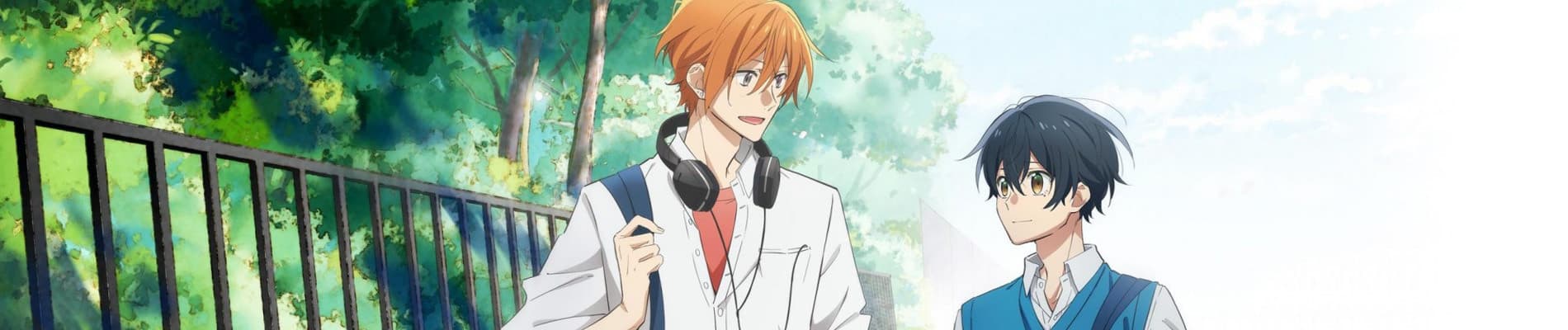
Sasaki and Miyano
a review by Wilza
a review by Wilza
The main character has to be a self insert. The story is clearly written by someone who has read way too much yaoi. This seems to be precisely the point of Sasaki and Miyano . But for the love of god, if you have this expertise do something clever with it.
Sasaki and Miyano presents a drawn out, predictable story about an upper- and underclassman, Sasaki and Miyano respectively. It was remarkably uninspiring story. I was overwhelmed by its mediocrity.
Miyano is a fudanshi. He likes Boys' Love manga. He talks about people at his school being “uke” and “seme”. For a quiet little first year this is fucking absurd. I’d be pretty horrified if some little asshole said I gave off “bottom vibes”. But the bizarre world this show presents seems to think this is normal behaviour, so let’s roll with it for now.
Sasaki is in the year above Miyano and takes an interested in his pretty boy kohai. Sasaki is a bit of a delinquent, but is a good guy at heart. He helps out at his parents bakery. But most importantly he begins to read Miyano’s BL manga.
So hilarity ensures and the two fall hopelessly in love and it’s really wholesome and great.
…
I wish.
Sasaki and Miyano tries really hard to go for this wholesome angle, and it’s just about the only thing it can achieve. The “romance” - if you can call it that - was frustrating. The comedy tag for this show is a blatant lie.
The only redeeming quality of this show is the highly impressive animation. So I extend my respect (and condolences) to Studio DEEN, this series looked fantastic all the way through.
Ok, rather than beg the argument, let us consider for a moment predictable writing. Is predictable writing bad?
As viewers (or readers, for the matter), we go into any romance story with the rough idea of where the story will go. We expect the couple to get together by the end. We expect a number of dramatic beats: a contemplation of feelings, a confession, an acceptance, maybe a first romantic moment.
It’s not a bad thing for stories to follow this progression. In fact it would make for a pretty terrible romance story if it didn’t.
So, is predictable storytelling bad? Well, I think it starts to be bad when it goes beyond foreseeing dramatic beats and it becomes predictable as to how these beats will play out. It’s fine if you can tell that a confession is coming, but it’s bad if you can know exactly how both characters will react.
In Sasaki and Miyano, I expected to Miyano spend half the series comparing himself to his manga and ‘umming and ahhing’ over every word said to him in the confession before obviously saying yes. And it was about halfway through I also realised the ‘umming and ahhing’ was the whole fucking show. And everything became even more dull and predictable.
This is to say that the predictability comes not from a foreseeable structure but uninspired writing within this structure. For Sasaki and Miyano, it is especially egregious because the structure demands us to stay invested in this idiot thinking for 80% of the show.
To provide an example of what I’m talking about, let’s look at a scene from Episode 8 that I have ear-marked as especially awful.
The final scene of the episode features the two in a room wth Miyano in crossdress. Sasaki has locked the door behind him and an astute viewer will have recalled the pair’s encounter earlier in the episode, in which the two comment on getting caught when Sasaki makes a joke about kissing Miyano’s forehead. Hoho, well they can’t get caught now.
Of course, we know nothing of the sort will happen here. It can’t. Miyano is in crossdress and we know Sasaki didn’t fall for Miyano for his femininity. The locked door is pointless addition that attempt to get the viewers mind racing - “Oh my god are they going to kiss?” No, don’t be ridiculous.
So what does happen? Well, Sasaki makes a comment about Miyano being pressured into crossdressing, and immediately regrets how he phrased it. Miyano is confused about why Sasaki cares about how he talks to him and concludes that it’s because Sasaki likes him. Yep. Miyano realises that the guy who has made it pretty explicit that he likes him… likes him.
And then off the back of this conclusion Miyano realises that he likes Sasaki and the Sasaki dramatically hugs Miyano. Are you kidding me? After all of the talking about what it means to like someone and all of the thought put into what Sasaki has said and done. It’s just the realisation that Sasaki was considerate of how he talks because he like Miyano? That’s what broke through this clueless twink’s little skull?
What perplexes me is that the real reason is right there. The actual reason that Miyano should realise literally happens. Sasaki considers it - Miyano offers to get out of the crossdressing contest on Sasaki’s request, and Sasaki ponders why Miyano would do something for him over his classmates. Miyano had heard and recalled the insight of the chairman about wanting to do things for the person you like. But Miyano doesn’t comment on it.
All it would’ve taken is one internal thought and this scene would be redeemable. Right after Miyano says “I’ll go talk to Kuresawa…” all it needed was him thinking to himself “But… why am I changing my mind now?”
If the intention was that there was some form of subtlety going on here, I simply don’t believe it. Why would the show flag such a ridiculous fucking realisation as “Sasaki likes me” but not this? It sets up such a satisfying dramatic conclusion and then falls flat on its fucking arse. Oh and don’t worry, the fucker still isn’t sure enough of his feelings to confess for another two miserable episodes.
Alright, we have to discuss tropes. Trope-writing is a huge part of Boys’ Love and audiences seek out particular tropes they are fond of. There is absolutely nothing wrong with this. This issue I want to flag is that tropes become bad when a writer deploys them in place of writing.
Tropes can be a great thing when they’re done well. When a writer has adept understanding of tropes, they can use them to great advantage.
With character writing, for example, a character that adheres to a trope becomes easily recognisable to the audience. This can allow for efficient storytelling which in turn makes space for more interesting writing. Less time is spent establishing the less important aspects of a character and more time can be spent focusing on a character’s quirks or how that character interacts with the world.
Miyano, for example, obviously adheres to a lot of tropes regarding otaku characters. He’s self-conscious and secretive of his obsession(s), he struggles to articulate himself and he’s nervous and shy. Done well, this could save the writer a lot of time. Rather than fleshing out the ins-and-outs of Miyano interests, the plot can focus on the rest of the character, perhaps their emotional side.
Sasaki and Miyano is very aware of these tropes, but doesn’t employ them cleverly. This is criminal writing. With such familiarity to the genre, I expect a writer to be able to play with it, do something new, subvert expectations, anything. Instead the series felt like pandering. For the pandered too, the show probably works great. To those with the vaguest bit of unfamiliarity to the genre, it’ll feel like watching a checklist of tropes that were being crossed off as the show went on.
I don’t want to exaggerate and suggest the show is filled to the brim with trope. It’s not in your face excessive, but there’s were so many things throughout this show that I’ve seen done before that at some point it stopped feeling excusable. I’ve seen the confession-while-they-sleep play out a number of times now, please do something new.
Out of everything, though, the trope that bugged me the most was the ‘But I’m Into Girls’ excuse that Miyano uses for a number of episodes. It drives me up the fucking wall. I get where the trope comes from, I really do. But I just can’t stand it. I cannot bear to watch a character contemplate their past attraction to a girl as a case against liking a guy. It brings me pain.
Miyano’s contemplation of his feelings is a significant portion of the show, and sexual questioning is obviously a staple of the genre. An unnecessary one, I’d argue, but fine. Take Given, as a perfect example of where sexual questioning plays a very minor role.
If it’s gotta be there - for the checklist, I suppose - I’d like to highlight that it doesn’t have to be done the way it is here. Consider the fairly similar yuri, Bloom Into You. Like in Sasaki and Miyano, the protagonist of Bloom, Koito, has been confessed to by her senpai.
Koito is confused about her own feelings for a long time, and struggles with her non-attraction to anyone up until that point. Bloom explores the questioning of Koito’s sexuality though an asexual-homosexual dyad, rather than a plainly ignorant heterosexual-homosexual one.
Believe me when I say I understand where the heterosexual-homosexual dyad comes from. But if the writer is as well versed with the genre as they seem to put on, do something different for fuck’s sake. Freddie Mercury didn’t die for bisexuality to go ignored by Japanese Boys' Love writers.
Alright, look. I’ve been pretty damn scathing of Sisaki and Miyano. It’s not awful. I thought it was a disappointment, but it’s not fundamentally bad.
The series is clearly made with a fairly specific audience in mind. If you live and breathe BL, I’m sure you loved the series and hate my guts. I get it. There’s probably lots of stuff I’m missing because I’ve only consumed bits and pieces of the genre. I just like romance stuff and someone told me about this series. This review is their fault, not your’s, dear yaoi fan reading this. And just so you know I’m not a hater, I’ll talk about what I enjoyed.
First of all, I thought Sasaki was a really sweet character. I seriously wouldn’t have finished the show if it wasn’t for him. His smile and obsession over how cute Miyano was was very wholesome. It warmed my cold dead heart.
I also thought Miyano’s worries of having feminine facial features was a nice element. The show touches on the idea of Miyano being worried that Sisaki is only into him because he looks girly. I thought this was very interesting. I liked the character development as Miyano became less self-conscious of this. It did feel like the two characters had an effect on each other. If the show had leaned into this harder it could have made for a more compelling story. The conflict that arises from looking feminine and having a boy attracted to you would make for a very interesting plot line.
My biggest praise for the series, though, was the animation. It’s a really, really pretty show. Every scene is beautifully animated. The use of watercolour makes for a very soft and warm visual style. The cut-away shots of the cat were sweet. And the visual motif of the squares and triangles was neat too, I guess. The show, visually, had a real warm feel to it, which really helped sell the wholesome-vibe the series was going for.
All told, though, I really can’t say I found the Sasaki and Miyano enjoyable at all. It was so miserably drawn out. There are some shows out there that grab you and you end up watching five or six episodes before you even realise it. This was not one of those shows. I struggled to get through more than two episodes at a time.
Sasaki and Miyano is painfully long at twelve episodes. Recommending this series to anyone - save the most dedicated fans of Boys' Love - is frankly an act of malice. Do not waste your time on this series.
68 out of 98 users liked this review
