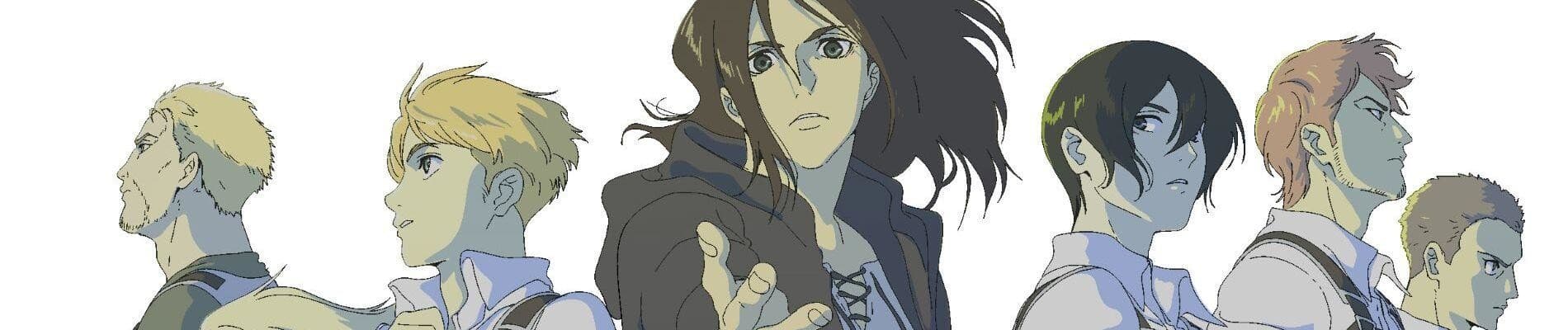
It’s hard to believe Attack on Titan is almost over.
I still remember all the way back in 2013, when one of my brother’s friends showed me the first episode of this weird thing called an “anime.” I was completely unfamiliar with the medium back then, unless you count dubbed Pokemon and Ghibli movies, and I had no idea what to make of something so radically different from the stuff I was used to in Western media. But even though I didn’t actually watch AOT until many years later, that first episode lingered in my mind. The imagery, the music, the electrifying visual storytelling, the vision of a dark fantasy world unlike anything I’d seen before, the sheer majestic brutality of Eren’s mom being eaten... even back then, I could tell there was something special about this show. Something I couldn’t quite put my finger on, but remained like a whisper at the back of my mind. You’ll return to me eventually, it seemed to say. It’s only a matter of time.
Flash forward almost a decade later. I’ve been watching anime regularly for over four years. I’ve discovered masterpieces that have blown me away, stories that have changed the way I look at media, experiences that have made my life infinitely richer. I have fallen in love with an artistic medium capable of truly dizzying heights, explored it from every conceivable angle, and still find new things to delight me. Anime is special to me, and I could not be more thankful for the journey it’s taken me on.
And almost ten years since that first episode creeped into my mind... I am still enthralled by Attack on Titan.
It has been a long decade for Hajime Isayama’s magnum opus. In the time since its first episode exploded into the public consciousness, Attack on Titan has grown so much that it barely resembles the beast it began as. Beloved characters have died, or changed so much that the people they once were are now little more than distant memories. The world we thought we understood has revealed itself to be far more bitter and cruel than we realized. Countless times, our understanding of even what this show was has been flipped on its head or smashed into dust. And the culture of anime itself has shifted just as drastically, ballooning to sizes that previous generations of fans must have thought impossible. Anime today is no longer a niche hobby for weird nerds: it’s one of the single grandest forces in the global market, with franchises and characters and iconography as recognizable as anything from the Marvel Cinematic Universe. And Attack on Titan, time and time again, has stood at the vanguard of that change. It’s the single most popular entry on both MAL and Anilist, a property so mainstream that it’s talked about in the same breath as Game of Thrones and The Walking Dead. Anime fandom’s explosive growth and mainstreaming can be explained in large part by how fucking popular this show has been. It created a space for anime to thrive in the west like nothing else, and it’s maintained the boundary-smashing power even through all its many jaw-dropping evolutions. There has never been a show like Attack on Titan, and there likely won’t be again for a very long time.
And in just one year, marking basically an exact decade since its first episode aired... it will finally be over.
It’s hard to think of an anime landscape without Attack on Titan. Ever since I’ve known about anime had a concept, this show has stood at its forefront. Love it, hate it, don’t care about it, no one can deny how much this show has defined anime for so long. But in just one short year, we will enter a world where we no longer have more Attack on Titan to look forward to. No more dizzying ODM-gear action scenes. No more utterly vicious gore and suffering. No more haunting portrayals of the horrors of war, both physical and psychological. No more gut-wrenching moral dilemmas that force us to choose the better of two terrible options. No more jaw-dropping twists to completely reshape our understanding of the story. No more Levi and Mikasa being the world’s biggest badasses. No more Armin thinking his way out of a desperate situation. No more Zeke. No more Conny. No more Jean. No more Hange. No more Eren Yeager. Pretty soon, all that Attack on Titan will ever be... will be. And we’ll have no choice but to be okay with that.
If it seems like I’m front-loading this review with tons of setup, well, that’s because I am. I’ve never been good at editing my long, sprawling streams of thought even at the best of times. But the reason I’m spending so long talking about Attack on Titan without, well, talking about Attack on Titan, is to help you understand the context I bring with me into this “final” season (By which I mean the first two parts of the now three-part “final” season.Pro tip: don’t label something the “final” of anything unless you’re actually sure it’s the last entry.) I cannot simply approach this show as I do most other anime, because Attack on Titan is not most other anime. It carries the weight of an entire generation on its back, so many memories and expectations and fans new and old. This show has presence. It has a legacy.
And as of this final season?
Well, as of this final season, Attack on Titan has officially become legend.
There’s a lot of reasons why, but most of them come back to the absolutely brilliant basement twist that capped off season 3, and how its revelations reverberate throughout the story from then on. When you look at Attack on Titan on a grand scale, one of the most impressive things about it is how well it grew from a seemingly simple tale of killing big monsters to a difficult, complex world where heroes and monsters are often just a matter of perspective. With each new layer of mystery unraveled, it’s become harder and harder to truly see anyone as wholly doing the right thing. And the reveal of Marley and Eldia, and everything that comes with it, is the moment where that thorny complexity gives way to full-on deconstructive fury. It turns out, these titans we were initially told to think of as mindless killing machines are actually victims of an explicitly Holocaust-esque ethnic genocide, and all this time we’ve been rooting for the protagonists to slaughter their oppressed kinsmen because both we and them bought into in-universe propaganda perpetuated by this world’s version of the Nazis. Gotcha.
It is, without question, one of the cruelest moments in any piece of media I’ve ever experienced. Forget just twisting the knife, this reveal takes the initial premise of Attack on Titan itself and punishes us for believing it. Suddenly, the rah-rah-kill-all-the-big-things edgy action spree we thought we were signing up for reveals itself to be a condemnation of that kind of mindless violence. Suddenly, we’re forced to confront the raw brutality of killing for killing’s sake. Suddenly, we’re forced to take a cold, hard look at the way that society dehumanizes those it believes shouldn’t exist, how rhetoric and media alike can reinforce the idea that some people just deserve to die because of who they are. In this one moment, Attack on Titan reveals that the true, ultimate evil our protagonists must overcome is, well, itself. Or rather, the show it was pretending to be. From now on, Eren and his friends aren’t fighting a mindless horde of monsters that deserve to be slaughtered; now, they’re fighting the forces that made them believe that mindless horde existed in the first place.
And the final season takes that subversion and runs with it. After a four-year timeskip, we kick things off not with our usual band of titan-hunting scouts, but with the people of Marley, the country that oppresses their people. We see how propaganda warps and twists the ordinary people of this country. We see how it molds eager children like Gabi into bigoted zealots willing to slaughter those they believe to be devils for the glory of their motherland. We see how the oppressed Eldians fall prey to its manipulations as well, cursing their bretherin on the far-off island of Paradis for supposedly carrying the sins of all their race. We see how no one, not even reluctant soldiers like Falco, is unaffected by the lies their country has fed them all their lives. And, most importantly of all, we see how those delusions hurt Marley as well, how these ordinary people’s lives are twisted into nightmares of violence and viciousness at the behest of leaders who will never have to suffer the same horrors. Marley the political regime may be monstrous, but Marley the nation is made up of people. People who, just like the people of Paradis, just like us in the audience, were made to believe lies that turn them against their fellow man, made to see them as nothing more than monsters in need of extermination.
In short, what we quickly come to understand is that the world of Attack on Titan is a world where there is to true villain to face. Yet, the Marleyan government is certainly corrupt and fascist, but even if they were overthrown in a flash, the hatred that years of war and propaganda have fostered in its people will remain. You can’t slaughter bigotry with ODM gear, you can’t shoot bloodlust in the head, and there are no arch-villains you can take down to end the pain of centuries of atrocities. The enemy is no single person, or even one society: it’s the concept of hatred itself, in all the cancerous, intimate ways it manifests in the human heart and soul. It’s hatred borne from lies, and the atrocities those lies perpetuate throughout the ages. A kills B, B’s friends kill A in vengeance, A’s friends retaliate in turn, and on and on the blood spills from generation to generation until no one even remembers what they were fighting for in the first place. All that remains is the sins themselves, endlessly perpetuating until, someone, anyone, finds the courage to stand up and say enough.
But it’s easy enough to say that the cycle of vengeance must stop. It’s much harder to be the one to stop it when it’s all you’ve ever known. And over the course of Attack on Titan season 4 (as I’ll henceforth call it), we see how no one is safe from the endless tides of violence. Characters we’ve come to love and trust commit horrific acts in retaliation for the pain they’ve suffered. Characters who perform detestable deeds reveal themselves to be sympathetic, even noble in their aims. Good intentions give way to cruel outcomes, hard choices only make the rivers of blood run blacker, and everyone’s hands end up stained by evil. I can’t remember the last time I watched a show that was so willing to let its characters- characters that a fanbase has spent years falling in love with- do such terrible things and make such impossible choices. Whoever your waifu or husbando is, they are now a war criminal with sins on their conscience that may never be able to wash clean.
Nowhere is this better portrayed than Gabi, one of AOT’s best characters of all time. Gabi is a child who fully buys into her country’s lies, and she does some truly heinous things in support of those lies. But it’s clear that in her mind, she’s every bit the unquestionable hero we once saw Eren and his friends as. The things she does to hurt the people we care about are no different than many of the things they did, atrocities committed unknowingly thanks to the blinders placed over their eyes. Had this show begun in Marley, and only showed us their perspective? We would’ve hailed Gabi as a hero, and cursed the island devils just as hard as she does. Because we are all victims of the sins we never knew existed; all that’s changed now is that which side is doing the killing. Gabi is no more a monster than the people she kills; she’s just a child who was never given a chance to see the world beyond the lies she was fed. But once she’s finally ripped from her comfort zone and forced to confront the truth of what’s going on and what she’s become? Then her slow, agonizing crawl back to humanity becomes the beating heart not just of this season, but arguably of the entire show. Gabi, in all her painful, unforgivable mistakes, represents the hope that when the dust finally settles and the killing is finally over, the children we leave behind can forge a better path than the one we laid for them. She is the symbol of the better future that, against all odds, we must believe is still possible.
Because what is there left to fight for, without hope?
Well, without hope, I imagine you’d end up a bit like Eren Yeager.
I’ve always had a deep, abiding love for Eren. Even back in earlier seasons when most people dismissed him as a shouty idiot, I saw the hidden depths beneath his raw, aching surface that clawed their way further into the light the longer the show went on. But even I wasn’t prepared for how fully season 4 would commit to letting Eren become the person he was always destined to be. Here, the relentless, furious boy who promised to slaughter everyone who stood between him and freedom has grown into a man with the power to make that dream come true and the perspective to understand just how much blood it’s going to leave on his hands. But unlike his friends, who still desperately cling to any possibility they can grasp in the thick mud of despair, he no longer sees any way forward but to plunge headfirst into hell. Let the world burn to ash and humanity curse his name; Eren Yeager will seize his freedom. And just as he vowed all those years ago when he watched his mother die in front of him, there is nothing, nothing, nothing that will stand in his way.
This is always who Eren has been. This willingness to stop at nothing, no matter how many people must suffer for it, has been the darkness swirling within him since the beginning. All that’s changed now is the scale upon which he can pursue that goal... and the understanding of everything he must destroy in order to achieve it. At once tragic and terrifying, unforgivable and understandable, the embodiment of all the world’s hatred and in direct opposition to it, Eren Yeager has grown into one of my favorite anime characters of all time. Call him a fallen hero, a sympathetic villain, an irredeemable monster, or however you see fit to judge him; the weight of his choices speaks for itself. Never before in anime has a protagonist so perfectly switched places to become a main antagonist without ever really changing at all. And never before has a character left me so broken with every choice they make, eternally torn between condemning him and pitying him for the path he’s chosen. Perhaps in a better world, a kinder world, things may have never come to this. But they have, and now we have no choice but to face that agony head-on before it decides the world’s fate for us.
Because the end is coming. Whether we’re ready for it or not, the end of Eren’s journey- and the end of Attack on Titan- will arrive soon. Frankly, I have no idea what to expect; with how desperate the situation has gotten, there’s no telling how things will finally shake out. And I doubt any prediction I make would even come close.
What I do know is this: ever since I started watching Attack on Titan, I feel like I’ve been waiting with baited breath for the moment it all finally falls apart. This roller-coaster ride of a show has been so breakneck at points, so overwhelming and ferocious, that it feels like it can’t possibly survive much longer. Sooner or later, some screw is gonna come lose and the whole thing is gonna crash and burn in a spectacular dumpster fire. Even now, with manga fans complaining to everyone in earshot that the manga ending is the worst thing to happen to humanity since Hitler, part of me still is still anticipating disaster.
But here’s something else I know: every single time I’ve come back to Attack on Titan, those fears have been proven wrong.
I thought there was no way season 2 would be able to recapture the shock-and-awe brilliance of the first season after a four-year gap. Instead, I was given a smarter, more tightly focused story that truly drove home the complexity and weight this series was capable of.
I thought season 3 would suffer from switching focus to fighting humans. Instead, the political revolution arc delivered some of the most jaw-dropping action setpieces yet.
I thought there was no way the basement reveal would live up to all the hype. Instead, the reveal catapulted the story into a level of brilliance I didn’t even realize was possible.
I thought that with the final season switching studios and heading into completely uncharted territory, it couldn’t possibly follow up on the promise of that twist. Instead, I was plunged headfirst into the best, most gripping material of the entire series.
So you know what? Fuck it. I’m done being scared of Attack on Titan going off the rails. I’m done anticipating disaster when this show has proven itself to me time and time again. Every time I doubt AOT’s ability to last, it comes back stronger and surer than ever before. And frankly, judging by the kinds of things the salty manga fans are complaining about (”Waaaaah too much comedy! Waaaaah not enough grimdark! Waaaaaaaah the show isn’t praising Eren for the terrible things he’s trying to do!”), I’m starting to doubt I can trust their word on the matter. I don’t know how Attack on Titan will end, but at this point, I trust Isayama to land this plane just as explosively and beautifully as he began it. What other choice could I make, after everything this show has given me?
In just one more year, marking a full decade since it began, Attack on Titan will end. It leaves behind it one of the grandest legacies in modern fiction, anime or otherwise. It revolutionized a medium, it mainstreamed a culture, it maintained success through years of constant evolution. And to this day, it remains, on its own merits, one of the most astonishing works of art to ever come out of anime. It’s an epic tale of war and violence, pain and forgiveness, cycles of vengeance and children lost in the woods. a vision of the horrors of hatred so raw it’s almost suffocating. It’s an action spectacle second to none and a deep, powerful drama about the people behind that spectacle. It’s an uncompromising journey through the most unforgiving parts of humanity, and yet it never fails to be entertaining- and even hopeful- in pursuit of those painful truths. It’s a triumph the likes of which we almost never see, and likely never will again for many years to come. And I cannot wait to see how the curtain finally falls.
118 out of 145 users liked this review
