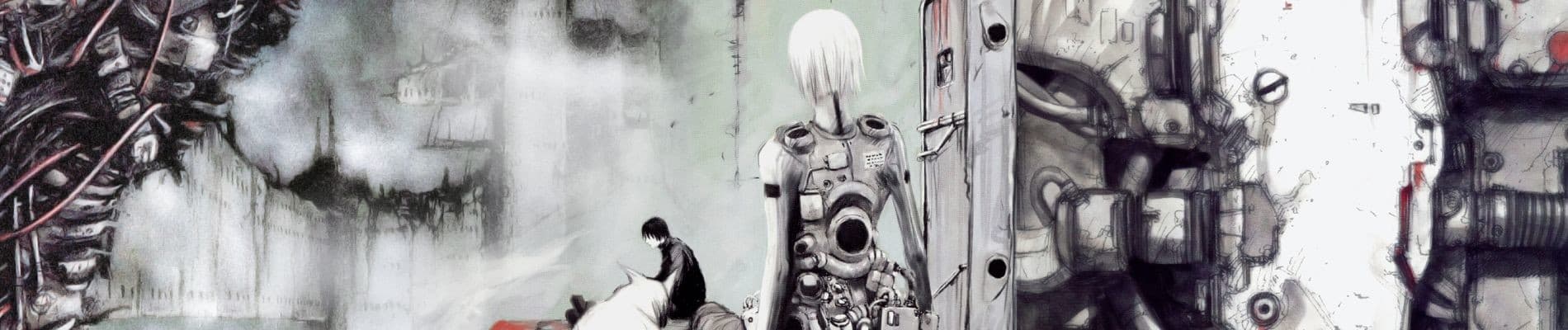
Contains spoilers for "BLAME!"
____
The current landscape of anime and manga is something that nobody would’ve been able to imagine 40, 30 or even 20 years ago. In the past two decades, it went from a couple dozen anime per year to hundreds in a single one. That’s great, of course, but with that comes a certain level of trend-following, predictability and most of all, oversaturation. With the exception of a few shows per year that manage to intrigue and captivate the wider audience or the dedicated few, most of them fall into the pitfalls of mediocrity. And there’s only so much tropey, self-insert and jarringly boring anime you can watch before you start ripping your hair out whenever you see next season’s intimidating lineup of six new isekai or “Best Girl, The Show” you think you just finished watching. Then you go out of your way to look at the weekly topping charts for manga in hopes of a brighter tomorrow and see a manga light novel adaptation of a series with a title harder to read than your doctor’s notes, and everything starts to become an amalgamation of its previous incarnations.

This is where a story like BLAME! stands out from the crowd and makes a name for itself in the manga and anime community over the years. In a sea of overly intrusive writing and predictable stories, BLAME! throws that out of the window in favor of a dreadful, vague and deeply personal story. Dialogue is far and few between in some chapters, others having none at all, done in such a way to fully take advantage of the visual medium that manga offers, letting the reader’s imagination completely take control over this seemingly infinite world and the endless journey of a lone man. Scarcely explaining, if even at all, the various bizarre structures and mechanisms found in the City, because the characters we follow understand only as much as the readers do. In a large portion of the story the environment serves as the true focus of BLAME!, using the characters as a vehicle to move from one scene to another in a way that tells the story by showing us, instead of outright telling us what is happening.
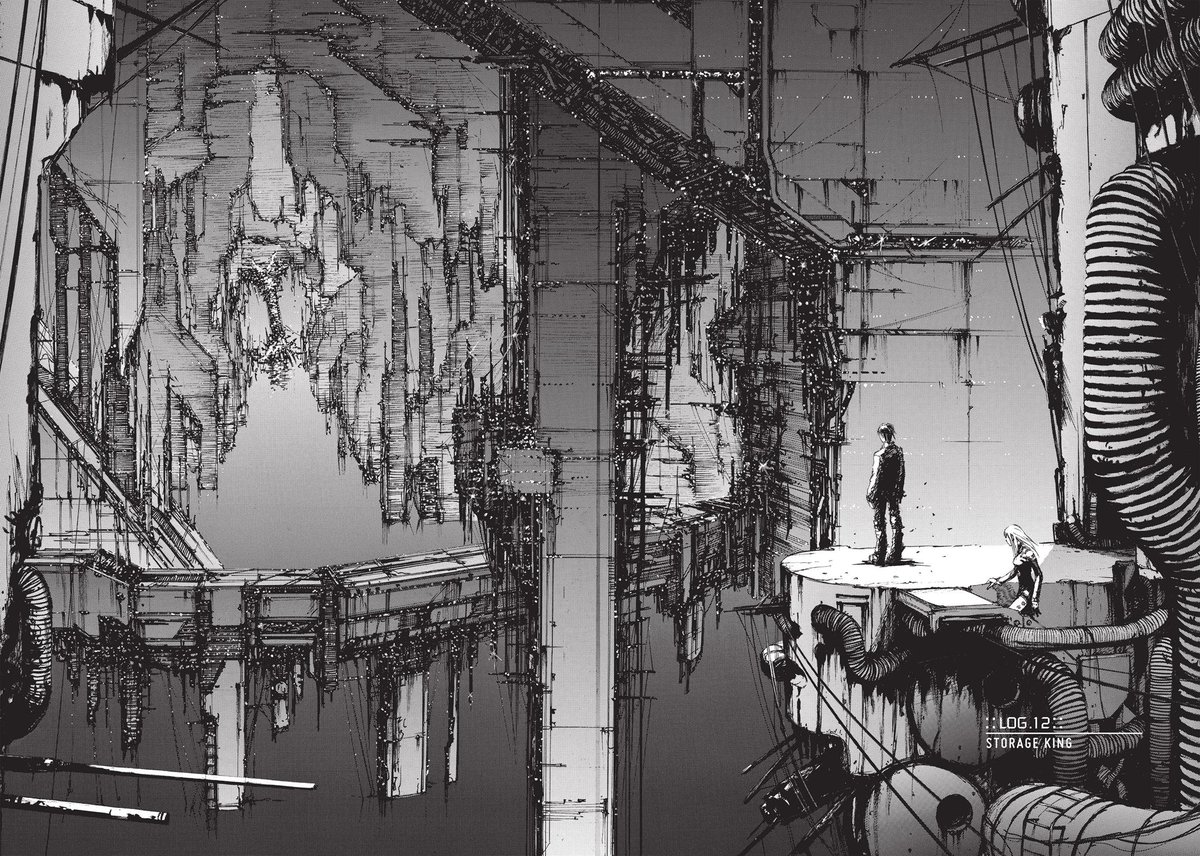
While the way the events are portrayed may lead to a lot of confusion, the effort of piecing the story together with your own interpretations is a gratifying and unique experience, but one that may put some people off, understandably so. Nonetheless, I find that as one of the traits most appealing to BLAME!, as you get lost in the vast City together with Killy, both of you trying to make sense of it.
____
This brings me to my next point – the entities you meet along this journey. Killy is the protagonist of the story, a man of few words, with a seemingly invincible gun on a journey simply defined by his goal of finding the Net Terminal Gene, something that humans used to possess long ago, which gave them the ability to connect to the Netsphere. I don’t really have a lot to say about Killy himself, as we don’t see him talking a whole lot and rarely get a glimpse into his thoughts. From his bland look to the unconcerned and robotic way he carries himself, only going on a rampage in a frenzy once and on rare occasions showing emotion, he is by all means a byproduct of his environment, one stripped of the restrictions of time and enveloped in utter chaos. That’s when a strange bond between the reader and the protagonist starts to form through our shared lack of understanding, using the “show, don’t tell” method to its fullest by making us invested in our own journey through the landscapes of the ever-expanding metropolis, accompanied by and through Killy’s own ventures. Creating this sense of understanding and relatability between you and the main character, despite him being such an enigmatic and fundamentally unrelatable character in terms of personality and characteristics, sometimes getting glimpses into his morbid and detached sides. Ambiguity doesn’t only shroud our main guy here though, as it stretches out to the very core of this nonsensical society. Characters often switch sides or completely transform as we learn to view them in different and conflicting lights.

Cibo, Killy’s main companion and one true ally, is no exception to this – from being hijacked by Sanakan to when she becomes the Level 9 Safeguard, there is no telling when she will unwillingly turn against Killy. Sanakan is another reoccurring and frequent character in BLAME!, originally introduced as a young, innocent girl and later found out by Killy to be a Safeguard, a threat to all humans living in the City. At the end of the story, after being reprogrammed by the Governing Agency she sacrifices herself to save Killy and the child embryo possessing the Net Terminal Gene, carried by Cibo. There’s also Dhomochevsky, who, despite being a Safeguard, protects all humans from the Silicon Life regardless of them possessing the Net Terminal Gene or not. His relationship with Cibo and Killy is one built on and filled with distrust, but still ends up aiding the two in the end due to common interests. These are just three of the many inhabitants of this metropolis that we meet, who walk an ever-changing line between allies and enemies. This also applies to the groups opposing our main character, and it’s also about time I explain what the Safeguards and Silicon Life are, two of the primary antagonistic forces Killy comes across. The Safeguards are programs designed by the Administration which serve to protect the City and its inhabitants and seek to destroy the Silicon Life, who do not possess the Net Terminal Gene, but somewhere along the way an “infection” spread that terminated the Net Terminal Gene in humans, disabling them from accessing the Netsphere, and as a result of that the Safeguards started hunting down both humans and the Silicon Life. Defective programs, which the Administration has lost control over, that now pose a threat to the City even more so than what they were designed to fight against. On the other side of the coin we have the Silicon Life, synthetic humanoid beings that were supposed to be a next step in evolution for humans, developed by a cult named The Order, as we learn from BLAME!’s short prequel story, NOiSE.

Despite the eradication of The Order by the Safeguards, their creations still remained as the Administration failed to fully get rid of them due to the ever-growing City and "infection" resulting in their loss of control over the Safeguards. As such, they made it their goal to never let the Administration gain control over the City again, in an attempt to survive. This goes against Killy’s ambition to find a Net Terminal Gene, as that would allow for connection to the Netsphere once again. The thing that made them surprisingly interesting was that they were no more than synthetic beings, thrust into this world against their will, doing their best to survive as a species, and it just so happened that they were on the opposing side of our main character and his goal. Under different circumstances they might’ve been the “good guys,” but that’s what makes the world of BLAME! and its inhabitants so interesting – there is no good and evil, only people who help you and people who don’t.
____
# Cyberpunk Galore
Time to finally address the elephant in the room – the art. With a story so heavily reliant on visual information, it’s quite hard to really meet the standard and quite easy to mess things up, but BLAME! manages to go above and beyond in terms of art with some of the most stunning environments I have ever witnessed in all of visual media.

From vast, expanding landscapes that stretch across the universe with no seeming end in sight to claustrophobic, densely packed corridors and alleyways that change at every turn, the world never fails to emanate the lonely, dreadful and dystopian vibes that hold the manga together. The City feels both lived in when it needs to be, and desolate when it doesn’t, but always unpredictable and dangerous. This is the key aspect that really elevates BLAME! to a story you don’t necessarily read, but experience. The author, Tsutomu Nihei, used to be an architect and mentioned in an interview that he starts his stories by drawing a rough sketch first. “I think of a story while I work on the panels during the rough sketch. If I don’t work on panel work, I don’t even know what’s going to happen next in the story.” From the creation process alone it is clear that the art is the story, and without the skills necessary it might’ve all just fallen apart. As for Nihei’s personal ambitions, he stated that the reason he became a mangaka in the first place and quit his job was out of a passion to create and spread something, especially to audiences outside of Japan, and that sentiment has reached me and thousands upon thousands of others. If you take a look at my favorite anime and manga, it becomes quite clear that I’m a huge cyberpunk fan – hell, it isn’t limited to just that as Blade Runner is one of my absolute all-time favorite movies and OK Computer is one of my favorite albums, but BLAME! succeeds in delivering the aesthetic to perfection, more than any other piece of media I’ve had the pleasure of consuming yet.

That’s the thing that made me fall in love with the series and interested in it to begin with.
____
Circling back to the beginning of the review, BLAME! offers an introspective journey of a possibility for humanity’s future, accompanied by stunning visuals that have no equal and a storytelling method that is unorthodox to say the least, thus creating a cyberpunk masterpiece that withstood the test of time and is now more intriguing than ever before considering the abundance of tired and uninspired media that surrounds us. But the real magic that made the story such a cult classic is the fact that it’s only as good as you can make it out to be. For some, it’s a rambling mess with cool art, for others it’s the journey of nightmares in a world of uncertainty and ambiguity. A large part of this analysis and review has been just my own interpretations, while others may see things differently. I've refrained from going too in-depth with the actual story, because it simply doesn't land itself to explaining or analysing, opting to become a rather personal journey for each reader in particular. As aforementioned, the only limit here is your imagination and willingness to use it, which creates a wholly one of a kind experience, whether you enjoy it or not. BLAME! isn’t the wanderings of any one man – it’s Tsutomu Nihei’s story, Killy’s story, yours and everybody else’s, each slightly different from the next.

36.5 out of 37 users liked this review
