Goodbye, Eri
a review by OsakaTiger

Disclaimer: I don't know how to review the way manga fans review lol. I don't know how to write those really long posts that also double as deep analyses. I just know how to mindlessly babble about what I liked and what didn't click with me, and have an itch to blurt them out somewhere.
Fujimoto-sensei sent me to this site. For a while I've been thinking about hopping on to one of these review platforms, but I just couldn't imagine what specifically I'd like to talk about.
Then I read Sayonara Eri. This is the book I've been looking for for months.
Some time ago I realized I became a bit more picky with the fiction I consume. I've always had a fondness for works with a strong sense of style, especially one that is informed by and informs the content. Some comics might just have generic panelling, coloring, and leterring. Some films might be philosophically enticing but consist solely of boring shot/reverse-shots. In contrast, there are stories like Asterios Polyp, where each character is drawn, colored, and even lettered uniquely in a story that touches on how different people find themselves from each other. And there are stories like 36, which divides itself into 36 still shots like the 36 photos in a camera roll, as a story about a location scout grappling with the loss of memories following a hard drive failure. These stories go out of their way to cleverly play with the idiosyncrasies of their own mediums in ways that were rarely done before in the same context, and their consequent style and content interplay and elevate each other in a way that is impossible otherwise. Perhaps formalism is the word I'm looking for, but I'm not educated enough to know whether that means what I think it means.
On a side note, I also have an appreciation for wildly trippy cleverness, or anything that I know is too smart for me to get. I may not understand them, but I sure as hell love stories like Pax Americana or Ultra Miracle Love Story.
So while I still enjoy shoujo manga and slice-of-life tales, I wanted something that really played with its medium and explored techniques that weren't just scarcely unexplored before, but really tie into and help express the underlying story.
Fujimoto-sensei delivered exactly was what I was looking for.
To no one's fault, many manga I come across have art that is expertly crafted, but still comes across as uninspired to me. Yes, the illustrations are done professionally (which is more than I can say for other stories), but why does every panel have to be something I've seen before? Someone's talking head against a plain background? Two people walking together? Shots/reverse-shots? And why are mangaka rarely enticed to play with paneling? They more than get their stories across, but why is it hard to come across someone with the same interest in panelling as Andrea Sorrentino or David Aja? I don't want to hold Western comics as some sort of standard that manga must follow. I detest that sort of ethnocentric mindset. And the answer to my question is probably just the stricter schedules that artists follow in Japan. But part of me still asks that question, given that some might argue that manga and comics are essentially the same medium.
If I were to expect most manga I would run across to fit those descriptions, Fujimoto-sensei smashed those expectations. I think I caught myself physically smiling while reading his work just a few pages in. This is what I was looking for. I don't even know where to begin describing it. And I know that I wouldn't be smart enough to praise it properly either. So instead I offer a simplistic bullet list of things that Fujimoto-sensei used to sweep me away:
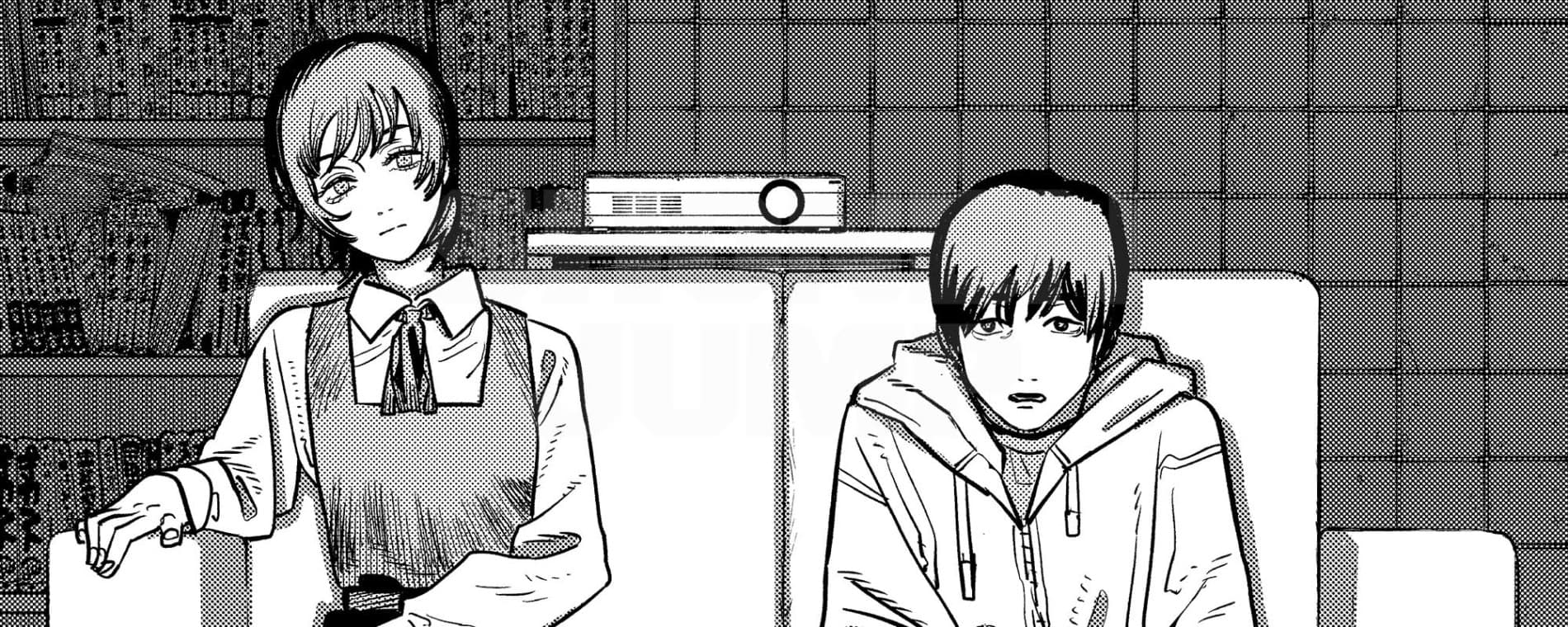
- Panelling. Like I mentioned before, I believe most mangaka are too restricted by their schedules to really experiment with panels the way other artists do, instead resorting to a sequence of panels that gets the job done but doesn't take the extra step to create some sort of rhythm or design. Fujimoto-sensei did the the opposite. I am limited by the scarcity of manga I have actually read, but this is the first manga I read that employed a grid format, in this case a four panel grid. I love this so much for at least three reasons: 1) it gives the book an opportunity to tell its story with an intriguing staccato rhythm, beat-by-beat; 2) it perfectly matches the whole found-footage schtick of the book; and 3) it allows for a sense of humor I didn't know Japanese audiences had (the whole "repeated still shot with silence and a funny statement at the end" thing).
- The meta-whateverness of it all. Like I said before, I'm not educated enough to know if "metafiction" means what I think it means. But I was astounded by Fujimoto-sensei's commitment to it's never-ending story-in-a-story-in-a-wait-am-I-still-in-the-story format. I get giddy just with recapping it: Goddamn
Spoiler, click to viewclick to hide
first you think it's just Yuta's home recordings, then you realize it's the film he showed in the school film festival. But wait, you then realize it IS still his home recordings, continuing from his peers reactions to his father meeting Eri at home. And then you realize even THAT is part of the film he's making with Eri. And when you think they were filming the story about the vampire, you realize you're actually watching a film of, well, EVERYTHING from the beginning, now shown at his school's next festival. And then you think it's over. We're in the future, back to more home recordings. Yuta leaves to kill himself once more, and meets Eri, an actual vampire? The realism of the story is broken, since we know we're not watching a film anymore. Until in the end, in a killer callback, the building explodes. Was it all still a film? - Fujimoto-sensei's art. I'm not referring just to his avoidance of manga's propensity for hyperboles (which I much appreciate in my search for something unique, though of course it's not inherently bad or anything like that), but also his decision to really draw in the motion blur. Smart, aesthetically pleasing, and well-appreciated on my end.
I'm sure there're more things I loved that I'm just forgetting. I'm a little sad that I'm forgetting them, but that's just how it is I guess.
That's pretty much all I have to say for now lol thank you so much Fujimoto-sensei
33.5 out of 36 users liked this review