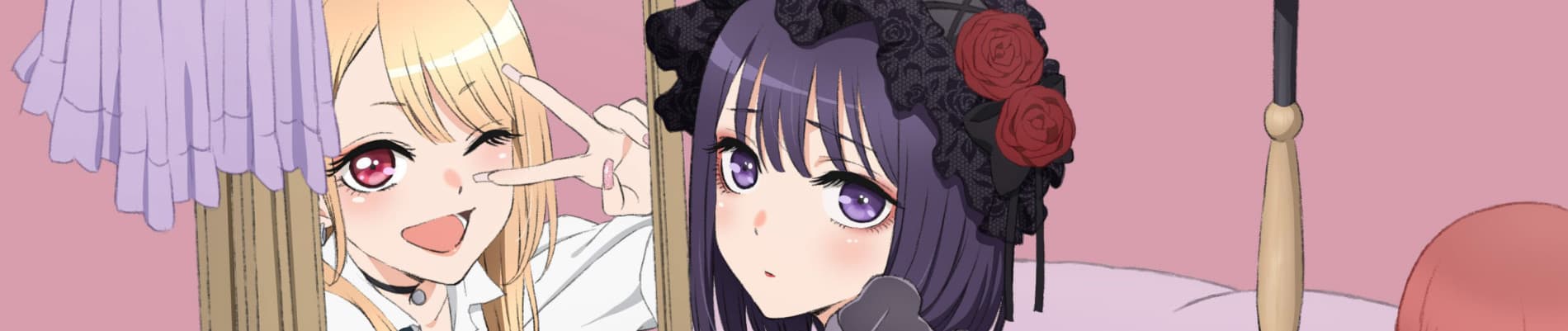

(Note: Most non-criticism on this show in the review is a joke— explicitly stated for the mods. Also, this is a bit less comprehensive than my usual reviews, and way different in tone. Let me know what you think. This review will also contain no spoilers.)
I am a Weeaboo. I am an Otaku. I am an incel. Most of all, I have no standards. So, if when presented with some dumb bullshit, even I recoil at a show’s blatant pandering— then one has to take a step back, and enter a state of postmodern self reflection.

My Dress-Up Darling ticks the right boxes. On a surface level, the tried and true hot anime girl paired with brilliant production is enough— but, as we will see, the egregious lifeblood of Dress-Up’s formula runs much deeper.
The Thematics

Okay, enough dicking around. Point in case: the Dress-Up themes pander to an incel-like demographic, that’s frankly cringeworthy. The very first idea introduced is a common note in anime: “your hobbies don’t matter, it’s okay to be weird: it’s what makes you you. Never judge people” Marin’s entire personal philosophy consists of this throughout the show, as she watches hentai and is proud to share it with the world. Which, of course, draws the shy main character out of his ever-so built-up shell of reclusiveness. This particular hobby of his being doll making, which isn’t even remotely weird, as it’s a respectable profession— but we can get past that. Let’s say in this society, people shun cringers born into families that produce antique commodities. The entire point of this is to appeal to me, and you, and your favorite E-Girl— as it is our “struggle”. Many, many otakus around the world feel outcast due to their hobbies. So when Marin, a hot girl, says it’s okay, we go: “Wow, so true! This appeals to my sensibilities!” Exactly like that, I may add. So, you may say: “what’s so bad about that?” Oh, nothing inherently. However, as a man with shame, I hate being pandered to. At least Oreimo has the decency to come out and put it flat, not touting some sense of moral complexity, acknowledging its own shallowness. When it comes to conveying themes that are simple, there are two ways: subtle, or outright. Repeating the same concept, drawing the direction to add a sense of impact, and basing entirely unnecessary character revelations around this is unfortunately Dress-Up’s method. Which, for obvious reasons, comes off as obnoxious to anyone who’s been taught that weird doesn’t equal bad before.

Okay, okay— I get it. Dress-Up Darling never promised to be a thematic masterpiece, but that doesn’t mean it isn’t a significant part of the show. I would have entirely omitted this section had it not been given such a sense of importance, and portrayed as powerful. It’s like Avengers: End Game, with the scene of all the women going all girl boss mode at once. The fact that it thinks it’s a powerful message is the most infuriating aspect of it, and a dose of subtlety would have done wonders. Subtlety isn’t really a concept I expect most anime to bother with, sadly, though. So, in conclusion: thank you Marin for telling me jerking off to children is okay because I like it, you’ve changed my life.
The Characters

Marin Kitagawa is a female. As I am a raging homosexual, this is a red flag. However, I am a man of culture, and decided to objectify her to make it work. However, despite my benevolent attempts, I was overwhelmingly shut down. As I am an incredible critic with many talents, I have discerned more flaws than just her feminine nature, fortunately. Escaping the bottleneck view of Marin’s thematic purpose, she is built to appeal to the average basement-dweller. A proactive personality, a love of Loli hentai, a curvaceous body, a modern sense of humor, and a cute back-and-forth relationship create the ideal fantasy girl. Her obnoxiousness is attractive to most, and typically, it would make her full of life; as I jerk off to episode eleven, contrarily, I begin to feel she’s robotic. Despite the rock-solid animation breathing life into a stilted character, it’s not quite enough to save her humanity. Due to her factory default setting personality, and perfected archetype, I can’t help but sense a hollowness behind her eyes.They’ve somehow white-washed the edges that animated her, transforming an average character type into a vacant shell. There’s only so much you can push for a certain demographic until the product becomes a revolting mess, and loses its personality.

At first, when Gojo was introduced, I was all hyped up like “they got the famous anime Jujutsu Kaisen in this show?!”. Then I realized that I wasn’t as funny as I think I am, and promptly shut up. That’s the most interesting thing I have to say about Gojo, as he’s yet another stale bread archetype. I argued on Twitter for a little, gauging the community’s defense of him— and to my utter bewilderment, their counter points were my exact points! He’s kind, gentle, somewhat shy, reactionary, good at cooking, and a loner— insane! When I heard that “good at cooking” was a characteristic thought to be unique, I fell over. I don’t know what it is about anime and dudes who like to cook, but it’s perhaps the most common motif among the “nice guy” archetype. Ryuji from Toradora being the obvious classic, but even Fuutaro and the gentleman Toriko are easy examples. The fact that he knows about dolls and cosplay does not make him a compelling character, as they don’t explore that thoroughly enough to be meaningful in any capacity. However, if I had one thing to say, he IS an outlier from other protagonists in this field. His sheer inconsistency is what astounds me the most. Episode ten being the most atrocious example. Gojo is sexually shy, of course, but he often gets so engrossed in his hobby he forgets this fact. That doesn’t make a lot of sense, but we can get over it— it’s for comedic set-up. The issue comes into play when Gojo suddenly breaks this established rule. To connect it back, episode ten entails Gojo struggling to talk to Marin due to his inability to suppress his raging boner. At first, I was like: “Wow, he developed some. This means his relationship is more meaningful, as he sees her in a romantic and sexual light.”. Then I was like: “Am I bloody fucking mad?”. Aptly so, for Gojo ALWAYS viewed Marin in a sexual light. Episode two was about him dramatically collapsing at the sight of Marin’s bikini. Nonetheless, he pulled himself together for her hobby and carressed her tits a little. In episode ten, he’s suddenly keenly aware of his libido at all times, and refuses to see Marin for it. You’ve already seen her practically naked, you wanker! You can handle a risqué outfit for the sake of cosplay, as the show has established this lame concept fifty four fucking times now. I can’t help but feel like they decided to forget his prevalent character traits to create a romantic beat at the end. Genius character writing, bravo.
Finally, I’d like to address character chemistry and vicariously, romance. I nearly forgot to include this section in the review; partly because it’s not comprehensive, and partly because it’s so inoffensive. If you want to enjoy Dress-Up as a purely romance show, you could do much better— but I’m not gonna cry about it. They have the typical proactive and shy guy dynamic, with a modern slant with stuff like the girl getting embarrassed and being relatable. Gojo is the same as every other character within his archetype, landing somewhere in the middle of the “fuck, I’m afraid of pussy” meter. Even the climax is so bland and okay that I can’t harp on it much. I mean, a fireworks scene is about the most cliche thing to implement, but the dialogue wasn’t horrible so it’s almost not worth mentioning. I can’t even really get into analyzing their relationship too much, as it would just bore you to death— they are exactly like you would expect, and are then same from episode one. The only bits of development that happen I’ve already addressed, and same goes for the inconsistencies.

Also, fact: this is a middle-schooler. I don’t care, but I think it’s hilarious.

Second bonus: While I didn’t clip enough to dedicate an entire section to this, the dialogue was fucking atrocious, and funny more often than not. Especially in the dub.
The Cosplay

Cosplaying is a fascinating hobby— from the production of the outfit, to the composition of techniques a cosplayer must employ to pull it off. As most hobbies do, it has a rich history of depth and intrigue that pulls many individuals in like a black hole. Storytellers have sought to chronicle art forms such as this for a long time; occasionally, someone will attempt to capture the novelty in a fictional work. From Shinjuko Rakugo’s depiction of its own rapidly changing art form, to Breaking Bad’s loving depiction of how to make meth— a wide range of stories like this exist. So, as many of the more devout fans would claim, Dress-Up falls amongst this category. It thoroughly depicts cosplay as an art form, one might say. Obviously, as this is a discourse, I don’t believe it holds up— but why?
It’s simply too shallow. Not necessarily incorrect, like some would claim, as I found more evidence supporting the opposite. Such as Shinichi Fukuda, the mangaka for Dress-Up, having gone on record saying they interviewed cosplayers about the hobby. However, the cosplayer they talked about must have simply told him: “at times it gets hot lol, keep that in mind. Don’t forget about titties and stuff, my big chest is always getting in the way of my tight dress!”, for this depiction is a fucking nothing burger. The compression bands are wildly exaggerated; masking tape is a basic technique you could Google in seconds. Nothing here is near educational, and rarely does it depict the art form in a compelling manner. Occasionally an idea will spark that applies to real life, such as females cosplaying masculine characters, or how stuffy outfits can get. Most of this potential is squandered, however, by a lack of exploration beyond surface level knowledge. If this is a in-depth depiction of cosplay, then Food Wars is an accurate representation of the culinary arts.
The Comedy

It’s safe to say I am a fan of comedy series— six out of ten of my reviews have been on them. So, I’ve garnered an eye for comedic timing and the art that goes into perfecting a joke. If only I could replicate that by being funny myself, but oh well, saying “boner” here is sure to make some people laugh regardless. Dress-Up— hooray— seems to be of the same laissez-faire attitude. There are two types of jokes to be found: haha sex, and reactionary face jokes. The first one is typical of any show harboring ecchi so heavily, and is honestly inoffensive. The jokes are mostly lazy, sure, but it’s whatever— they rarely play them to be obnoxious. Bar the occasional tit grab or I accidentally slipped my penis into your vagina moment, where it’ll lead directly into a reactionary joke. Creating an obnoxious combination of the former and latter type of joke, but I suppose I should actually cover the latter before delving so heavily into this concept. Have you ever heard something weird then abruptly stopped a conversation to make an over-dramatic reaction? I hope not, because if so, I hate you. You’re ruining my review. While they rarely scream “NANI????!!”, there’s still plenty of GIF-able and pandering facial expressions to gauge in any particular scene. I’m not gonna pretend like it’s a show-stopper, but it certainly does interrupt the more interesting and subtle dialogue. Dress-Up can’t seem to portray a non-romantic idea without tagging in some shitty facial reaction and “witty” straight man remark. Lots of shows do this, but the lack of alternate comedy here makes it particularly unbearable.
Needless to say, this wraps right back around into appealing to incels with the sexual comedy. So, it’s sexy fun times— to many, that fact is epic. However, is the sex appeal even good?
The Direction
CloverWorks has mastered the art of lighting in anime. It feels fresh, smooth, natural— it adds spades to the tone and visual style. However, Marin is a fucking harpy, and Gojo is a bumbling giant with down syndrome. I mean, look at this vixen’s pointed smirk:


 Bonuses:


Doesn’t really seem natural, does it? Her facial expressions can often seem jagged, inhuman, and bizarre. I would not have mentioned this were I the only one who noticed this, but I’m not. Every cringer under the sun has noticed a facial expression going awry occasionally. Were I to place this, it would point solely at the direction. Whoever decided to overproduce the animation, framing, and lighting here is simply insane. For a slow, “wholesome”, slice-of-life burn one should have a tone that reciprocates that. However, the directors thought it seemed pertinent to put every character on fucking crack. While it does well to capture Marin’s boisterous energy, it creates for awkward looking frames that don’t mesh well with the art style at all. The direction is impressive— but for an easy example, I wouldn’t want One Piece directed like The Monogatari Series. It’s at times tonally abrasive, aberrantly uncanny, and strikingly inhuman. Which is where we begin to connect back to Marin feeling so fake, which ruins the effort put into her seeming so much more proactive.
Naturally, this overproduced direction is obnoxious, which cascades into the point of it’s comedy being blatantly annoying. Which leads to:
The Conclusion

My Dress-Up Darling is an incel-pandering, obnoxious, mess of a product that harbors ape-brained messages and ideals. It’s irredeemable garbage among the lowest common denominator of media, crafted with the undeserving love of a production team that did not understand the show they were making. I would rather have my testicles nailed to the wall than watch another singular episode of this god-forsaken garbage fire. Anyway, see you peeps next season, as I am going to go watch a good show: like To Love-Ru.
