
86 EIGHTY-SIX
a review by xDanyul
a review by xDanyul
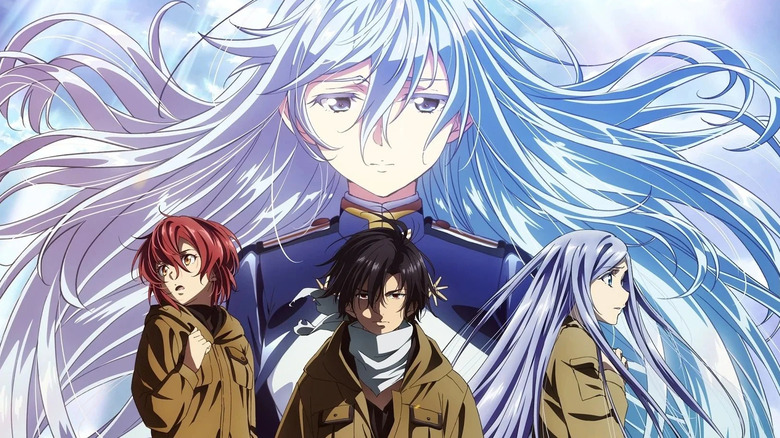
Going to rip this band-aid off first. As I said, it's very surface level to say the show repeats the idea of "racism bad" too much because that very thing is why Lena is a well-written character. She's extremely naive in her beliefs and how she drives them forward, and the anime makes that clear. It isn't trying to deliver a message about how bad racism is, you can see that simply from watching, it's trying to show how flawed Lena's approach to dealing with it is. The majority of the time she is voicing her complaints to a different person than the previous time, though the main two are Annette and Jerome, her friend and superior officer respectively. They both call out her as naive, though for different reasons. Annette criticizes Lena on the basis that nothing that they do in particular matters in the grand scheme of things, even if she believes the treatment of the 86 is wrong. Lena is very outspoken when it comes to the atrocities being committed, but as Annette eventually points out, that's all she's doing. She isn't going out on the battlefield with the 86, but just commanding them from a safe and secure room while showering them with pity. You could compare Lena to the average Twitter user I suppose. All bark and no bite, she thinks speaking her mind is the way to change the world, even if the world around her refuses to move. Jerome is also of the opinion that nothing can change in regards to the treatment of the 86, and blames it on the country as a whole. His approach is a bit more cynical and he believes that the only way change can truly be brought to the Republic is through its destruction. The people of the Republic don't want war casualties or to participate in war themselves, and so with no other options, the 86 have to fight in their place. It's all to preserve the illusion of a utopia. It takes some time, but once Lena finally realizes that she's going to lose the few remaining soldiers she has left, her character arc finally takes hold of her personality and for the first time, Lena truly takes action. Guilt-tripping Annette into illegally using the mortars to help Shin and Co. take on the army of Legion in their path/defeat Shin's brother finally gives Lena the substance she needed as a character. Someone who not only truly believes in what she preaches, but is willing to go above and beyond to prove that. She might not be able to go to the battlefield, but she can do her best to truly support the ones she cares for. As I've said, Lena was naive, and so it's no wonder it took so long for it to get through to her what she needed to do all along. This was only one novel's worth of character, and so I believe it to be a good starting point for her, even if it annoyed some people.
__
Shin
Shin is a bit more awkward of a character to analyze in part one, but it at the very least sets the foundation for his growth in part two, so I'll go over how it did that. We get mainly introduced to Shin through the way other people view him. We only get so much insight into his thoughts as most of that is saved more for part 2, so we come to see him in the light that others do as we don't have anything else to go on. I think this is a beautiful setup for what his character becomes down the line. We never even really consider his feeling toward his role, he just does it, but we don't really know what he's thinking behind his cold gaze. He's the Reaper that takes pieces of those who fall by his side with him towards the final destination, the end of the war. The biggest issue shown though is that Shin is a very in-the-moment type of person. He has goals, but they don't span very far out. He's asked about what he wants to do when the war is over, if he has any dreams for the future, and he doesn't have an answer for that. Getting his brother back so that he can properly carry him toward the end is what's most important to him. I think it's only at the end of the first part that we realize what Shin is really after once he accomplished his base goal of getting his brother back. With no dream for the future, he leaves his friends to go be a distraction so they can continue moving forward. He later tells them at the start of part 2 that his intention wasn't to die, but even if he wasn't actively trying to, we all know the situation that he put himself in was a death sentence. The Reaper had no one to carry him forward, and so he wanted to find his stopping place, where there was no need to go anywhere else. Shin is also shrouded by a lot of mystery, mainly due to his ability that led to the creation of the PARA-Raid device used throughout the show, as well as his ability to locate Legion. It's more explored in part 2, so eventually when I review that, I can talk more in detail about this mystery.
A-1 Pictures is pretty well known as an anime studio and they have done good work on a multitude of titles, and they continued that with 86. The general animation quality was good and the CGI used for the mechs was well incorporated. It would have been near impossible to hand animate the mechs, so it was good that they had quality CGI to help out. There weren't any single scenes that blew me out of the water with animation quality, but it was consistent throughout and that's the most important part.
I liked the art style overall. I don't have much to say about it though as it didn't really add or take anything away.
The most impressive part of the art side of things to me is for sure the OST for this anime. It was a Sawano OST so you already knew it was going to slap, but this might be some of the best music in all of anime for me, at least from what I've watched. It's not only just the songs but the way that they are incorporated into the anime that makes it so special to me. Avid was probably my ending of the year for 2021 if Nai Nai from Shadow's House didn't exist. Overall, a job well done on the artistic side of things from A-1.
I don't think there was ever a dull moment for me during this anime. Whether it was building up its world or characters, or showing off the mobility of the Juggernaut machines the 86 used in combat, I was glued to the screen the entire time. I find it hard to get bored of anything regardless, but this anime will keep you engaged.
For the one thing this anime did best, it was for sure the directing. I mentioned earlier that it was the director's debut and boy did he outdo himself. I mentioned that the music was used to perfection, but I think the reason it all felt so clean was because of how cinematic this anime was. I don't care much for movies themselves, but the feel of certain movies is an attention grab for me. That's a bit vague of an explanation but I don't know how else to put it. It made the war feel real. 86 was an absolute experience. The most impressive thing is that this is a light novel adaptation that actually wanted to adapt instead of advertise. Most adaptations will go through as many novels as possible to reach a certain point, but 86 part 1 was practically just one novel. I believe the end adapted some of Volume 2, but by the time part 2 ends at episode 23, there were only 3 novels used. That's 2 cours of anime that used half as much as most 2 cour do. I'll never get over how this anime was put together, it was one of my favorite experiences in all of the shows I've seen.
I liked this part more than part 2 by just a small bit as it kept the cinematic feel consistent through the whole part as well as a consistent tone. Part 2 is still great and I'll get into that review eventually, but for now, I'm singing the absolute praises of Part 1. I believe this to be a masterful adaptation of just as quality source material and I'm hoping that this anime one day gets a Season 2. I hope anyone who disliked the anime read through what I wrote down and gave it some thought, and perhaps even changed their view. You're allowed not to like something, but please give it a fair shot. 86 really is great, trust me.
83 out of 91 users liked this review
