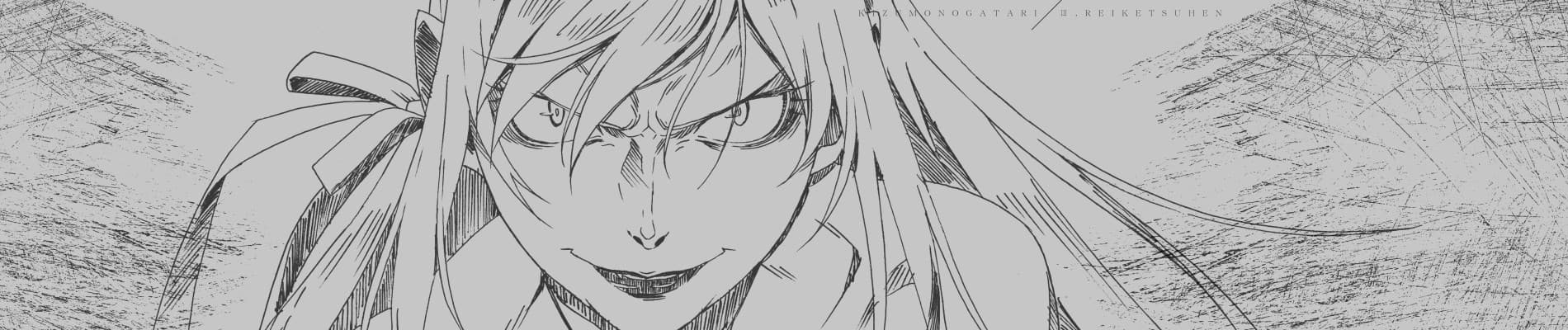

####This review is for Kizumonogatari I, II and III. It contains spoilers.
#Prologue
Just over two months ago, I watched Bakemonogatari and posted a review for it. It was fairly well received, so I set out to repeat my success with a review for Kizumonogatari. I didn’t enjoy them all that much, and well my review… it was not well received. Since then, I have foolishly continued to review Monogatari, broadening my eyes and enjoying the series to bits along the way.
Immediately after finishing these three films and getting blasted for the review, I pledged that I would return to re-watch and re-review Kizumonogatari following the release order. And my god have I been on a journey since then. Watching this film fresh out of Bakemonogatari is a very different kettle of fish to watching it all the way down the line, now, just after finishing Owarimonogatari.
I don’t know what I missed the first time, but Kizumonogatari tells such an incredible story and takes such an interesting approach to the loss of humanity story. The burgeoning friendship and romance of Araragi and Hanekawa playing out along side what ends as the tragic pairing of him and Kiss-Shot is marvellous, and so I’m going to take some time to explore it here.
Beyond it's story Kizumonogatari stands as the most visually distinctive entry into the franchise since Bakemonogatari. The animation borders on ground-breaking – making full use of the modern tools of animation to create three films so lively yet so dark. And they have an awesome soundtrack too.
I loved these films so much more the second time, so I'm very excited to delve into them. So enough with the formalities, let's get going!
#Part I: The Story
Kizumonogatari, at its fundamental core, is a story about the loss of humanity. There are literally seven character in the three films and you could quite easily place these characters on a ‘human-monster’ spectrum, and then track how Araragi moves along this spectrum as the films progress. At one human end there is most human, Hanekawa, probably followed by Oshino, and the other are the vampire hunters and Kiss-Shot.
How every character relates to and effects Araragi can be understood through how Araragi gets moved along this spectrum. Each of the fights can be understood as pushing him one way or the other. Equally, important conversations pull Araragi each and every way as he struggles with his own humanity and the gravity of the situation he is in. Subsequently, all of these characters can be understood as relating to his humanity in completely different ways.
But what exactly does this loss of humanity actually mean? Well, the most basic interpretation of this loss can be the loss of humanity to vampirism, in that by becoming less human, one becomes more vampiric. In this sense, the story is centred around Araragi and Kiss-Shot, and the story quite basically unfolds as follows:
The vampire Kiss-Shot is saved by Araragi. Araragi then wakes next to an innocent looking young girl, stripped of her vampiric abilities. Araragi now stands in her place as a vampire. So Kiss-Shot sends him on a quest to make her a vampire again, promising that by doing so he can become a human again.
Along his way, he has to fight three vampire hunters, each progressively less vampiric, with Dramaturgy being a full vampire, Episode being a half-vampire, and Guillotine Cutter being fully-human. Finally, the film concludes with a vampiric Araragi facing off against a vampiric Kiss-Shot and the film resolves by trapping them both in a state of being not quite human, yet not quite vampire.
Through this understanding, however, the struggle and tragedy of the films make little sense. The actual loss of humanity that Kizumonogatari explores is much more complex than this. It’s important to note that only one of the seven characters die in this film, and the death is used to demonstrate what humanity is actually at stake. Rather than the loss of humanity to vampirism, it’s the loss of humanity to becoming a monster, but by monster, the films mean someone that kills.
Quite ironically then, the humanity of these three vampire hunters is actually inverted by this understanding. While Dramaturgy is the most vampiric, he is the least monstrous. Episode is half-vampiric, yet attacks and nearly kills Hanekawa. In his willingness to do so, he is made out to be a monster. Finally, Guillotine Cutter kidnaps and is completely willing to kill Hanekawa in order to ensure victory, making him the most monstrous of the three. In turn, fighting each of these three progressively pushes Araragi further towards monstrousness himself, with each fighting pushing him close to this limit.

###“Give up your humanity.”
So if the vampire hunters are all pushing him one way, then Hanekawa is pulling Araragi the other way. Hanekawa is the idilic human. She’s more than human: absolutely saint-like and impossibly kind. Although not to excuse it, this idea even feeds into her exaggerated physical depiction. She doesn’t exist merely as a helpless princess for Araragi to save, but she acts to transform him and grant him strength as a human.

###“If they got hurt, I’d be hurt too.”
In Araragi and Hanekawa’s first encounter in Part I we understand that Araragi sees human connections as a weakness. When he sees his friends - if he had any - in pain it hurts him, when they cry he cries. He seeks this a weakness, and therefore remaining friendless allows him to be “stronger as a human.” In essence, he sees empathy as a weakness.

###“Have I told you about the strength of human beings?”
Part II essentially tracks how Hanekawa changes Araragi. Araragi enjoys talking to her, but when he is trying to be stronger at the beginning of the film he pushes her away and deletes her contact information. By the end of their encounter in the wheat field, we see how meeting Hanekawa has brought about character growth for Araragi. “When you were wounded, it hurt like it was my own,” he tells her. He now understands that empathy is human and it what makes him stronger in these fights.
This empathy, however, drives him too far and after he almost kills Episode and her kidnapping by Guillotine Cutter drives him to do something that is, as he says, “not human at all”. He tries to send her away to both protect her and protect himself.

###“This is certainly not human at all”
However her return in Part III is what stops him from killing himself and pushes him to fight for his humanity so he can see her again after Spring Break. In this moment Araragi sees himself as a monster for unleashing Kiss-Shot upon the world, and for every human she kills, he sees that it will be his fault. Suicide, in his eyes, is the only way to atone for such a sin.
Hanekawa, however, pulls him down of this ledge. She tells him that she is willing to die for him. If he must eat, he can eat her. In this moment, Araragi reflects on her self-sacrifice through out the story and realises he can’t kill himself.
In the climax of the story, it is Hanekawa once again, putting herself in the face of danger, to stop Araragi from killing Kiss-Shot. In the moment before he kills Kiss-Shot, Hanekawa explains her and makes Araragi realises that killing Kiss-Shot too would make him a monster.

###“Do you really think my servant can kill me now that he has heard all of that?”
As a quick aside: I do have to mention that the aforementioned scene between Hanekawa and Araragi in Part III devolves into pure fan-service to the wider detriment of the film(s). There’s the vague justification that the breast-fondling shows that Hanekawa is willing to do anything for Araragi, and I suppose you could argue that there is some parallel between giving up her body physically and giving it up sexually. However, in my eyes the scene totally dehumanises Hanekawa. With Araragi forcing her to say the gross lines, the whole scene just left a really bad taste in my mouth. If Hanekawa is supposed to be the idilic human, objectifying her really undermines this. It’s also just a bit sexist. Anyway, moving on…
So it’s only though understanding of the importance of both forms of humanity that the films’ conclusion becomes so tragic. In Part III Kiss-Shot has quite literally grown-up and regained her full vampiric form, but in the eyes of Araragi she is yet to be a monster. In fact, the moment they share talking on the roof cements Kiss-Shot as a friend in his eyes – his only other friend aside Hanekawa.

###“You are probably the first human in history to willingly offer his neck to a vampire.”
She’s transformed into a monster when she kills Guillotine Cutter and Araragi realises what he’s actually done. The only solution to prevent more death is to kill her, which leads to the climactic final battle. And the climax of this climax, is the moment Kiss-Shot lays on the ground and Hanekawa begins explaining.
In the moment I felt really mixed about Araragi's decision to not kill Kiss-Shot and restore his own humanity. I found it somewhat difficult to empathise with Araragi. It seems like a win-win; she wants to die and he wants to be a human.
But Araragi isn’t just someone who will do the right thing, he will do the rightest possible thing. During Second Season we see Hanekawa’s innocence and purity peeled away and in turn we come to learn that it is really Araragi who is unquestionably altruistic. In this, we the viewers might not perfectly empathise with Araragi’s justification - in his position, killing Kiss-Shot to regain his humanity seems like a no-brainer.
But for Araragi, killing her would mark the loss of his humanity too. Monsters kill people, and as much as she was a monster, Araragi comes to empathise with her as she lies there crippled and Hanekawa explains her motivations. Kiss-Shot’s willingness to sacrifice herself echoes not only his own willingness to die for her at the start of the films, but Hanekawa’s own willingness to die for Araragi, thus humanising her once more for Araragi.
There is no win-win, but Oshino presents the lose-lose, thus making this their great tragedy, forever linking them through their wound tale. By damning them both the an existence of not-quite vampire, not-quite human, Araragi is cursed with a twisted irony: he gave up being human to save his humanity.
#Part II: The Production
The first thing to note about Kizumonogatari is that it is markedly different from all other entries into the Monogatari Series. And I don’t just mean visually. Kizumonogatari not only looks and sounds different, but it’s founded on a completely different way of telling a story.
A phrase that gets thrown around a lot in discussions about Monogatari is ‘dialogue-rich’. And this is true; Monogatari is, without a shadow of a doubt, very ‘dialogue-rich’. But ‘dialogue-rich’ is just a nice way of saying that a lot of the show features two or more people expositing at each other. A huge part of dialogue writing is exposition and explanations and talking-at, rather than talking-with. This ain’t a bad thing at all. No, it’s actually at the heart of what makes the Monogatari Series… well, Monogatari.
Kizumonogatari, however, isn’t really ‘dialogue-rich’. In fact, the dialogue is a lot more… normal. The ‘show don’t tell’ mantra that Monogatari fiercely disobeys, is more adhered to here. There’s exposition, sure. But the script is written so people have actual conversations. And the animation is utilised in tandem with the spoken.
Something I’ve noted before as characteristic of SHAFT’s animation of Monogatari is what I’ll call a ‘platform animation’ style, in which the animation seeks to be a platform from which the dialogue is delivered on. This style is what creates these very detached animations of dialogue scenes, in which the visual depiction is very obviously not the reality of the scene. The wild animation seeks visually engage the viewer and to amplify the dialogue rather than expand upon it.
Kizumonogatari takes a daringly distinct approach from the series, however. Along with the more restrained dialogue (by which I mean there is literally less dialogue, not that it’s less dramatic), the series seeks to animate the scenes with a much higher regard for reality. What this means is that we get three films that care a lot about cinematography, mise-en-scène and sound, and their relation to the story and the creation of a mood.
Through this the films successfully and very incredibly create a brooding and tragic atmosphere.
To save a bit of time, I’m just gonna limit myself to ONE of the cool things the films do to build this aforementioned mood. Through out the films there is a lot of visual storytelling done though light and shadow. Characters and buildings often cast long shadows, drawing attention to where light is and where characters are. Sun pours in from windows to partially light the characters or beams of light do so fully. Backlighting creates dramatic dioramic shots. My favourite little trick they played was in this set up during Hanekawa and Araragi’s first encounter:

###“Yet she has no shadow”
In this moment we’re told that vampires don’t cast shadows, and so this shot provides a foreshadowing of Araragi's fate, that is beautifully payed off when Hanekawa and Araragi’s meet again in Part II:

###“You might run into a vampire.”
And we have to talk about the music. My god, Satoru Kōsaki’s soundtrack is masterful. Tracks like Negotiator or Friend heavily build this jazzy style that evoke the classic noir genre. Meanwhile violin and string pieces masterfully build tension that capture the iconic horror sound in pieces like On the Verge of Death or otherwise feel perfectly tragic in their own right like Blood.
And not to forget the heart-wrenching main theme of the movies, constantly being referred in the rest of the music. Etolie et Toi makes for such an incredible closing track for the trilogy. Why does French sound so romantic yet so sad?
From an actual technological perspective there are a number of things the films utilise to make such striking visuals. The most notable are, of course, the CGI work and the rotoscoping. The rotoscoping makes for unbelievably smooth character animation, the characters move with such fluidity, unlike anything hand-drawn animation can achieve alone.

And these characters live within a CGI rich environment. Often, CGI in anime can have the effect of sticking out like a sore thumb. This tends to be because CGI is used to render a handful of 3D objects throughout a show or movie, often those that move through the scene in a way that would be incredible difficult and time-consuming to animate by hand. In Kizumonogatari, the 3D objects animated with CG are, well, most of them. It doesn’t stick out because nearly all of the non-character animation is CGI. For films that so heavily utilise light and shadows, the CGI also allows for some incredibly lit shots that you’d only really be able to do in live-action film otherwise.

Together, the CGI and rotoscoping create a very interesting visual style. At worst, the two can feel slightly disjointed. However at its best, it allows Kizumonogatari feels so rich and detailed. The settings feel complex and real while the characters leap off the screen. My personal favourite example of where this works so well is the nerve wracking sequence of Araragi following the trail of blood through the winding passages of the train station to find Kiss-Shot’s body. By using both rotoscoping and CGI, this scene is able to easily exploit camera movement and it allows for some incredible close-up shots of Araragi walking, which keep the forward moment of the scene while also showing Araragi horrified face.

##Epilogue
Wow. Ok. Well, if you looked at this daunting wall of text and skipped here, I don’t blame you. And if you read all of that, I’m amazed. The three Kizumonogatari films make up one of the most interesting Monogatari entries to break apart and talk about, so I hope you don’t blame me. If you, for some ungodly reason, want to read more – I ended up cutting a third part of this review, where I revisit some of the issues I had when I first watched them. I’ve posted it here.
The films explore some really interesting themes, deploy clever subversions and uses of the vampire genre and are fantastically animated and scored to boot. There is no denying how pretty these films are; they ooze style. And this time, I also think it told a damn good story. It’s probably the least Monogatari Monogatari has ever been, but it works so damn well.
When I finished Owarimonogatari, I was very excited to watch these films again and this excitement was well-founded. Kizumonogatari is an absolute joy. There’s so much more of this movie that I found on my second watch and so much more that I wish I could talk about. So many more sequences and shots that I’d like to jam in here - I didn’t even mention a single fight scene!
All told, Kizumonogatari, the wound tale, the blood-soaked prequels, are brilliant. A tragedy told in red, a romance cast in black. Worth every second of your time and worthy of all the praise it gets.