Goodnight Punpun
a review by Illuya
a review by Illuya
Sometimes, life sucks. We fall into heated arguments with old friends, get crushed by society’s norms and expectations, and the terror of wasting our lives away in some nondescript office, perpetually filling out Excel sheets until we can finally go home for the day, is always lurking beneath dreams and aspirations. In this sense, it can be hard not to view the world as a sadistic yet unacknowledging obstacle course, always throwing roadblocks in our way with the hope that we will, one day, succumb to the pressure and give up. Most of us endure this and move on, but there are also those to whom this seems pointless.
Punpun Punyama is an ordinary kid: he gets into trouble with his friends, watches whatever porn they can get their hand on, and dreams of becoming an astronaut and discovering his own planet, one free from unreliable adults and boring school lessons. One day, a new girl starts in Punpun’s class: the gloomy yet endearing Aiko Tanaka. He immediately falls in love with her, and this marks the beginning of an obsession, a desire for Aiko to love him back. But life doesn’t always go as expected…
This is the setup for a story chronicling the life of Punpun from childhood to early twenties. It’s a notorious manga, and for good reason: Goodnight Punpun provides little in the way of comfort, a crushing reflection on the harsh realities of the modern world and the confusion felt by young people as they navigate life-shaping decisions and pressure from the people around them. There are brief moments of exultation and human connection, but these are fleeting and come with a bittersweet taste: as readers, we know they won’t last for long.

What sets Punpun apart from other depressing pieces of media is creator Inio Asano’s effort to remain grounded in reality. Every action, no matter how repulsive or excruciating, feels plausible, and the manga often walks on the edge between ordinary life and atrocity. This is what makes it such an effective story: deep down, although we may not be inclined to admit it, we know that this could and will probably happen to us. We, too, will make mistakes and hurt others and humiliate ourselves; after all, that is part of being human. In this, there is a sense of horror: the reality of Punpun is right around us, right in front of our eyes. There is no escaping from it.
However, reducing the story to “hey, life kinda sucks!” would be a massive disservice. As the ending grew closer, I came to realize that the message of Punpun is not related to its worldview or sense of dread; it is found within our main character. From his early teens, Punpun is convinced that there truly is no hope, that he is on his own and will just have to hide his pain for the rest of his existence. His one solace is his fixation on Aiko, a sentiment that seems to carry him through the tough times; over and over, he tells himself that once the two of them are together, everything will be alright. He will finally find happiness and be purged of his burdensome feelings. This is his problem: rather than moving on and trying to carve out a living for himself, he spends years obsessing over a single individual, inadvertently harming himself in the process.
Yes, the world can be a bad place and is full of bad people. But what will we gain by telling ourselves that over and over? The answer is nothing. We will slowly seep into a dark nothingness, a state of hopelessness and despair where we come to hold the conviction that there truly is no way out. But we also can’t just sit back and wait for something to descend from the heavens and grant us a clear path; that is for us to figure out. It might be difficult, but it is something we must do. Not just for ourselves, but also for the people around us.

Punpun’s perspective is only one side of the story. There’s a peculiar doomsday cult, two schoolmates still clinging to each other years after graduation, and a troubled uncle; Asano introduces us to multiple characters that organically shift in and out of the narrative, forming not just one story, but a collective of them. Just like the people around us, these stories cross paths multiple times, both directly and indirectly, until they eventually collide into a larger whole… and then separate as time passes and individuals change. Sometimes, these pieces seem to thematically resemble each other: as one character is preaching about the approaching apocalypse, another sees his life slowly crumble. It’s masterful.
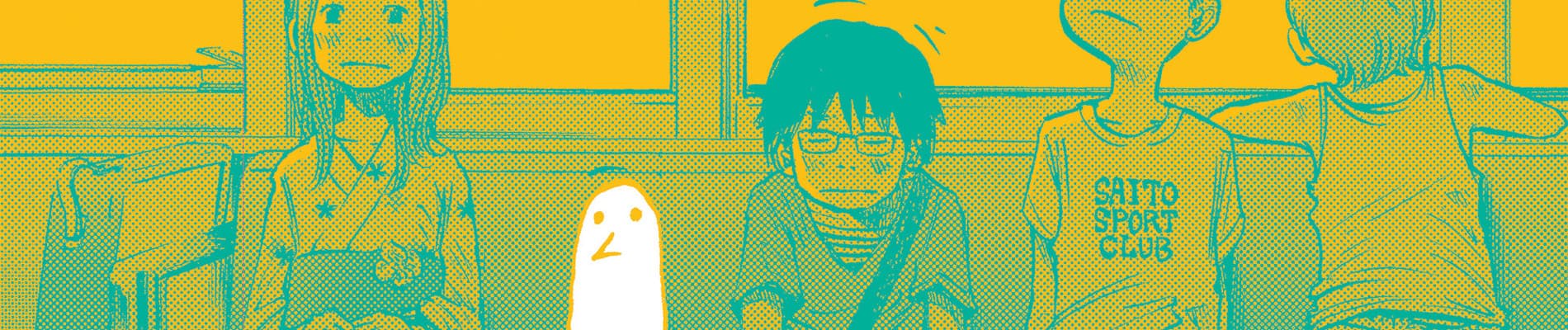
The art style, too, is one of many elements. Asano juxtaposes strikingly realistic backdrops of Japanese cityscapes with cartoonish character design, best seen in the way Punpun and his family are depicted as simplistic, bird-like creatures. Even so, his characters are drawn with immaculate detail and carry an array of emotions expressed through subtle detail, such as a single tear taking shape in an eye. There are also plenty of experimental panels, with examples being how Punpun’s appearance shifts as the story progresses, and an imaginative god being shown as a poop-adorned alien in a UFO. Yes, you read that right.
These visual oddities symbolize a childlike wonder and playfulness, contrasting with the boring, utilitarian buildings our cast is surrounded with. But as they grow older, this imagery comes to carry a new meaning: the characters have now lost this innocence, and their creations remind them of a simpler, more carefree time where they had little to worry about, but also the people they were back then and how they’ve changed. They spent their childhoods alienated by grown-ups; now, they have become ones themselves.

Goodnight Punpun took me on a rollercoaster of emotions. Four times it made me shed a tear, often it made me depressed, and occasionally, it even caused a faint smile to appear on my lips. There are times where it feels like the narrative isn’t heading anywhere — we’re simply observing Punpun and his acquaintances go about their mundane lives, every so often having fun in the company of each other — but it is through these scenarios that Asano shows us who these people really are: humans, just like us. Flawed, but ultimately benevolent beings stuck in a world that at every turn seems to be their opponent.
We all face challenges at one point or another. What matters is how we respond: do we tell ourselves that we’re a failure and don’t deserve to exist, subjecting ourselves to constant self-pity, or do we try to face the obstacle, either alone or with the help of someone else? When faced with change, should we wistfully cling to the past or seek new opportunities? If Punpun has taught me anything, it is that, for both questions, the best answer is the latter. Life is tough for everyone, and in the end, it is our perception of this toughness that determines where we’ll end up and who we’ll become.
119 out of 125 users liked this review
