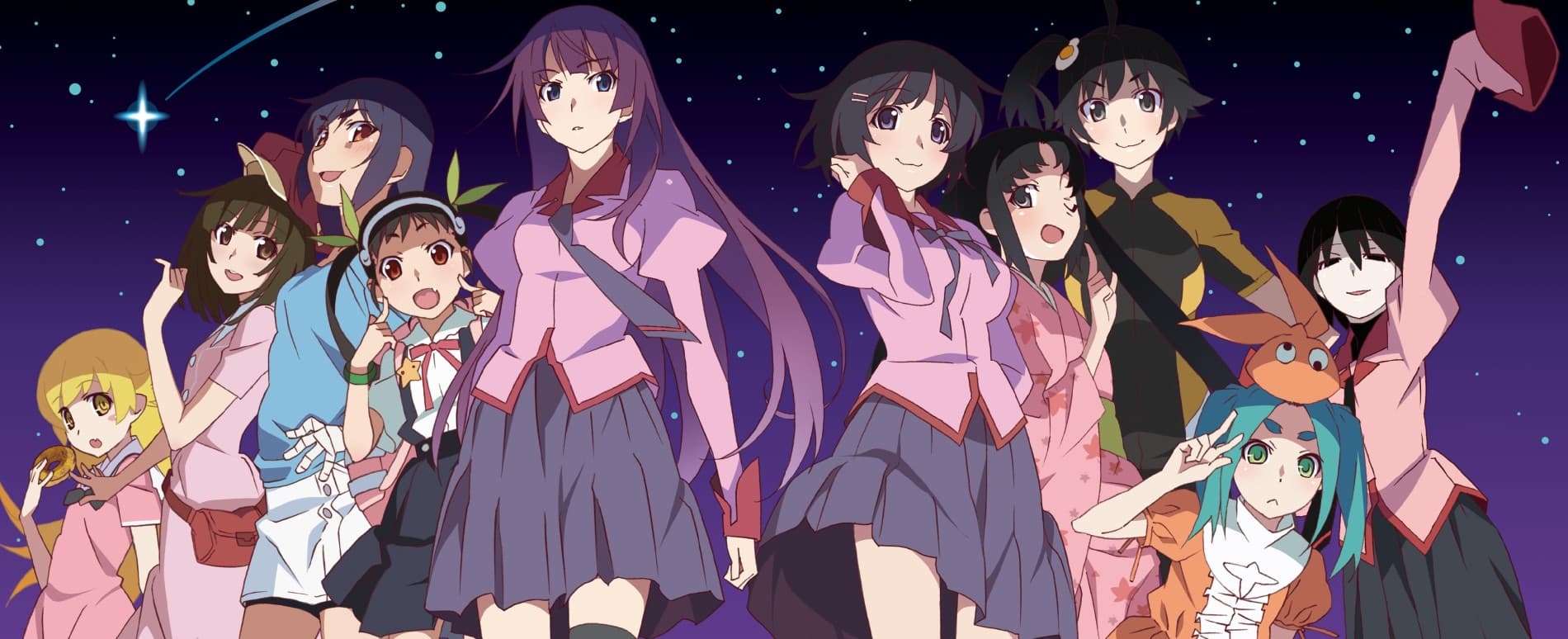
Koyomimonogatari
a review by Wilza
a review by Wilza
#####This review is spoiler free.
When I review things I try to consider what that thing is trying to be. We can judge something for both what it’s trying to be and how well it achieve that. In comparison to the rest of Monogatari, Koyomimonogatari is unimpressive. But it’s trying to be something very, very different from a typical Monogatari series. So, because Koyomimonogatari is a series of short episodic ghost stories, we shouldn’t judge it the same way we judge the other series.
To save you some time, my three word review for Koyomimonogatari: “It was neat.”
The stories aren’t particularly interesting, but each time the episode wrapped up the inevitable conclusion got a good chuckle out of me, or at least a warm smile. It was enjoyable enough without being dramatic or exciting like other Monogatari series.
In part I think this is because Koyomimonogatari is completely episodic. If my memory is correct, the only time a single story has been covered in one episode was the Ougi Formula arc in Owarimonogatari, and even this was done as a special double length episode.
The Monogatari storytelling style doesn’t work at 14 minutes, consequentially, to put it quite harshly, the series does vaguely feel like an imitation of something it cannot be.
The title, Koyomimonogatari, reveals what the series really is, a calendar tale – a series of stories that take place over the timeline of Monogatari. The series essentially acts as a recap of the timeline without actually recovering the specific events or arcs we’ve already seen.
And to be fair, this was useful. My understanding of the timeline was a bit foggy and I’ve actually been trying to keep track of it (I don’t want people to yell at me about my reviews).
In this, the series provided an opportunity to look at how the world has changed. It was nice to go back and see Oshino or Mayoi, and to see Hanekawa and Senjougahara with their long hair. I liked watching the openings from the old series again. I think Koyomimonogatari was a very clever way of looking back on Monogatari and in that regard, it was neat.
And in exploring the more everyday events of stuff we’ve seen before, there were some interesting new little perspectives and insights. This was particularly so in episode eight and ten.
Episode eleven and twelve are the exception to the theme of the series, and present the major plot developments that set up Owarimonogatari Second Season. And, I must say, it’s some very dramatic set up. But to keep this review spoiler free, I won’t discuss them any further.
To actually provide some use for this review, to any fence-sitters out there, here’s what I know and my advice. (I don’t know why you’d be sitting on the fence now, it’s the ninth fucking series, but whatever)
From my asking around, the consensus seems that only the last two episodes are required viewing. I’d agree with this. The rest of the series is completely irrelevant to the plot. But there’s a couple of interesting episodes, and a few that I think are pretty good.
I’d honestly just say watch the whole thing, it’s so short. But if you insist on not watching it all (or you just want to revisit interesting parts of the series), again, I’d argue episode eight and ten touch on some stuff that isn’t essential, per se, but is constructive to the narrative.
Otherwise, I consider the better, albeit non-essential, episodes to be one, five, six and nine.
And so for what you’d call an epilogue or punch line for this review…
Koyomimonogatari is a weird little series. It’s not bad, but I’d be hard pressed to present an argument to suggest that it shouldn’t be the lowest rated Monogatari series. It really is Monogatari at its least interesting. Until the last two episodes, it’s devoid of tension or drama, and there’s nothing much in its place except some light comedy.
Despite all the criticisms, though, I really just think it was neat. It really wasn’t excellent. It’s probably the weakest Monogatari series, but it was neat.
82.5 out of 93 users liked this review
