
Malice@doll
a review by jayvee
a review by jayvee
Preface
____
If you're here I assume one of two things happened; you either fell down the Chiaki Konaka rabbit hole or went down the "Recommendations" path. My case was a mix of both since I started looking for Konaka's stuff and remembered seeing Malice@doll somewhere, which prompted me to look more into it. Before the actual review starts, I want to preface it by saying you WILL be uncomfortable watching it, it is not something you can really just prop up and watch whenever. This piece of art is not for everyone, but I want you to know that if it IS for you and it hits you, it feels like one of the most unique things you'll get to experience. I don't have a scoring system so that is really arbitrary; whatever it receives is what I think it should receive and that's that. Furthermore, this is my first review, so do tell me your opinion about it. Finally, here are my somewhat disjointed thoughts on Malice@doll:
____
Story
This section contains spoilers for most of the story, but it's worth reading have you watched it or not; you'll understand why.
It's not especially difficult to grasp the general sense of what has happened in Malice's world, but the show doesn't really spells things out to the viewer past the "The humans are gone and this is it" idea; Malice's strong fort comes not necessarily from its narrative but through the ideas it conveys through it.

The main character, Malice Doll, is shown to be a sexual android that's now having her very existence and functionality put into question with the disappearance of her human masters. This is one of the main ideas the show puts forth; with the humans gone, all Malice really does is wander through the same places, meet with the same dolls and robots, and continue to live a "meaningless" life. Until while in one of those walks trying to find the repair robot since she was broken, she encounters something which transforms her into a human; at which point Malice, doing "The only thing she can do" and thinking she is helping, transmits this "disease" to all other beings in her world. Seeing what she has done and understanding the reality she has created, she goes back to what transformed her into a human, gets absorbed back into it and becomes an angel of pure light.
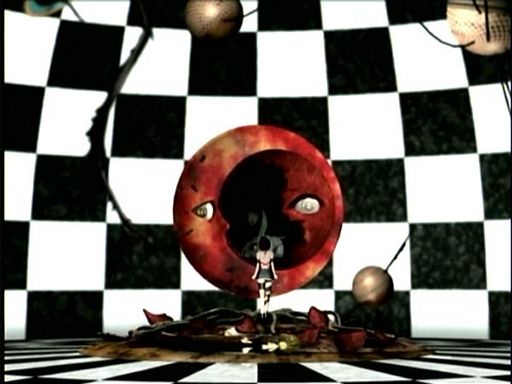
Now, with the general story grasped what I want to talk the most about are the themes it presents, because it's easy to imagine there can be many different interpretations for it, not only because it's written by Konaka, but because of how the story itself is presented. Sure, you can theorize what may even be real in shows like Lain, but in my opinion Malice@doll uses so much symbolism or vague abstractions in place of a straight forward plotline that it's really hard to think about the "story" in the same sense that you'd do otherwise.
Malice is a tragic character from the get go; we get to learn about how she unknowingly loathes her very condition. Her masters are gone, she has naught to serve and her very reason for existence is put into question; her unbecoming through the human transformation now materializing the past trauma she's suffered but was unable to fully understand because of her lack of "real" feelings or her inability to grasp just how these same things could have been affecting her without her knowledge. Malice, the human, is nothing more than "the voice on the back of the head" for Malice the android; they're both sides of the same coin, but the true challenge arises when human Malice has to understand her own present condition and come to terms with her place in the world. This is her quest to find herself, but above all find and understand love; being an android up until this point had inhibited her from having an actual reason to live, only repeating the same routine be there humans, be there not.
This really robotic (duh)-like function is what brings Malice to think what she is doing is right; for it is the only thing she knows, it's the only thing she must do, and in that delusion of well being augmented by the rampant trauma she herself suffered, she thinks it's the right decision to continue. Her body has changed, yet her actions have not; she hasn't adapted or evolved with it, and that's what, in the end, brings calamity to her world, this dissonance between body and mind. The only one to truly accept her love out of his own love for her is Joe, which is a really interesting case since unlike Heather who blindly trusted human Malice from the very beginning, Joe was skeptical; after all, there couldn't be a doll this warm, this "alive". This Malice wasn't Malice doll right? After all, she looked like a human, like the very god that created them.

To have a better understanding of the ways in which these themes tie together is the fact that Malice is a sex worker. Think of all of this within that context; once Malice understands her reality better her suppressed trauma hits her all at once. Joe, the one person to truly love her, by the end is skeptical of her very nature. Malice, repeating the same pattern of actions she had until now only unknowingly made things worse for the ones she connected with the most. Now, I can understand why with this in mind one might have a different understanding of the story as far as how it views these concepts, but I believe it to be very nuanced in its approach and understanding of its characters and their realities. It's very foundation is based on understanding Malice and what she has gone through; going by this idea, the story is incredibly sympathetic with the struggles that come in the kind of experiences she's had and sexual violence she's suffered. Be it the trauma that is shown mostly through Malice, the blissful ignorance shown by Heather, and the difficulty to adapt once things change for someone in this situation; Malice not being accepted because of who she is now, having even Joe doubt her, all of that besides the clear mental and physical scars something like this can leave. At its core this is the story of her liberation and everything that's tied to it, the trauma, the violence, the acceptance and the distancing she suffers because of it; this is her coming to terms with her past and present even if those around her can't quite feel or understand it as deeply as she does.
Animation and aesthetics

I love this with my whole heart. It seems like Malice managed to combine these very specific generally appealing aspects of visual design I absolutely love and combine them with a rustpunk aesthetic really reminiscent from other shows I grew up with; not only on this aspect, but the general atmosphere and animation too. When it comes to something like Malice@doll I believe it to be incredibly reductive to dismiss it because of the animation itself when it's done this well. This is incredibly impressive especially because of when it was made, and the subtle details and choices when it comes to the animation and direction, more specifically relating to the characters themselves are truly amazing and impressively immersive.

51.5 out of 56 users liked this review
