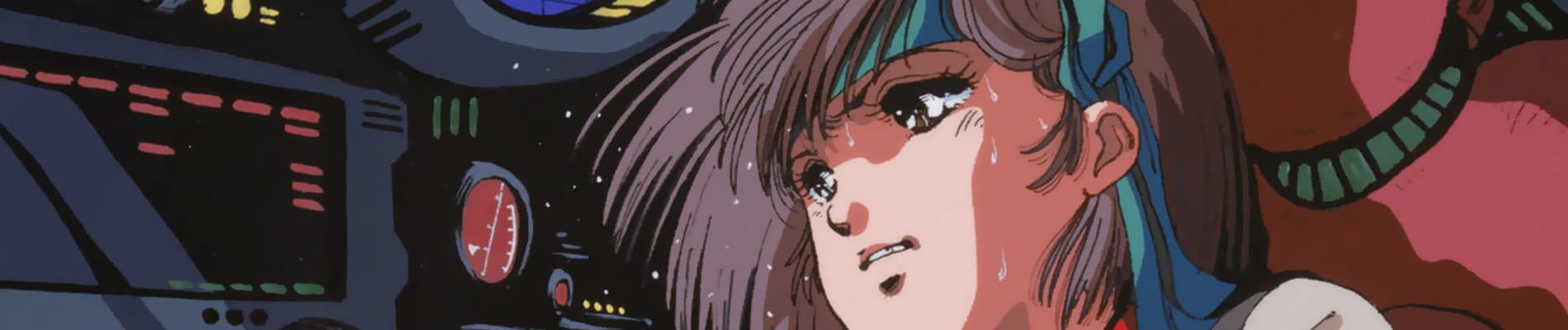
Gunbuster
a review by saulgoodman
a review by saulgoodman
Another preliminary warning: I'm not a mecha otaku. Sorry, not sorry.
Experiencing Gunbuster after Evangelion and Gurren Lagann was a retroactive whiplash. Moreso than the joshi kosei fan-service, Noriko being the blueprint for Gainax's future mecha pilot protagonists was eye-catching. Heck, the entire OVA felt like an unfinished prototype for its future shows. That is, its splotches of character turmoil and blunt nature. Note to differentiate character turmoil and character development. In its 6 episode time-frame, Gunbuster short-distances intricate character development. Jung Freud has some sort of rivalry with Amano, challenges her, becomes friends, rinse-and-repeat in a shorter cycle with Noriko afterwards. Amano's taciturn attitude at Noriko melts when she witnesses her successfully piloting the Gunbuster. I don't hate it though, because Gunbuster itself is an unapologetic blazing star. Short-lived as they are, Noriko's conflicts and resolutions aren't useless detours from the heart of her character.
Gunbuster scrutinizes Noriko's insecurity as a pilot and trauma after Smith's death-in-service, streaking through these delicate conflicts with glorious battles and orchestra, these points foundations for the likes of Shinji and Simon. Noriko's final and most grandiose conflict; the disparity between her and those holding Father Time's hands on Earth; is scrutinized with silent, delicate inference and consideration of past episodes. The hypertensive, romanticized school life built in the first episode with Noriko being bullied, her training montage and fight with an envious ojou-sama concluding with their friendship, acts as an anchor for the Noriko acting awkwardly with the aged Amano, referring to her with militant respect rather than endearing "one-sama". The tonal transition during the early half seems to be a primary target for Gunbuster's flaws. A picturesque 70s ojou-sama drama in fashion of Aim for the Ace! and Glass Mask flying into a space opera of time dilapidation certainly was a glare, something Anno crafts better in Evangelion, but nonetheless I felt it fit the strained narrative towards the end.
Even as everyone else passes by her in the passage of time, treasured memories of days past persist in her heart and give strength to live and fight in a separate time. The flaring shift from underdog wimp to savior of mankind, glistening with youth and fervor, isn't exactly tight writing, but the sentiment is felt to the core.
▶ VideoThough, sure enough, what I've described can understandably be interpreted as dime-a-dozen imperfections. Perhaps the whiplashing, yet fitting tonal shift is rather unchecked script writing, the bull-dozing character development punctuated by grandiose mech battles ultimately rushed character writing. Still, in reference to either or, Gunbuster's a radiance of potential and inspiration.
Anno took his baby steps in his first director gig, and his shit wipes are to remember. Each episode is punctuated by distinction; the first episode a silly Aim for the Ace! clone, the second episode Jung's introduction and Noriko horrified by her late father's dead ship, the third episode Smith's influence on Noriko's character, the fourth episode Noriko's lowest point and subsequent blazing climax piloting the Gunbuster, the fifth episode apostrophizing the horror of time dilapidation when Noriko returns to Earth, the final episode a testosterone-inducing one full of screams and shirt-ripping, and the ending one of optimistic and bitter. The intertitles and thoughtful cinematography that'd be cemented in his future works, and of course, the grey-scale, muted palette of the final episode.
Feelings may vary, but it's difficult to deny the heart and creative direction wringed from Gunbuster. Superficial as it sounds, my perspective on older OVAs have tilted towards a positive direction now. While the production value, from the attention-to-detail in key animation and technical designs to the magnificent orchestra, is aesthetically pleasing, it's moreso the gushing passion the staff has put into it that one can infer even 30 years after the fact.
As affected by rigor mortis as present-day Gainax is, Gunbuster etches itself strongly in my mind, as much as Noriko and Amano's blazing sacrifice for humanity millennia later.

Contrary to my prejudiced thoughts prior, Gunbuster is far from a relic stashed in Gainax's attic. Pretty and shoujo as the character designs are, it's ablaze with burning passion and creativity. Where Evangelion, Gurren Lagann and perhaps many other mechas yet unknown to me have siphoned inspiration from, Gunbuster delivers an interesting sci-fi/space opera plot and coats of character conflicts for its underdog protagonist. As you'd expect from a mere 6 episode frame, though, not all of its potential see full nurture. Gunbuster blazes through conflicts with climaxing fights in space and orchestra crescendos, valuing mesmerizing pathos over paced, complex writing. And it succeeds in being ever-so straight-forward, ultimately a pedestal for its lone protagonist pilot and her transition from; hackneyed as it sounds; zero to hero.
As blazing as the writing is, the passionate production matches its sentiment. However, like the writing, they don't exist in a vacuum of simple combustion. The key-animation is more than eye-candy, the technical designs more than grand, the cinematography and choreography more than awesome, the music more than climaxing; they're the results of passion and symbolic of the sentiment behind it all.
Like one's old lady or man, Gunbuster isn't perfect but I love the imperfections it wears on its sleeves.
28 out of 30 users liked this review
