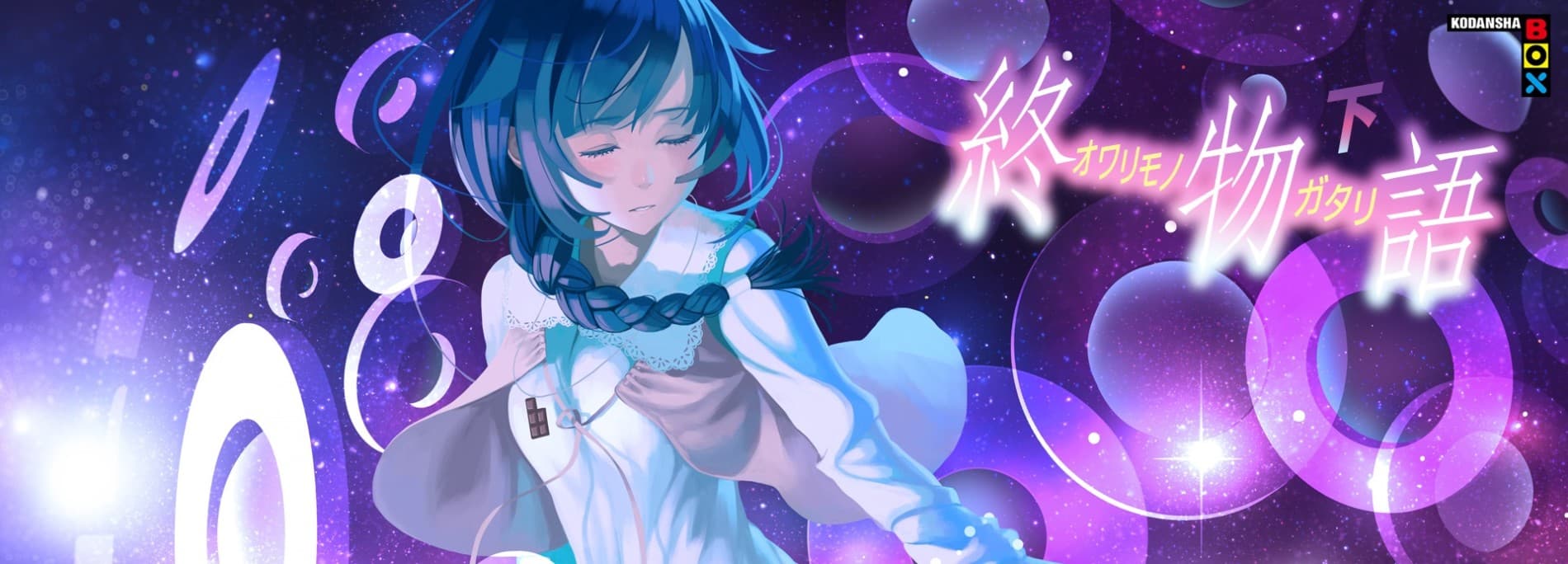

This review contains spoilers.
#Mayoi Hell
Chapter one of the end.
What an incredible way to start a series. And, by extension, what an incredible was to end a series. In the final moments of Koyomimonogatari our protagonist is literally cut down, killed and ends up in hell. The ultimate cliff hanger, so incredibly executed. The drama of using the demon sword to kill him forged from the armour of the first servant. And the final moment, Araragi waking up to see Hachikuji. I think I actually laughed at how good it was. And so Owarimonogatari Second Season picks up not a moment later, with our protagonist dead. And in hell.
Well, there’s a prologue first - there always has to be - in which Araragi says a few interesting things, introducing us into the themes of the final series. He bringing up friends being a human weakness again, something he immediately juxtaposes by talking about Hachikuji. He says he considered the idea of dying just to see her again, but continues on telling us the only reason he didn’t was his family, lovers and friends. He’s changed a lot from the Araragi we saw before the events of Spring Break.
In hell, with Hachikuji, Araragi revisits these early days, the events of Spring Break and Bakemonogatari. Although we might not know it yet, in death Araragi has returned to being a human, and in this he is returned to a state of being before the events of the year and given a chance to relive them.
First, he sees Shinobu wounded in a train station. He moves instantly to save her, but she’s not really there. So Hachikuji asks why he tried to save Shinobu if he regretted the decision so much. All he can say is that his body moved on its own.

###“All I can say is that my body moved on its own”
Next, they see Hanekawa. Hachikuji presses Araragi, telling him that while the tumultuous year may have started with meeting Shinobu, a major cause of the meeting and how the year transpired was because he befriended Hanekawa.
And this is true, Hanekawa transformed Araragi. If Araragi, as he suggested in the prologue, is now weak as a human, Hanekawa is to blame. But Araragi says he does not regret becoming friends with her.
Then we relive the very first moments of Bakemonogatari, with Araragi catching the falling Senjougahara. Hachikuji and Araragi note, with hindsight, that Senjougahara would’ve been fine when she fell. Even with this knowledge, Araragi says he would catch her.

###“I’ll catch her, as many times as I need to”
With all of the moments the pair consider, they conclude that Araragi would have acted the same way, no matter if the events unfolded for better or for worse. This, of course leads them to the outlier: Sengoku, the girl Araragi failed.
Hachikuji is the voice of reason here. How could he have acted different, she asks, he isn’t omnipotent. Araragi, too, only knows what he knows.

###“Most people are more eager to correct mistakes than do the right thing”
These talks lead the pair to talk about something that becomes a central theme of the series. What is right? What is wrong? And what are mistakes?
Araragi agues that there’s a difference between doing the right thing and correcting mistakes. While correcting mistakes can feel like doing the right thing - Araragi points to the Fire Sister’s quest for justice as an example of the latter - they are not the same. If one only corrects mistakes, it will not, as he says, be a “pure white kind of right” but a “pitch black kind of right.”
This white and black of right obviously has an elusion to the black and white Hanekawa, but I think this line foreshadows the difference between Ougi and Araragi, as Ougi becomes likened to the idea of the darkness (that appeared in Second Season). And so this entire conversation becomes a foreshadowing of the final encounter.
As the conversation wanes, Hachikuji remarks “You just said you weren’t speaking about yourself,” asking, essentially, if you aren’t just correcting mistakes, who are we talking about here? Araragi considers this for a moment and realises he’s talking about Oshino Ougi.
An in that, the conversation entirely comes to foreshadow who Ougi actually is. If Araragi does the right thing, and Ougi corrects mistakes, is there a difference between mistakes and doing the right thing?
When the conversation ends, Hachikuji and Araragi make it to their final destination, where Araragi is to be revived by none other than Tadatsuru Teori, the same man who tried to kill him at the beginning of this season.
And we are yet again presented, here, with another interesting character who makes us question what it is to be human and what it is to be an apparition. While we’ve met Teori before, he was not much more than a mysterious counterpart to Yozuru. But here we find him in hell, a dead man but one who still maintains a presence in the material world. His puppets are apparitions and grant him endless life, yet his self in hell seems human. Once again, the line not only between apparition and human is blurred, but the line between life, death and immortality.
At the same time as we consider this character, it is revealed that this line has been made dramatically clear for Araragi. He was not merely killed and brought back to life, but his vampiric self was taken from him. He was a vampire and now he is human. He was dead and now he is alive. Teori, on the other hand, lives on the fringe of both these distinctions.
All told, This arc was incredible. It worked so well to not only continue the narrative set in Koyomimonogatari, but also building up the core themes of the series to follow. And Koyomimonogatari works best in this context, after just revisiting the characters of the story thus far in the series, we then see them looked at through Araragi’s eyes as he is now, after a year of development.
It’s also some of the prettiest animation Monogatari has seen outside of the direction Tatsuya Oishi. This arc was a marvel to watch. The two walking through hell with weird nonsensical bridging between places. While not as outlandishly over the top as either, it reminded me of the off-the-wall animation style of Pen Ward and the striking visuals of Satoshi Kon’s Paprika.
#Hitagi Rendezvous
It really has been a long time since Senjougahara got lengthy screen time. She’s only been a focal character of two arcs before this - the original Hitagi Crab story and the Hitagi End story in Second Season. But here, we get to see the Araragi and Senjougahara have their last high school date.
Keeping in the series’ motif of linking back to the Araragi of the past, in the prologue, Araragi talks about falling in love. He describes it as something he feared, avoiding it a “self-preservation instinct.” He saw himself as a narcissist, but loving himself is what he held as part of what made him strong as a human.
Hanekawa may have brought Araragi out of this shell, but by falling in love with Senjougahara, Araragi completely changed. He lost this narcism for he cannot love himself like he loves her. His selflessness is what drives him to do the right thing, but he also holds that his selflessness is his great weakness - because of it “he’s as good as dead as a human.” Yet despite this internal conflict he loves Senjougahara all the same.
The arc is no grand romance story (they don’t even kiss), but I’m so glad we got to see Senjougahara’s sarcasm, dry wit and generally bullying of Araragi one more time. The penultimate moment, in which they call each other by their names was very sweet. A fitting happily ever after for the couple…

###“Calling her by that name for the rest of my life”
It wouldn’t be Monogatari, though, if we just had to sit through a slice of life-style date. In a dream, Araragi and Ougi meet and return to our central theme of the right thing and mistakes. It’s strange how we almost unquestioningly accept that Ougi meets with Araragi in a dream, and that she was able to monologue to him just like she normally would. In hindsight, this obviously only happens for one reason.

###“I don’t know anything. It’s what you know, Araragi-Senpai”
Ougi asks Araragi what he thinks is the right thing. She complicates Araragi’s view, pushing that while doing the right thing is difficult, it’s even more difficult to do “just the right thing.” She tells him that doing the right thing is always accompanied by a wrong thing, a mistake. It’s a zero sum game, so there is a balance. And Ougi admits that she is one who’s version of the right thing is correcting mistakes, here eluding that she corrects his mistakes, specifically in a process that must happen.
And in this, the arc attaches a symbolism to Ougi. Her name, 扇, Ougi (or Ōgi), means hand fan. Senjougahara, earlier in the arc, tells Araragi that the universe is shaped like a hand fan. Ougi is not the darkness, rather she sees herself as “the principles of the universe,” and thus by extension Araragi sees her this way too. She is the inevitable correction to balance out the mistakes of Araragi’s actions, to settle the score at zero for the unfair advantages Araragi has gotten away with so far.

###“It’s my role to eject those who have broken to rules”
Without knowledge of what’s to come, the two become ideologically aligned, yet opposed. Fighting to do what’s right, one as force to correct mistakes and one who sees the correcting of mistakes as a black kind of right and who tries to do the proper right thing. And so we have the black and white of righteousness, Ougi and Araragi. Of course, the imagery, along with some very clever dialogue, foreshadows the greater connection the two share.
#Ougi Dark
And so, at least, we come to the final arc. The great twist and the happy ending, the end of Araragi’s adolescence. Ougi Dark is masterful, or rather, it’s a masterful capstone to such an incredible and well established story. Everything is so neatly and beautifully tied up. And the dramatic reveals… so perfectly well done.
Where to start? Well, I’m gonna start with the story of the town.
In Gaen’s telling of her grand plan in Part 1, she retells the story of the Shirahebi Shrine. The shrine was originally located in the park before it was destroyed by Kiss-Shot’s arrival hundreds of years ago. After this, the shrine was merged with the local religion, a merge that worked because Shirahebi Shrine enshrined a water snake, and the local religion worshipped a mountain snake. The joining of these two faiths was not perfect, and it produced an air pocket, an imbalance, that created bad energy and attracted apparitions.
I’ll be honest, I’ve always dismissed the story of the shrine(s) as nothing more than some cool world building, a mere background explanation for the events. But listening to Gaen tell the story, I was reminded of something. Water snake… Mountain snake… hold on. Ougi talked about these snakes in the dream during Hitagi Rendezvous.

So, I went back and rewatched the dream scene.
The first constellation Ougi talks about is Hyrdrus, the water snake or the hydra. The hydra is an immortal creature, with regenerative powers, which reminds Ougi of Kiss-Shot. Ougi continues, summarising the greek myth of Hercules killing the seemingly invincible hydra. She even mentions another constellation, Cancer, the crab (Senjougahara) who attacked Hercules during this battle. This becomes a very poetic comparison, Kiss-Shot is represented as the same God she displaced and replaced in her original arrival in Japan.

###‘Hydrus’
But next Ougi talks about another constellation, Serpens. Another snake constellation, this one a snake that has been chopped in half. It survives despite its mortal wound, a sign that, like Hyrdrus, shows immortality. “Well, Araragi-senpai, you seem to have your body chopped in half rather often as well,” reads an intertitle. Ougi continues, describing that in the centre of the Serpens constellation is another, Ophiuchus, the snake charmer. The snake charmer was a sage physician, who’s remarkable medical skills that allowed him to resurrect the dead. Sounds a lot like Tadatsuru.

###’Serpens and Ophiuchus’
While this is a great scene with some very cool symbolism, this interpretation isn’t particularly remarkable. No, what’s remarkable is that it clues us into a parallel story going on here. If Kiss-Shot is a water snake and Araragi a (mountain) snake, their story mirrors that of the shrine. When Kiss-Shot is destroyed, she is merged with Araragi, much like how the shrine of the water snake is merged with that of the mountain snake. The story of the town, then, is the story of the pair. A bad air pocket forms over the shrine that attracts apparitions just as Araragi’s new found knowledge of apparitions brings about a year plagued by them.
It’s no wonder then, that Araragi’s story cannot be finished without also concluding the story of the town and enshrining a new god at North Shirahebi Shrine.
Alright, let’s fast forward back to Ougi Dark again. And at last, the great big mystery, the grand climax will be revealed. Just who is Oshino Ougi, whom over the last few series has been slowly developing into the grand antagonist. A total enigma, who seems to know so much yet insists that she knows nothing. And Gaen says just this, for Ougi, “the loss of her true identity is the only identity she has.”
Ougi may play the same role as the darkness, requiring her ‘extermination’, but, as Araragi learns, she is not. She is, however, an apparition. Not an ordinary girl, but an ordinary monster. Ougi is a quasi-darkness, she “refuses to allow a tidy ending. [She] says that giving everyone a happy ending is cheating.” And in this comment, Ougi becomes tied to the very fabric of the story the show is telling. Obviously the villain threatens a happy ending, but here the very concept of the narrative is brought into focus.

###“What can’t live of their own accord… are monsters. Just like you and me.”
As Ougi and Tsukihi talk they explore this idea. As they go from Sengoku’s house to exploring the cram school, Ougi describes the very process of figuring out the purpose of building. “When we figure out its true identity it ceases to be scary at all,” she says, describing the cram school but obviously eluding to herself. It’s not for mere dramatic suspense that this entire scene is cut to right after Gaen begins the sentence that will finally reveals Ougi’s true identity, but before she can finish it. In Ougi’s philosophy, the interjection of this scene prolongs Ougi’s existence, both literally and metaphorically.
Ougi and Tsukihi’s talk about mystery novels delves into Ougi grappling with the fate that lies before her. Once the mystery is solved, Ougi says, there is no fun left, and she believes this precisely because once her enigma is revealed she will cease to exist. But Tsukihi disagrees, she says that in reality unmasking the mystery proves the very existence of the thing you were afraid of.
While Ougi thinks the story should end the moment the mystery ceases to be just that, Tsukihi believes that how the world deals with this knowledge is an important part of the story too. These views are especially poignant in how the pair here share an important characteristic, as both exist with a hidden identity. Tsukihi is the phoenix, an imposter into the family. Yet when this mystery is revealed to Araragi he continues to love her anyway. Ougi, on the other hand, can see the reveal of her mystery only moments away, and she knows that her existence will end because of it.
So when this mask is finally ripped off, we learn that Oshino Ougi is Araragi Koyomi. An apparition created by him. A simulacrum born from his own desire to criticise himself. Rather than this grand balancing force, Ougi is the manifestation of an internal desire for balance within Araragi, seeking to settle the score of a series of events that he feels that he has cheated.
Ougi sought to kill Araragi not because his immortality upsets the balance or is a danger to humanity, but because Araragi feels that he has cheated fate in being immortal. And within Araragi are many more of these self-criticisms of how he did things. He feels that he took advantage of Senjougahara and that he isn’t worthy of Hanekawa’s feelings. He questions if he was even allowed to reconcile with Shinobu after everything that happened, that despite going against her he can freely use the powers of immortality.
Ougi is much like the darkness, then. Seeking to destroy that which cannot be. And it’s because Araragi sees the good things in his life as unfairly earned that they must be destroyed. To have the happy ending, then, Gaen tells him this:
“Go be victorious in the battle against yourself. Killing yourself for the sake of others is something you do every day. It’s Koyomi Araragi, the one you loathe the most. So… go end it all. By your hands, you need to end it all. That is the end of your adolescence.”

In their final encounter, Ougi and Araragi have a last talk about right and wrong. With the darkness looming behind Ougi, he asks her,
“So after all this, Ougi-chan… Me or you – who was right?”
And she simply responds,
“As I am the one disappearing like this, it means that Araragi-senpai, you were right.”
In reality, though, neither are right or wrong. Ougi is the darkness within Araragi, the dark side to his light. The black kind of right, to Araragi’s white kind of right. Doing the right thing and correcting mistakes are, in fact, the same thing - two sides of the same coin. Two parts of the same Koyomi Araragi. If there must be balance, there’s must be these two forces inside him. If he sees the result of his choices as injustices, his immortality us unfair, Ougi exists to restore balance, and to make Araragi’s life more right.

###“Really… you are foolish”
Of course, Araragi cannot kill Ougi. She may be an ordinary monster, but if Monogatari has taught us anything, it’s that you cannot kill the monster without becoming a monster yourself. As Gaen says, Araragi has put his entire life on the line countless times for the sake of others. And this was to avoid becoming the monster. Araragi’s desire to do the right thing – no, not just the right thing, but the rightest possible thing – has made Araragi incredibly and unrelentingly selfless.
This selflessness that meant he was willing to sacrifice himself to save a vampire. A selflessness that put him on the line to save the girls he loved. A selflessness that meant he was willing to bring himself to the brink of death day after day to help a girl mistakenly enshrined as a god.
A selflessness so strong and rigid that to be selfish, to fight for himself, he had to selflessly save another person and lose his arm in the process. This is how Araragi grows. In saving himself, Araragi believes he is saving the same person that all the others in his life have saved. And he can only save himself by saving himself embodied as another person.
So it’s no wonder that it’s now when Oshino Meme can appear again, once Araragi finally listens to his advice. Once Araragi finally helps himself.

###“Did something nice happen to you our something?”
The tragic and gruelling year that started in spring break finally comes to an end. And it gets a happy ending too. There’s nothing more you could wish for form a series. All the loose ends neatly and cheerfully tied. Hachikuji has completed her journey, once lost and looking for her home, she has now found one in the temple in which she is enshrined. We got to see Oshino Meme again. And we got to see Hanekawa. Hitagi and Koyomi have reached a new phase of their relationship. We see Sengoku healthy again and freely following her pursuits.

###“Yeah, I’ll go visit at any time. At your home.”
Most importantly, we got an answer for the question put to use at the start of the season. Owarimonogatari ends with Yotsugi and Araragi talking about his link to Shinobu - are either of them happy? Araragi thinks not.
Rather than receiving a merciful death that would return Araragi’s humanity at the end of Kizumonogatari, he saved her, pulled her from grace and made her a weak little girl. All but literally defanged, Shinobu was damned to be Koyomi’s counterpart, linked in life and death. This may have been how Araragi saw it - damnation, trapping the both in an existence a step away from what they could be. Never quite human, never quite vampire. It’s a pitiful existence for Shinobu and a frightening one for Araragi.
But for Shinobu, being returned to a harmless little girl under Araragi grants her the wish she had in Kizumonogatari. She wished for death as a way to be free from the constant need to fight for her existence. And she has found that salvation in Araragi. Reunited, the question of if the two are happy is finally answered. And the answer is yes. Shinobu receives a new life, one that is peaceful and free from the fighting that she came to resent. And the two are forever bonded, they would not continue on without each other.
Even Ougi gets a happy ending. By Oshino Meme recognising Ougi as his niece, she becomes distinct from Araragi. She can exist as her own person. She may continue to prod and poke and mess with apparitions, as we saw in Hanamonogatari, but she can exist separately from Araragi. The one is now two.
And for Araragi, we see the end of his adolescence. He makes it to the graduation he wasn’t sure he would see. But even more importantly, he completes this grand character growth set in motion a year ago. First learning to let other people into his heart, he learned to fight for others. He gave up his mantra that connections made you weak. As he continued to open his heart and fight for those around him, he became more and more selfless. He put his life on the line to save others, to do the right thing.
But eventually he became too selfless for his own good. He became totally selfless, devoid of any care for his own body. So he brought himself to near death day after day in hopes of saving Sengoku. But eventually it was too much and his humanity began to slip away from him.
His desire to help and do the right thing meant he had lost the narcissism that he thought made him strong. And fighting to save Ougi had meant he had gained just a little bit of it back. He didn’t have to be completely selfless, he can fight to save the same person all the people he loves fight to save. He can fight for himself.

Owarimonogatari Second Season was an incredibly clever, delightfully written conclusion to the Monogatari story. It was so pleasingly smart and, as always, so beautifully animated. As twistedly clever as Nisioisin always is. A glorious celebration of the long narrative behind it.
While I don’t think it can individually stand as the best Monogatari series – a title that I can unambiguously say must go to Monogatari Second Season – Owarimonogatari Second Season stands on the shoulders of a giant. It’s the narrative capstone to a mammoth of a story. The reward for how ever many hours of commitment we have put in to this wonderful show.
It’s not often that series gets to end on such a high, but we should consider ourselves damn well happy that it did. To Nisioisin, Shaft and all who worked to make this spectacular story, all I can say is thank you. Thank you for your hard work, because it paid off. Monogatari will continue to excite, inspire and capture the hearts of fans for a long time coming because of the passion so clearly poured into this great work.
And so to finish, I will end with the comment that started my series of reviews: just as much as Bakemonogatari was better than it had any right in being, Owarimonogatari was better than any ending had the right to be.