Paranoia Agent
a review by Illuya
a review by Illuya
Throughout history, there have been multiple cases of the phenomenon known as “mass hysteria". Inhabitants of a town manically dancing to the point of falling unconscious, their feet bloody because of this exertion, girls at an African boarding school unable to stop laughing, and fans of a Portuguese soap opera exhibiting the same symptoms as a character on screen. In all scenarios, abnormal behavior starts manifesting among individuals that, at first glance, have no medical relation to each other and soon becomes not unlike the outbreak of a virus.
What has been the cause of debate is not so much the validity of the events, but rather the circumstances that lead to them. In the case of the townsfolk, it’s often theorized that their symptoms originated from starvation because of the famine spreading across Strasbourg, the city in which the events unfolded. Similarly, while investigating the behavior exhibited by the African schoolgirls, linguist Christian Hempelmann blamed the incident on years of psychological pressure from strict parents.
This does not explain the key question, however: why did the villagers dance and the schoolgirls laugh?
Pretty hard, it turns out. There is seemingly no correlation between the victims, and the perpetrator himself is an elusive one, reportedly disappearing into thin air after committing his crimes. Thus, the mystery grows: who is Shonen Bat and what does he hope to accomplish?

As viewers, we’re immediately led to believe that the evanescent Bat represents something larger, something more significant. Paranoia Agent can be seen as a series of bite-sized narratives, with each episode delving into the struggles of a new target, exploring the psychological exhaustion they felt prior to the attack. There’s Yuichi, an extolled boy whose popularity gets to his head and sees him plunge into feelings of egocentrism and jealousy when a fellow student threatens to take his place, and Masami Hirukawa, a depraved father who starts committing crimes to pay back his debt.
It’s through characters like these that Satoshi Kon once again demonstrates his ability to craft flawed yet believable characters. There is a humane quality to his storytelling, a belief that good will ultimately prevail, which keeps his stories from attaining an edgy or pretentious characteristic even when exploring darker subjects. This is thanks to the sense of honesty that seems to pervade in all his works: Kon shows us his characters at their best and worst, bringing us closer to their struggles and giving us an appreciation for the finer moments. His stories are harmonious dances of emotions, every motion balanced with exactitude and pride.
In spite of that, he is not afraid of toying with the viewer. In Happy Family Planning, the eight episode, three online friends meet up for the first time, but not with the purpose one might expect. In contrast with the dark subject matter, Paranoia Agent opts to use goofy character design and comedic music that gives this chapter a wholly different feel, while still managing to make us sympathize with them by the end.

One thing that echoes throughout all his works is the relationship between reality and fiction. In the case of Shonen Bat, we see how perception of him changes as rumors propagate throughout Musashino City. At first, he’s an insolent school kid. Then, he’s three meters tall. And suddenly, he’s a terrifying beast with sharp teeth.
In the age of the internet, it’s becoming increasingly difficult to tell apart what is real and what is the product of falsehood. With technologies such as deepfakes and voice cloning, anyone can manipulate the flow of information while hiding behind their distained computer monitor, and it is possible for an individual to gain large influence without ever revealing their identity. Similarly, media conglomerates hold a stronger grip on the populace than ever before, subconsciously shaping our opinions through entertainment and pop culture.
Above all else, Kon excelled in his understanding of how media affects us. We’re not simply consuming stories detached from any kind of reality for the sake of entertainment; whether we like it or not, the stories we engage with become part of us… for better or worse.

As I’ve been thinking about mass hysteria, I keep coming back to the concept of escapism. When under severe pressure, many of us resort to places of comfort, things and people that make us happy. As technology has evolved, this has become the likes of TV shows and video games, digital scenarios removed from our own troubles. However, while there’s no harm done in spending time within these worlds, many fall into the trap of subconsciously ignoring their problems, retreating themselves to a false paradise. Could the dancing and laughing not be viewed in a similar manner? What’s initially meant as a safe haven is bent into a device of self-harm without us even realizing it. Slowly, we lose control…
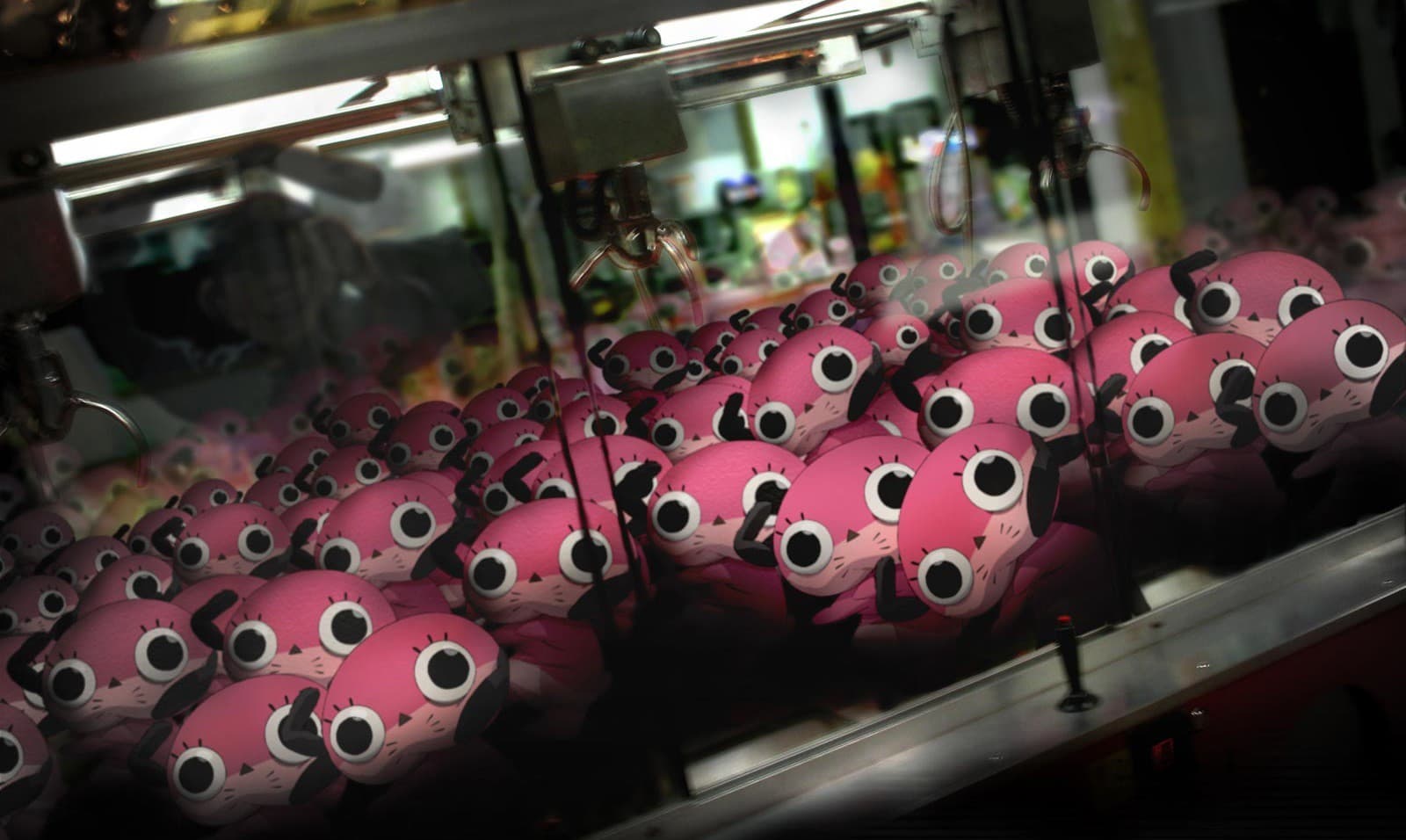
Paranoia Agent’s opening stands out. As we cycle through scenes featuring different characters in different situations, one element stands out: laughing. Everyone is laughing. Accompanied by Susumu Hirasawa’s Dream Island Obsessional Park, equal parts celebratory and haunting chant, this opening is an invitation into falsehood. It is the chant we sing as we rejoice in an imaginative paradise, ignorant of our own problems, laughing sardonically while drifting further away from reality.
Yet within its lyrics is a semblance of hope. The image of a mushroom cloud in the sky is contrasted with depictions of tranquility — “in the afternoon of birds pecking at food in an alley, touching the grass under the sunlight streaming through the leaves, I'll talk with you” — telling us that there is still hope. Together, we can face our fears.
In Japan, this is an increasingly relevant message. This is the country where mental health is often neglected, where taking a break from work will get you ostracized and where students across the school are ranked by their grades. Confronted by societal pressure at every corner, many become shut-ins, so-called hikikomori, and lead their lives in complete isolation, leaving their homes only when it cannot be avoided. Meanwhile, those who are in employment dedicate so much of their day to work that they’re afraid of committing to a relationship. According to population forecasts, nearly half of the population will be single by 2040, and even today, many are opting for a solitary lifestyle. It paints a terrifying picture of the country: Japan might be mechanically efficient, but at what cost?

Paranoia Agent reportedly started out as an amalgamation of scrapped ideas too short to get their own movies, and while Kon does manage to tie them all together through the enigma of Shonen Bat, there are times where it shows. The second half contains episodes irrelevant to Ikari and Maniwa’s investigation — while these are certainly decent short stories, they don’t contribute anything to our understanding of Shonen Bat, serving only as gratuitous examples of his deeds.
Similarly, the series struggles to reach the levels of emotional resonance displayed in Kon’s previous works. In Perfect Blue, protagonist Mima’s turmoil was immaculately captured through obfuscating editing, and in Millennium Actress, he tells a bittersweet story of hopeless love and clinging onto the past. Because Paranoia Agent often has as little as 20 minutes to establish a character and their inner conflict, we never come to sympathize with them on a deeper level.
This is an inherent sacrifice with episodic storytelling. The benefit, on the other hand, is that it allows for a deeper level of experimentation: though not all episodes are hits, the show stays fresh throughout with its deconstruction of tropes and blending of styles. In one episode, an otherwise tedious and drawn-out interrogation takes the form of a fantasy adventure, established characters appearing as everything from talking frogs to butterfly-like witches. Even the previews at the end of episodes are unusual, featuring a short, aging man speaking in silly riddles.

If one thing is clear, it’s that this playfulness would not have been possible in a movie. When working on a new film, you’re betting everything on a single idea — does that idea not work, you’re screwed. Taking this into consideration, Paranoia Agent’s alleged origin makes perfect sense. How could you possibly turn the concept of Happy Family Planning into a feature and not fear for your career?
I’m glad I saved Paranoia Agent for last. After all, what better way to end my Satoshi Kon trip than to visit a compilation of his capabilities? The man may have died with only four movies and one series under his belt, but given the quality of these works, it’s hard not to feel a tiny bit grateful. Naturally, I am compelled by the prospect of him still being around, to this day toying with our expectations and showing the industry how it’s done. But some things are too good to be true…
False realities are inevitable. They’re all around us, from the media we consume to the thoughts we deal with. When after a long day you turn on your computer and start watching a cozy slice-of-life anime, is that, too, not a false reality? There is nothing wrong with the act of indulgence, as long as it does not become an inhibition for our own progress. To seek comfort in escapism is justified; to get trapped in it, to cease moving forward, is not.
This is what Kon is telling us. He’s telling us to stop placing our happiness in virtual uncertainties and to instead face our problems, like a warrior heading into a fierce battle. It will be difficult, and there’ll be times where we may succumb to our worries, but if we keep picking ourselves up and moving forward, it will all resolve itself eventually.
“Don’t run away. A makeshift salvation is nothing but deception. No matter how hard it is, don't run away; we'll overcome it together.”
25.5 out of 28 users liked this review
