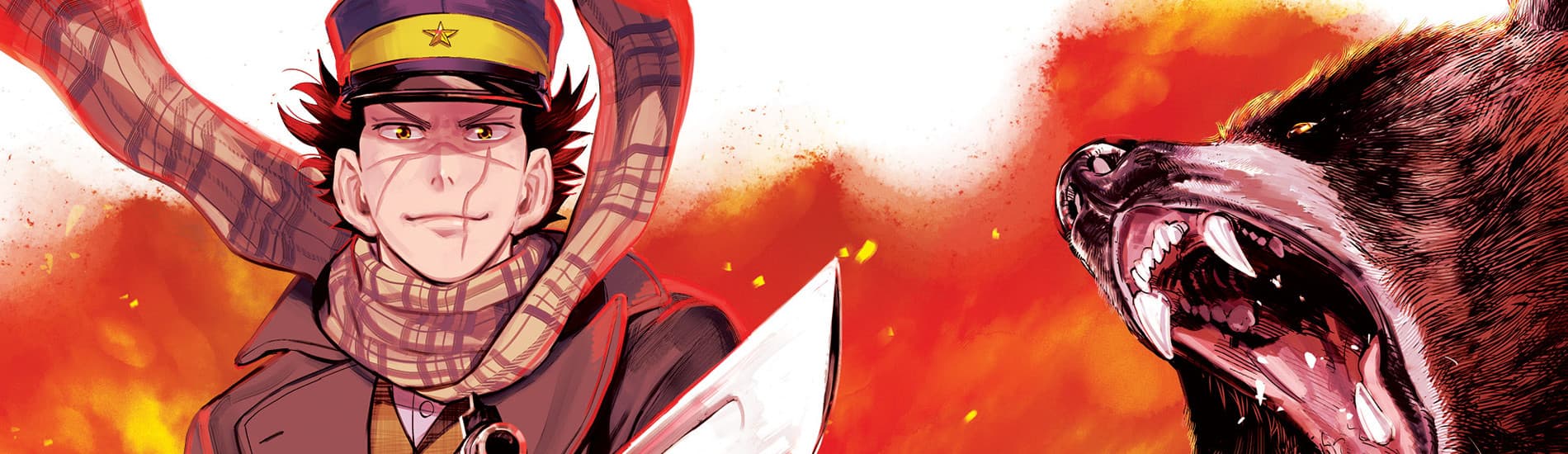
Golden Kamuy
a review by myvelouria
a review by myvelouria
This review is spoiler free.

The world of manga is a huge place. The options that lay before us are almost endless, so many stories just waiting to be read. Considering the scope and scale of manga as a medium it can be difficult to discover something that stands out amongst the crowd as a thoroughly unique work. What we have here in Satoru Noda’s “Golden Kamuy” is not only one of the most distinct manga of the last decade; it is one that occupies a very curious position in the broader world of manga. If asked to describe another manga that feels like an equal to it in style or content I’m not sure if I could. The one manga I think is most similar to it in terms of writing technique is “Jojo’s Bizarre Adventure” and even then there are still many quirks to Hirohiko Araki’s writing that keep it from feeling like an equivalent experience. And due to the nature of “Golden Kamuy” I find that fans all seem to take away different things from it. It simultaneously stands as a story of adventure, vengeance, self-improvement, love, betrayal, culture, greed, and a whole slew of other topics. It ran from 2014 through April of 2022 in Shueisha’s seinen magazine Weekly Young Jump and received many accolades including the Osamu Tezuka Cultural Prize in 2018. To many in the west their first exposure to the series was the first season of the anime, which had an infamous beginning due to the CGI rendered bear in episode one. That was my first look at anything “Golden Kamuy” related and in spite of that I decided to pick the manga up and was quickly lured in by its brilliance. Following its conclusion I read it again and it exceeded my expectations again. It leaves me with so much to discuss that I almost don’t know where to begin.

“Golden Kamuy” is the story of Sugimoto Saichi. A veteran of the Russo-Japanese War struggling to fulfil a promise made to his deceased best friend, Toraji. He swore that he would pay for a surgery to preserve the eyesight of Toraji’s widow, and the woman he loves, Ume. While panning for gold in Hokkaido he encounters an old man with a peculiar story about a hoard of hidden Ainu gold and a secret code that has been tattooed onto escaped convicts from Abashiri prison by the mysterious inmate Noppera-bo. Initially skeptical he soon discovers that the man is one of those prisoners and is motivated to find the gold to fund Ume’s surgery. Shortly thereafter we meet our deuteroganist, an Ainu girl named Asirpa whose connections to the gold run deeper than either of them are aware of. She bears no interest in the treasure itself, but is instead motivated by personal matters as she says her father and his group were betrayed and killed by Noppera-bo for their gold. Through their journey in the wilderness they encounter the 7th Division of the Japanese Imperial army, led by the unstable First Lieutenant Tsurumi, and even the presumed dead Vice-Commander of the Shinsengumi, Hijikata Toshizou, and countless others. Where is the gold? Does it actually exist? What was Noppera-bo really planning to do with it? All this and more remains to be discovered in the deep wilderness of Hokkaido.

One of the biggest selling points of “Golden Kamuy” is the cast of characters. A manga with a large cast, such as this, isn’t uncommon. However, the way Noda manages them all is truly incredible. Everybody is written as though they are the protagonist in their own story. Many characters actually became far more significant than I initially anticipated them to and the direction of their arcs surpassed all expectations. Sugimoto, Asirpa, and Shiraishi Yoshitake the escape king, make for a fantastic and well balanced main trio. Asirpa between the three of them has the most insight and understanding of the wilderness they travel through, without her wisdom and hunting prowess it’s difficult to say how they would have fared. Sugimoto is nicknamed “Sugimoto the Immortal” due to his ability to survive through injuries that would have killed a lesser man and yet I never got the impression he could just shake off any obstacle in his path. Noda writes his manga in such a way that death truly feels like it looms all around them. With Shiraishi he’s a character I came close to giving up on during my first read. I hit a point where it started to feel as if he was someone who would just create more problems than he helps solve. But then he actually grows and, in spite of his presumed slow wittedness, becomes an essential ally to Sugimoto and Asirpa. There are periods within the manga where Noda breaks this group apart and we really get to see how they shine without the dynamic they previously relied on. None of them feel static; they each undergo their own personal journey that enables them to become stronger versions of themselves. While most other manga tend to have your primary characters be wholly virtuous what makes these three, and the rest of the cast, work so well is they can prove themselves to be emotionally challenging. Sugimoto and Shiraishi are not perfect people, a huge weight on Sugimoto’s shoulders is Toraji’s death in the war and that he will never be the person he used to be. He’s haunted by this throughout his arc and there are times where his struggles boil over and the reader starts to believe him when he says he’s got a ticket to hell. Shiraishi meanwhile, being one of the escaped convicts, is someone who’s been living a life of crime and is a victim of his own desires. Very often he fumbles into bad situations, but more regrettably his issues have an effect on those around him. It’s once we see him placed in tense situations where we really get to the root of who he is and discover he will put Sugimoto and Asirpa’s needs above his own. Asirpa is the one among them who comes closest to being pure, though not in an archaic sense as she considers herself an Ainu woman for a new age. Regardless, her inherent good nature is constantly threatened by the situation she’s placed herself in. It’s convincing because we’ve seen the way other people have been consumed along the path to the gold and there is no reason not to expect Asirpa to make difficult decisions. Noda’s writing for them is a gift that keeps on giving. And this is only three of our characters.

Tsurumi Tokushiro is one of my favorite antagonists of all time. He manages to be equal parts sinister and hilarious. Too often when it comes to villains people seem to only choose one of those two extremes, but Noda found that sweet spot that allows Tsurumi to be both while also being more than he lets on. The deeper you go with Tsurumi the more you begin to realize you’re looking at a complete person whose experiences color every decision he makes throughout the story. The men he surrounds himself with like the dependable yet exasperated Tsukishima Hajime, or the spoiled sycophant Koito Otonoshin also prove themselves to be dynamic characters in their own right. Koito experiences some of the best development within the manga, and it’s the type of development that doesn’t come from outside forces backing him into a corner. Meanwhile, Tsukishima serves as an interesting look at a person that has resigned himself to this lifestyle because he doesn’t believe he deserves more. Former members of the 7th Division are also among the best in the story. Tanigaki Genjirou and Ogata Hyakunosuke are men who break away from Tsurumi’s control, but for very different reasons, and they each walk a distinct path within the narrative. Tanigaki was a Matagi, a group of hunters within northern Japan with their own distinct customs and practices, and he seeks a new purpose in life believing to have lost his way. The new lease he finds on life comes in the form of bringing Asirpa back home to uphold a promise he made to her grandmother for healing his wounds. Ogata meanwhile is driven by a force that remains mysterious throughout the manga, but once everything crystallizes and we see just who exactly we’ve been dealing with its nothing short of breathtaking. That intrigue with Ogata is what makes him such a gripping character, you want to get the clear picture of who he is, you must know. And when the information is finally presented to you it makes you realize how poignant his journey is. Characters like Hijikata, and former Shinsengumi captain Nagakura Shinpachi, meanwhile sit outside of this group with their own aspirations for the gold. Hijikata was someone I expected to die prematurely in the earlier parts of the story as some sign to the reader that danger is around them, but that’s the fool’s way of writing and Noda makes full use of this character. On my second read he became one of my favorites to follow because Hijikata was someone who lived a life so long yet he believed he still had more to accomplish. There are periods where the manga focuses solely on his group and it wouldn’t surprise me if some readers wished for his success even if at the expense of Sugimoto. I could also bring up characters like Kikuta, Kadokura, Inkarmat, Wilk, Kiroranke, Vasily, Sophia, Ushiyama, really the cast in this manga is massive and we’ll be here all day if I try to cover all my bases.

Some of the most identifying elements to the manga are in its setting and the cultures it explores. While the story takes the characters through different locales including Tokyo and the far border between Russia and Japan, much of it takes place throughout Hokkaido. Now there are anime and manga that show Hokkaido, but usually for brief periods as opposed to making it the primary setting. So being able to see it to the degree that we do in “Golden Kamuy” does set it apart from other manga. The forests and cold landscapes look beautiful and the regional animals have a role to play as well. Hokkaido is one of several parts of Japanese territory where the Ainu people reside so basing the manga there allows us to explore their way of life. Noda didn’t settle for merely putting Ainu characters in his manga, he wanted to show their beliefs and practices in depth. Really think about this for a moment. How many anime or manga have you seen where the Ainu are involved? Now I want you to think of how many of those stories explore their culture in a substantial or meaningful way. Personally, I can only name “Samurai Champloo” and “Shaman King” and neither of them goes to the length that Noda does. He read many books on the subject, which are cited at the end of every manga volume, and sought out assistance from various scholars on the Ainu, other indigenous Japanese people, and the Russian language. Noda once said that he wanted to capture the Ainu culture as accurately as he could or else he felt it would humiliate the people that assisted him behind the scenes. And he certainly succeeded at being informative. The reader is exposed to their language, their animist beliefs, their clothing, weaponry, food, hunting, naming practices, how the history between Russia and Japan effected their land, even mundane objects found in an Ainu home are allowed a moment of explanation from the narrator. Perhaps my most favorite display of the Ainu culture informing the manga is within its title. At face value “Golden Kamuy” is another way of saying “golden god”, but it goes beyond that. We learn about how Japanese people panning for gold in Ainu rivers has had negative consequences for them and that historically the Ainu did not place a lot of importance on gold, it was foreigners and Yamato Japanese people who did. However, due to the way the gold drives the story we see the characters refer to it as a kamuy. Tsurumi, in one of my favorite scenes, asks Asirpa if this golden kamuy was benevolent or nefarious due to the amount of lives it’s stolen. It’s so clever how he tied all of this together.

One of the other notable aspects of the manga comes through its exploration of masculinity. Specifically, Noda’s employment of homoeroticism throughout the manga. This is something that has taken on a level of infamy among fans due to its explicitness and Noda’s unapologetic approach to it. Once he was asked what he wanted the major takeaway of the manga to be and his response was the following: “The beautiful nudity of men. I want to keep drawing the naked bodies of men, be they pot-bellied or with thick chest hair.” Indeed one of the most striking aspects of “Golden Kamuy” are the male designs and the amount of variation within them. Noda doesn’t appear to be interested in the bishonen archetypes and that’s led to him giving his characters some rather unconventional design choices. But that doesn’t hold him back from treating these features as alluring, if anything it enables him to do the opposite. The men are attractive and beautiful in varying ways due to the “imperfections” he has granted them. I think because the average anime and manga consumer doesn’t usually see male characters of this nature in an erotic context its led to some assuming it’s a joke. But I really do believe Noda when he says he wanted this to be an important staple of his work. In addition to the various scenes of nudity there are several characters exhibiting attraction to other men. Many of the men who work for Tsurumi do so out of an underlying affection they feel towards him, often presenting itself as sexually charged. This isn’t a cheap gag or window dressing; it happens so frequently through the manga that it becomes difficult to imagine it without these elements.

It would also be remiss of me if I didn’t acknowledge that “Golden Kamuy” is an expertly constructed manga. Noda is a mangaka with an excellent paneling style. Much like Akira Toriyama he is able to simulate movement and action expertly and make it into something that the eye can comfortably follow. Noda exclusively draws digitally which gives his lines a very clean look. And the realistic approach to drawing animals contrasted with his stylized humans still makes for a cohesive aesthetic. I understand there are those who prefer to get into a story through its anime adaptation, but this is a case where I strongly encourage reading it instead. The anime is good, but comes with several flaws, and it just cannot really adapt certain moments where Noda is taking advantage of the manga format he’s working in.

When it comes to Noda’s influences he cites “Jojo’s Bizarre Adventure”, “Kinnikuman”, and “Keiji”. Like I mentioned earlier I do see some points of comparison between his style and Araki’s. And I don’t just mean visually speaking, but in terms of how he feeds the reader information. Both men seem to like having the reader be fed lengthy explanations for things through either spoken dialogue or narration. These dumps of information feel like a hallmark to both manga, but especially “Golden Kamuy” where the narrator will chime in with a whole manner of knowledge. I also see similarities in their liberal use of sexually charged imagery, pop culture references, and lack of concern towards anachronism. In spite of Noda’s commitment to cultural accuracy he has said he isn’t above inserting historically inaccurate details for the sake of creating the scene he wants. In addition to that a common element of Noda’s writing is reincorporation. Certain dialogue and scenes are referred back to frequently; a notable example would be the first conversation between Sugimoto and Tsurumi. He also refers back to specific details in a character’s past, such as Tanigaki’s kane mochi with walnuts or Ogata’s anglerfish hot pot. The manga can also be equally poignant and humorous. Characters are able to be taken seriously or empathized with while also making you laugh at the absurdity of their behavior. For instance, Ogata manages to be a bathed in mystique and the best nekomimi I’ve ever seen. This dichotomy is a perfect encapsulation of the eccentric manga we see before us.

“Golden Kamuy” is a manga that is difficult to put into words sometimes. In a way I think it’s best to experience it because on paper it almost doesn’t sound real. A historical fiction treasure hunting manga about skinning escaped prisoners while having heavy homoeroticism and brain eating. To a lot of people that is exactly what “Golden Kamuy” is, however it feels incredibly unfair to leave it at just that. While it is in many respects a ridiculous manga, it is also one with a lot of substance beyond its bloody surface. That one scene of Sugimoto and Asirpa talking about the dried persimmons he used to eat was enough to bring me to tears. Simple character driven moments like that are scattered through the manga amidst all of its maximalist elements. And to Noda’s credit I admire this “more is more” approach to writing that he displays. A story doesn’t need to be quiet or overly realistic to be effective. I love my big action filled manga with over the top situations and characters. “Golden Kamuy” manages to be exactly that and more and it never feels compromised. There is something so invigorating about a manga that knows exactly what it wants to be regardless if it’s too weird for most readers. It is all at once a beautiful story about appreciating culture and coming to terms with your personal demons and a story where an escaped serial killer is literally aroused by the idea of Sugimoto violently murdering him. And I wouldn’t want it any other way.
53 out of 53 users liked this review
