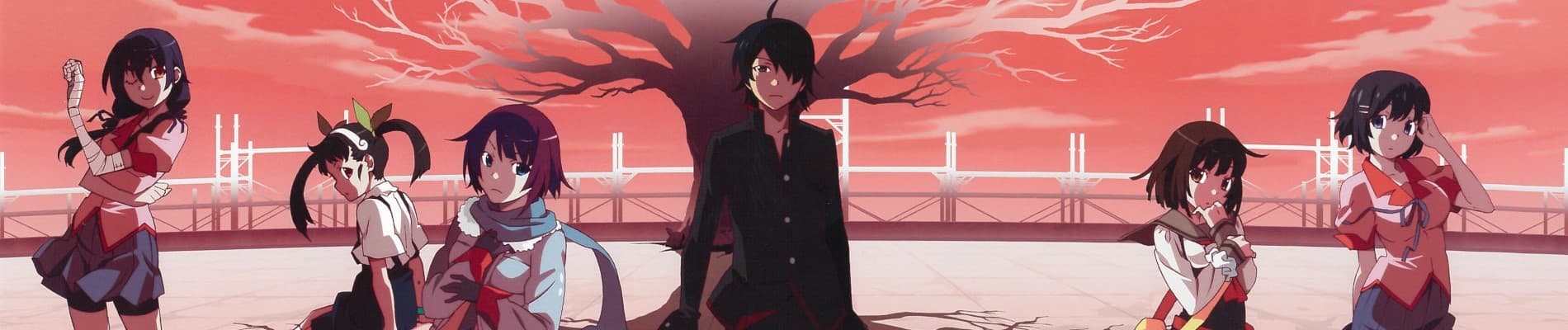

Playing a Character and Becoming, or Saving, Yourself
(I am doing a review series as I rewatch through the entirety of the Monogatari series, so check out my previous reviews. This might be my last review for the series—we’ll see if I’m able to find the motivation to maybe write more though, who knows)
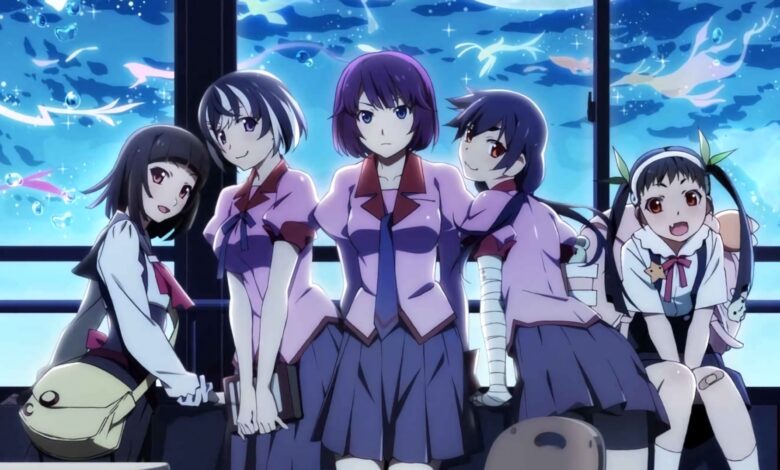
Monogatari Second Season, perhaps the most impressive entry in the entire series, concludes many of the girls’ arcs, and thematically drives home its deconstruction of harem in conjunction with the series’ core message—that only you can save yourself. It explores the root of the girls’ problems, the core issues they are faced with as a result of their trope personalities and thought processes. It takes the groundwork of the arcs in Bakemonogatari, builds upon them, and reaches beyond to serve as a source of inspiration for the audience. It does this by illustrating the human inevitability that we play as a character in our lives to a certain extent. It serves as a message on how to deal with some of the issues that can arise from this phenomenon and a fervent call to claim our lives for ourselves.
I won’t really be talking about Mayoi Jiangshi or Shinobu Time in this review, as they don’t contribute as much as the other arcs to the main ideas I want to go over and explore. Both are good arcs with great emotional beats and self-contained ideas in their own right, but not a ton to them that relates back to the series as a whole that I care to discuss.
Shinbou’s taking the lead on the series as chief director for the first time with this entry tones down its chaotic production to a slight degree. In my opinion, this brings with it a more refined, intentional approach to the direction that while might not be quite as relentlessly engaging as it was in something like Bakemonogatari, ends up being more effective at conveying its ideas. While earlier entries were more of a flurry of visual tricks and metaphors, second season seems more to lull you into the supernatural spaces of the series and let you ponder what that space is trying to communicate, using those kinds of tricks and metaphors at more deliberate points. All of this is only to a slight degree, however—the production is still very much Monogatari and is more chaotic and dense than practically anything else you can find in the medium, constantly reinforcing the ideas being discussed and the nuances around them with enigmatic and engaging imagery.

Hanekawa’s arc in Neko Shiro is one of my personal favorites. While somewhat more simple than some others, it is in my mind one of the most effectively executed arcs in the entire series. It is a powerful journey toward self-acceptance with a variety of facets paralleling and reinforcing it. Acceptance is often one of the most critical requirements to be able to take a step forward.
As a deconstruction of the humble, saint-like know-it-all character, Hanekawa faces the glaring issue pertaining to this archetype. If someone were really like this, they must be repressing everything else about them. This personality of hers is in many ways a character she is putting on. With the self-awareness the Monogatari series has, it presents her as being a character inside of a story, putting on an archetype common to these kinds of stories, but this is very much paralleled to reality—as real people put on characters every day in order interact with the world around them. We all repress parts of ourselves, and if it gets too severe, it can become destructive. This human layer was always present in the characters and in Hanekawa through the series’ self-awareness. Through being self-aware and hyperbolic, the characters show that they are playing up their archetypal personalities—they show that that is not all there is to them. And now, Hanekawa is forced to confront this. Her repression of certain parts of herself, everything her character appears not to be, has gotten to a destructive point. Her negative emotions have taken on the form of the Tiger aberration, which is acting on her envy for what others have. This repression of herself has been in some ways caused by her environment. Her feelings for Araragi that she is forced to repress due to him being with Senjougahara. Her family situation, where she is left without even a room of her own, forced to sleep on the ground of the hallway. In the final episode of the arc, she is forced to confront herself and these outside influences. Expressed through a breathtaking scene of visual storytelling representing her emotional journey toward self-acceptance, she calls out to Black Hanekawa. She asks Black Hanekawa, who is herself, to save her. In order to save herself, she confronts those negative emotions and accepts them as part of her—She must also take the initiative to confront the outside influences that cause her to repress these negative emotions as well. She confesses to Araragi and is rejected, allowing her to accept her relationship as it is with him who is so important in her life. She also directly asks her current guardians for a room of her own in their new house. This room of her own, as she says, is needed in order to give her “little sisters’, the aberrations of Black Hanekawa and the tiger, the space they need. This self-acceptance and confrontation of the influences in her life are Hankawa’s conclusion—and her savior of herself.

Nadeko’s arc in Bakemonogatari being as sparce as it was and her overall character arc being as complex as it is leads Nadeko Medusa to be almost purely an outline of her issues and struggle—which isn’t able to yet conclude them. This arc is an exploration of contradictions. Adolescence is a time full of contradictions. A swirling of emotions and worries without an easy way to sort through any of it—without the knowledge or maturity to know where to even begin. Nadeko struggles with an inner contradiction of her self-inflicted reliance on others, of her playing the victim—and her not wanting people to treat her that way, her yearning for people to see her for who she really is. This is paralleled by a more exterior contradiction she struggles with in her being in love with Araragi but knowing she can’t be with him.
Nadeko, the archetype of the exceedingly innocent and cute younger girl character, suffers because of this personality of hers. It has resulted in her repressing her inner self and true desires. While it is very much something she has brought upon herself because she has played up this shy and cute personality and used it to deflect things she doesn’t want to deal with, playing the victim in many circumstances, she is still a human being with more to her. Her playing this character of hers up and others treating her in this way have created a reciprocal relationship between the two affecting her. Shinobu and Tsukihi act as catalysts in this arc, illustrating clearly to Nadeko the issues with how she acts. As Tsukihi puts it, if you don’t want people to see you a certain way, you need to have more things about yourself to present to them. Eventually, she ends up not being able to deal with people treating her this way anymore—not being able to continue her life without anyone noticing her true self.

Her inner self, the snake aberration, which she has held back all this time, is forced to come to the surface. At the same time, Araragi finds out about her feelings, rejects them, and thus she is forced to confront that contradiction as well. This causes her immense distress. Becoming a snake god and letting these contradictions and the distress they cause her distort into an outward anger, Nadeko finds justification for the idea of “if I can’t have you no one can” in how to deal with her problems with her feelings for Araragi. We end the arc with a compromise—leaving Nadeko in a lost state, absorbed by her aberration, and without any means to sort through her emotions.
Hitagi End is widely regarded as one of the best arcs of the series. Similar to Neko Shiro and Nadeko Medusa, it utilizes the unreliable narration of a side character to flesh them out through what is said, how it is phrased, as well as what is left unsaid—and this is used to the utmost degree with Kaiki being a con artist and telling us right at the beginning that he will “guarantee this story’s quality if not its truth”.
This arc covers a lot of ground, recontextualizing everything around Kaiki’s character, from his past to his relationship to others in the story. It also concludes Nadeko’s arc in conjunction with developing Kaiki’s philosophy and thought process which relates to almost every other arc and fully forms the core message of the series. Through Kaiki’s lies, we uncover much more about him than it may seem at first. The way Yotsugi talks to him with such familiarity points out many aspects about him, and when he lies to her, we are able to tell because of this, as well because of his tone of voice. If we are to believe what this conversation gives off, it paints Kaiki as a more genuine person who plays the villain due to his personality. With his philosophy being that a fake can at times be more real than the real thing, we see that he has taken on that role for himself. In an attempt to be as genuine as possible through purely his actions, he obfuscates his intentions and deceives those he’s helping. We learn about the ways he did this in the past with Senjougahara—that he single-handedly took down the cult that was preying on her mother.

Hitagi End is an arc of lies and passion. The character we play in the story of our lives is a lie. This arc provides the solution of one’s passion to that issue. In living a lie we are owed the opportunity to seize our lives and create anything we wish out of it--everything is replaceable, which is why Kaiki says he hates irrelplaceable things—and what more genuine a lie is there to persue than one’s passion. Kaiki is more thematically important to the series than it may seem at first, which I think is why he gets the spotlight as the final arc in second season—to drive home some of the series’ main themes. Words are lies. Thus, you are the only one who can understand, and therefore save, yourself.

Monogatari Second Season brings the show’s deconstruction of harem full circle, with the intricate exploration and justification of the girls’ trope personalities, it breaks down the issues that they face as a result of them. It portrays a simultaneous acceptance of and transcendence beyond these tropes, using them to illustrate its grander messages. While hyperbolizing and flipping many aspects of these tropes on their head into satirical comedy, it also examines the ability of them to have value by relating to real life and having a genuine effect on the audience. It then uses its awareness of all of this to attempt to affect the audience in its own way, with its exploration of psychological issues in the form of aberrations and its weaving of its message for those dealing with them to save themselves. It weaves this message with a sensitivity and sincerity created through its awareness and deft writing. It acknowledges the circumstances and outside influences that contribute to and sometimes entirely create these issues, but it nonetheless serves as an attempt to inspire individuals to take the initiative that they have owed to them.
As we all play characters in our own lives, we see characters within a story reflect issues related to their playing of these characters—issues related to their humanity. The story illustrates these characters’ coming to terms with the fact that they are just that—characters. This provides solutions to help us with that very same reality and ways to help deal with the various issues that arise out of this human phenomenon that crops up because we tend to ignore it, especially in adolescence when we are figuring out exactly what it means to be human, and to be ourselves. It is in this acute understanding of what it wants to portray, and its very embodiment of its messaging that it is able to resonate so fundamentally.
‘Words fall short, yes, but sometimes their shadows can reach the unspeakable.’
The quote above from Chinese novelist Yiyun Li in her book Where Reason Ends gets at what i believe Monogatari is able to achieve--however in its case it would be characters and stories instead of words.
Representations of reality such as these connect with us because reality is a representation of itself. We all have our own stories we are living each day, and we need the stories of others compare with our own and learn from the best we can.
Monogatari Series: Second Season above all else is a call of inspiration for those struggling to discern who exactly they are. Those learning how to identify and come to terms with the parts of themselves that are a product of their environment, and what is truly themselves. Those who feel entrapped as a result of the innumerable psychological issues we are all bound to encounter. In the face all of these problems and what it means to find, or save, oneself, it ultimately argues: As the only one who can fully understand yourself and your problems, you can take the first step to addressing them. Whether that first step is self-acceptance, making connections with others and asking them for help, pursuing your passion, or an alternative way forward you find for yourself—you can be your own savior.