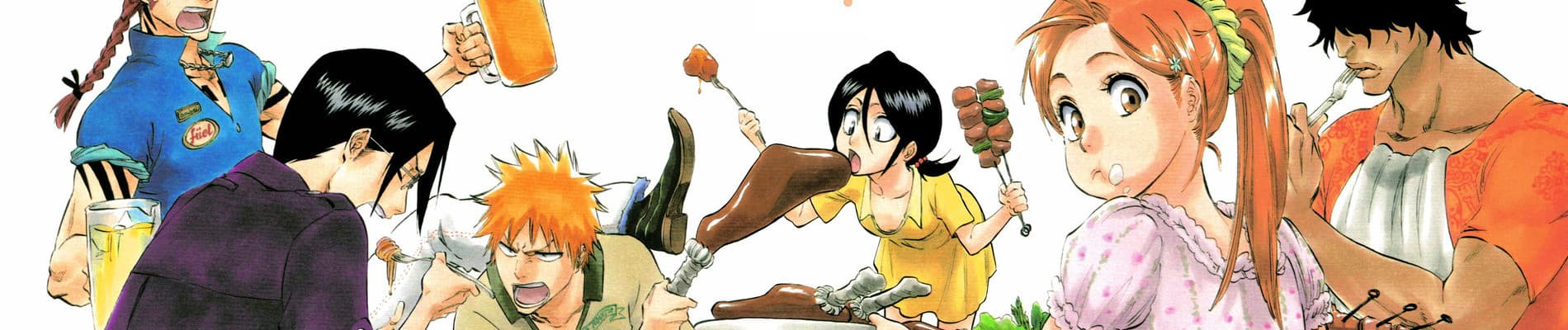
Discovering the anime world at a relatively young age meant starting my journey in it mainly via the shounen demographic. If memory serves right, I probably did not even expand into a number of titles I could count on one hand when I tried the first episode of Bleach. The funny story is that it did not immediately grab my attention, and it took some months, maybe even a year or two, before I found myself willing to fully explore the series. My sensibilities at the time were different than what they have shaped out to be as of the time of writing this piece, and the title's introductory statement probably failed to fully resonate with me.
I have since both watched the anime and read the manga multiple times and Bleach has become my de facto favorite shounen of all time, my one true favorite manga, and one of the few anime titles that strikes all the right cords and makes me love every single moment of it. A few days ago I finished yet another rewatch of its anime counterpart, a rewatch with a precious interpersonal side to it, and one that took a little less than a year to reach completion. It was the longest time it has taken me to actually sit through the story from start to finish, something that kept the title in the forefront of my thoughts for the longest of times and helped me dive deep into all the fine details I adore in this shounen masterclass.
As it should be obvious by now, this review will be nothing less than a dithyrambic praise, an ode to Kubo Tite sensei's misunderstood genius in writing and artistic skills, and one with nothing less than overflowing positivity towards it. If you have questions on what my view on anime and manga is and how I approach them, feel free to take a peek to my profile and maybe check my other reviews too. Now, raise your Reiatsu and let's visit this world of Human Souls and Hollows, Shinigami and Quincy.

Bleach was one of the most successful manga to ever grace the biggest manga magazine in Japan, Weekly Shounen Jump, and even garnering attention high enough to be established in the readers' consciousness as one of the Big 3, a term coined during a period when a set of three certain manga were consistently the highest selling and most popular in Japan, effectively rendering any competition non-existent. Despite finishing its run with individual volume sales as high as most manga could not even dream of achieving, the editors treated the title poorly forcing it to conclude in a rushed and abrupt manner and treating its creator unfairly. Fortunately, Kubo Tite sensei has currently returned stronger than ever with a new series set in the same extended universe as his magnus opus, and a continuation of Bleach in the form of a one-shot for the manga's 20th anniversary, while having full liberty to release new stories according to his own terms and desired frequency. There is probably no other incoming content that could get me more excited than fresh stuff from my favorite mangaka.
But this is a piece for Bleach's anime counterpart, so let us get more to the point at hand. As a long running shounen anime of an extended weekly manga, and in an era when multiple anime seasons with breaks in between were not the norm, the series carries two inherent problems. The first is the existence of filler episodes, created to give time to the manga to pump more content for the anime production to adapt. The good news is that they are entirely skippable, and an episode count of 366 episodes which could dishearten people from watching Bleach due to its sheer size, is now reduced to one of a little over 200 of them. The second drawback, is that despite fillers being a part of Bleach, there are still moments throughout its run that are characterized with a pacing that is less than ideal and could feel like it is dragging to some, especially ones not familiar with long running great epics that take their time to paint the full picture.

Now, for the anime's strong points, the direction and the atmosphere it exudes are superb and match the tone of the story perfectly. Some of Bleach's main allures are its incomparable style and fashion sense, as well as the emotional depth and impact the characters carry. All of that is portrayed perfectly, while never sacrificing the sense of epicness and grand scale that is slowly unfolded as the story progresses.
To the above, the instrumental factor that enhances and elevates the experience is the music. My favorite anime composer, Sagisu Shirou, has created what constitutes my single favorite soundtrack of all time with a multitude of contrasting emotions and music styles coming together in curious yet perfect harmony. It is not only the soundtrack itself that is brilliant, but mainly the use of it throughout the series that shines and excels. Even if everything else fails for the individual viewer, one can undoubtedly appreciate every single episode if only for the journey through its musical orchestration. While on the topic of sound, one cannot neglect to appreciate the all star seiyuu cast that gives life to the characters and perfectly encapsulates the flourishingly emotional character traits that differentiate them and make them unique and memorable, as well as the opening and ending theme songs, some of the best in the industry and able to invoke a nostalgic feeling for the time they were composed.
All in all, the anime adaptation is iconic and one that helps some of the greatest moments in shounen manga history remain deeply nested in the viewers' minds. So if the question arises on whether one should try the anime or give it up for the manga, I would wholeheartedly advise to give both a shot. I ensure that, in my point of view, none feel lacking, it is just that each plays to its own medium's strengths. With every Bleach fan's dream now being a reality closer than ever, the anime sequel that will adapt the manga's final arc, there is no time like the present to visit the prime Kubo Tite sensei experience for the first time or maybe refresh it.

The shounen demographic is characterized by extended long arcs with complex plots, twists and converging threads cleverly planted many episodes before. Before reaching those seemingly more serious and plot heavy arcs, it is customary for the first one to be comprised of standalone episodes often comical in tone for the viewer to warm up to the world, characters, and the title's poise. Bleach is no exception. Where it excels though, is its handling of its intoduction. The Agent of the Shinigami arc has some of the best episodes and most memorable moments of the series.
Orihime's past and her brother's drama is tragic and touching, the parakeet episode is heartbreaking, and Ichigo's visit to his family's grave offers one of the most memorable quotes ever, reinforces the Ichigo-Rukia partners-in-crime dynamic and mutual understanding, and dives deep into our protagonist's motives and raison d'etre. The Sado focused moments showcase his inner strength and quality of character, while Urahara Kisuke's presence brings a constant flair of mystery and intrigue in constrast to the everyday school life and the Kurosaki family funny moments.
During the latter half of the arc we also get two of the most important worldbuilding plotpoints, even considering the anime macroscopically. Firstly, the inclusion of Ishida and the Quincy opens up the world, brings a counterpoint to the existence of the Shinigami, introduces the intelligent concept of the balance between souls, and sheds a light to Soul Society's dark past. It also offers a first piece of information to the Hollow power scaling categorization. Lastly, it is the movements from Soul Society's side that bring a momentary end to the more lighthearted moments of the series and birth the need for the main cast to train, gather intelligence, and understand their current standing and need for growth through acquiring means to reach their goal to protect what is important to them. Of all the shounen I have consumed there is none that comes even remotely close to how its aforementioned introduction has been handled.

What follows is an effort to transport into Soul Society, find a way to infiltrate the capital and rescue the abducted Rukia, and to that end our party will team up with peculiar individuals and try any means available. In parallel to our main cast's movements, the Shinigami side is also gradually unfolded, mostly through its main military branch, the Gotei 13. Slowly yet effectively we get a look into the Shinigami hierarchy, nobility, mythology and lore. Far from being a monolith and divided into Divisions everyone has their own sense of justice, way of thinking, endgoals and means of acting. This structure makes what is probably the most interesting part of the arc's setup, something that gives room for teams with contrasting motives to form and inner conflict to ensue.
In a fight that is a top contender for the most emotionally tense one, both in the series and outside of it, Renji's character is explored and fully broken down, as his struggle between loyalty and inner will is stretched to the edge. In a heartwrenching climax, the hotblooded stray dog will entrust all of his hopes to our orange headed bearer of hope. Be it training, conflict, or power ups Ichigo's trip and victories feel earned and well presented while everything is cleverly set so that it makes sense in the grand scheme of things.

After curious and ambiguous movements from certain members of the Gotei 13 that serve to raise suspicion while offering nothing conclusive for the viewer, the death of a certain well mannered Captain that shocks and rushes every character's actions further, and a momentary reunion between Ichigo and Rukia, the arc's plot will slowly reach its endgame. With the execution imminent, everyone finally moves according to his own sense of righteousness, something that gives rise to confict, stunning action and interesting and imaginative powers unleashed, all which is constantly woven around a strong emotional core and character moments, as is typical of Bleach.
At the same moment when Ichigo finally surpasses his short-term adversary and succeeds in rescuing the person that opened up his world and expanded it into one of spirits, souls and supernatural powers, the overarching plot is also revealed in what makes the single greatest, most intelligent, and unexpected answer to be found in shounen fiction and one of the cleverest solutions in the genre's mystery element. An answer that renders the entirety of this perfectly built arc to be mere setup for what's to follow.
Revisiting the arc again and again, the moment when everything comes together and the culprit is revealed is absolutely rewarding, never fails to bring a smile to my face, and leaves no room for even the smallest of nitpicks. An overpowering enemy, an unforseen threat, a well crafted and brilliantly executed masterplan. Despite all that, a true understanding of the danger to follow, the reason of treachery, and the purpose of the actions so far remain partialy unknown.

The victory earned during the trials that preceded left a bittersweet feel. The rescue was successful, but it still carried a sense of loss and helplessness. Before, we had inner tension in Soul Society itself and conflict rising shrouded in a sense of mystery, yet we now have a definite enemy, a serious threat, and a promise of imminent war. To complicate things further, a curious group called Visored appears and approaches Ichigo trying to cooperate with him, as they hold answers relative to his mask.
Meanwhile, Aizen's threat is accompanied by a sense of reality as a group of modified and enhanced Hollows with intelligence, called Arrancars attack Ichigo's hometown and his friends and acquaintances. In answer to that, a group of the Shinigami we came to know during the Soul Society arc arrives as reinforcements. An aura of the unknown is once again brought back to the forefront as the identity of Ichigo's father is partly shown and Urahara Kisuke's actions remain as hidden and unclear as always.
With the various factions present and the conflicts that ensue, the climax to the first contact between Shinigami and Arrancar is an absolute, commanding psychological warfare against Orihime's psyche will conclude in my single favorite and most powerful emotionally dramatic moment in all of fiction, "goodbye, halcyon days". Ichigo feeling cornered and with no immediate help from the Shinigamis will take independent action and assault Hueco Mundo itself, the home of Hollows and Aizen's new base of operations, in search for Orihime's whereabouts.

The next part of the story features the longest learning curve in the series so far, as Ichigo's group starts gradually going up against lower ranked Arrancars, previous Espada and the lower half in terms of strength of the Espada themselves, Aizen's strongest Arrancars, with Ichigo exhausting the utmost of his available powers at that point. Other members of the party have the chance to showcase the fruits of their labor and their new powerups, namely Sado and Ishida. On the other hand Rukia has a well deserved and long awaited full fight against an Espada, a fight that is intricately linked to her past and source of sadness and sorrow, which after overcoming will help strengthen both her character and mentality.
This option of taking the time to properly extend every step of the cast's journey, serves to bestow a greater sense of scale and round up the different power layers in a complete manner. Kubo Tite sensei is not afraid to take his time and give every single moment the attention and time he deems necessary without cutting corners.
In the meantime, we get many moments inside the Las Noches castle, and movement from Orihime's side, how she fights in her own way and ultimately finds herself back to Ichigo's side before the latter's grand clash with Grimmjow. Orihime is developed in a subtle manner, most parts are shown through her eyes, reactions and expressions all of which are qualities Kubo Tite sensei excels at. Her emotional angst and its weight, yet the fortitude it takes to overcome them and stand strong through neverending kindness are a testament to the complexity she carries despite her simple presentation.

So far our main cast has all but run out of strength, yet the strongest half of the Espada force remains. Bar the three strongest who will follow Aizen to the next part of his plan as he finally makes his move to attack Karakura town, the rest of them will be intercepted by the Shinigami Division Captains that had the room to be adequately explored throughout the Soul Society arc. A great writing option, familiar faces will have a more direct role with opponents already explored, while the Captains and Vice-Captains that did not have the chance to shine and show their abilities previously will be kept for later use and stronger opponents. Soul Society makes its move on multiple fronts both launching an offensive on Hueco Mundo and assuming defensive positions in Karakura town.
I would like to give a special mention to Mayuri's fight against Szayelaporro for having one of the most horrifying, gruesome and violent deaths in the medium with just a sheer demonstration of intellectual superiority and scientific madness.

Right before the fights can enter their final phase, we get a long awaited arc that entangles various threads together and answers a plethora of questions. The Hollowification Incident is presented in detail and the role of the Visored as well as their origin and place in the story are explained. Aizen's machinations and planning detail are further enhanced and Urahara's identity, character, and interpersonal relations is now revealed and shown clearly.
It is a long awaited flashback and one that rounds out the plot in an excellent manner. Having the chance to take a peak into the Soul Society of a hundred years past is a refreshing experience and provides further character dynamics and sides to them that are more than welcome.

The final act of this saga is structured as the ones that preceded it with each Espada's Fraccion, their personal Arrancar followers, fighting lower ranked Shinigami, mainly Vice Captains, before the big players get their turn at last. The result is some great fights with my personal highlights being a well needed lesson for humility for Ikkaku, a brutal decapitation from Kira, and an explosion of skill and expression from Hisagi, all of them offering memorable entertainment and iconic moments.
It is at this point that I would like to take the time and offer particular praise to the fights in Bleach. They are not only epic in scale and fabulous in presentation. It is not even the fact that they are emotionally charged, manage to make you care for the participants themselves effortlessly, and have you feeling totally invested in each and every one of them. What is unmatched and unparalleled is that every single one of them, from the very first to the last, has a clear thematic standing seperate from everything before it, a thematic which the series explores fully and from at least two opposite sides bestowing upon the series philosophical qualities, which helps and solidifies the drama and the tragedy consistently present in it. It is one of the fine details that have Bleach standing above the rest of the pack in its genre.

Ulquiorra represents the final obstacle before Ichigo can achieve Orihime's safety. In an exchange that was long awaited and rightfully anticipated the bond between the orange haired romantic duo against the devilish figured adversary and his absolute authority and power, will give form to a tragic and brutal transformation and fighting sequence, one of the most shocking in all shounen. While Ulquiorra himself never struck me as interesting or intriguing, the obstacle he represented and his role in the story are some of the most important and attractive for the duration of this arc. After a bittersweet victory that could not possibly leave a sense of accomplishment, Ichigo is partially ready to join the Shinigami in Karakura town in the final stand against Aizen.
From the rest of the fights involving the top Espada, I am extremely fond of the one between Kyouraku Shunsui and Starrk. Be it its thematic, Starrk's past or Kyouraku's versatile, powerful Shikai, that part of the arc is one I find immense rewatchability value in. Tousen's end is also one that was explored in great detail and offered closure to Hisagi and Komamura and I appreciate its handling.

The moment everyone but Aizen and Gin has fallen is when Bleach climbs another step and becomes better than ever before.
Gin is the one character that has managed to generate such a vast amount of intrigue while taking minimal action and by merely existing and grinning suggestively for the most of his screentime. His romantic subplot turns out to be his main one and his end and thematic representation managed to carry more weight than storytelling rules would dictate.
Aizen with his unparalleled Zanpakutou makes many extraordinary Shikai feel absolutely useless as he overpowers the opposition. Multiple transformations via his evolution process for achieving his goal through the Hougyoku give Kubo Tite sensei an opportunity to present his pure artistic talent and dazzingly astonish. Forcing everyone to play his hand, even the mostly unmoving Urahara, and silencing Ichigo with a disarming reveal of his scheming and control over his entire life, and even repelling a last minute treachery that managed to work in his favor.
The unreachable obstacle will only be breached when Ichigo will overcome his previously earned fear regarding his own powers when he gets assistance from his father. Through a process of introspection and acceptance, be it himself, the contradicting nature of his powers, his world and his will to protect, he accesses his full unlimited potential in exchange for losing his powers forever, yet he does not flinch and faces Aizen in an epic display of superiority, returning victorious and reestablishing peace and tranquility to everyone's lives.

One would think that the Arrancar Saga could be a perfect ending point for the series, a pretty popular notion among a chunk or Bleach viewers and readers. Properly understanding Bleach, its creator, and the nuance of his work, the above statement could not possibly be further from the truth. Many characters have not even released their Shikai or Bankai or gotten proper character arcs yet. The Quincy part of the series, one of its most interesting concepts, and one that was introduced pretty early has not been properly explored. There is even a concept that was introduced as early as the parakeet episode, Hell, and it seems that the recent manga continuation will expand on something cleverly present and set right from the start. I mean, Hell Butterflies were the very first panel of the very first page of the manga's first chapter. But even without all of the above, there is a more fundamental reason for Bleach to keep going. What do we really know about Ichigo?

The anime's original run closes with one of the most criminally underrated and disliked arcs in shounen history, a notion that hurts me deeply especially because it could not be further from the truth. The Lost Substitute Shinigami arc is a deep character study on our protagonist, a journey of self realization, an understanding of his own will and drive. Even its tone is in stark contrast to what came before it and what will follow. The atmosphere is more melancholic than it usually is and for half of the duration of the arc Ichigo feels alone and isolated from everyone.
The orange haired former Substitute Shinigami has lived 17 months after his brilliant victory over Aizen without his powers, something he used to make nothing of. However, with protecting being his inner calling and nature, he feels absolutely powerless at the moments there is trouble and he cannot provide assistance. After a series of what seem to be coincidences, Ichigo gets the feeling that he cannot rely on his friends, family or employer, and instead is approached by a group called Xcution, humans bearing the newly introduced power of Fullbring. They offer to help him awaken his own Fullbring as a step to get his very own Shinigami powers back, and he starts training with them.

At the same time a new adversary with a fearsome ability that makes use of Ichigo's friends and turns them tragically against him, will serve as the final nail in the coffin. A last minute mindblowing, climatic revelation will leave our orange headed protagonist feeling manipulated, isolated, in tears and completely helpless.
As a ray of hope breaking down despair, Rukia appears and returns Ichigo's powers in one of the most beautiful moments of the anime that clearly mirrors the beginning of the entire epic and serves as a great restarting point. Alongside Rukia, all of Soul Society now stands by their savior's side and eliminate a threat they had an indirect role in creating.
Right when one might have thought that Kubo Tite sensei peaked with Aizen and his controlling schemes and stratagems, he once again showcases immense genius and writing brilliance, not only crafting a plot that remains unpredictable until the very last second before its big reveal, but also by connecting it with Soul Society lore and the iconic Combat Pass, making it intricately linked to the overall story.
In this temporal epilogue, Ichigo, now better explored and more certain about himself than ever, can carry on with a smile and protect what is important to him, true to his desires.

Nothing ever is.
Yet Bleach is a prime shounen example, a masterclass in style, artistic sensitivities, emotional depth, epic plotlines and grand revelations.
The overworld is simple but rich, constantly enhanced with new elements that always feel like home as if they were right there from the start.
The characters are colorful, vibrant, diverse, with high emotional intelligence and heightened rationality, and they have subtle and meaningful progression.
Subtlety is a prominent element in Bleach, be it eye expressions, movements, a look or a verbal exchange. Everything has meaning which is conveyed visually or in a minimalistic manner. Kubo Tite sensei has vivid poetic inclinations after all.
The choice of the protagonist's character and attitude plays to all of the above strengths and his progression through his inner trials via Zangetsu are a great testament to that.
A series with drama and tragedy prominent, Bleach always stays true to its melancholic aura, yet never fails to lose sight of the happy upbeat moments that shape up life and finds empowerment through them to be a kinder, gentler version of ourselves in search of said happiness.
Finally, the sound department is one that manages to take a perfectly crafted story and elevate it even further, making it memorable, but most importantly unforgettable.

Few series have spoken to the core of my being in the way that Bleach has. A story that wants to protect and promote kindness against adversity. A grand scale drama that ends through inner strength of character. Epic plotlines and reality bending powers shattered in the face of the spirit of the heart and the power of bonds. An endless stream of positive qualities and lessons to live by presented in a subtle, intelligent and non-intrusive manner. Be it the manga or the anime version of the story, it is definitely one for all to enjoy and find pleasure in.
I will excitedly wait for the upcoming Sennen Kessen-hen adaptation, for the original manga run to finally conclude in anime format as well, and I will be delighted to cover it in a review, when the time comes.
Honest thanks to everyone who read through this, and I hope you found both my analysis and thoughts on Bleach and the series itself a worthwhile and entertaining experience.
36 out of 40 users liked this review
