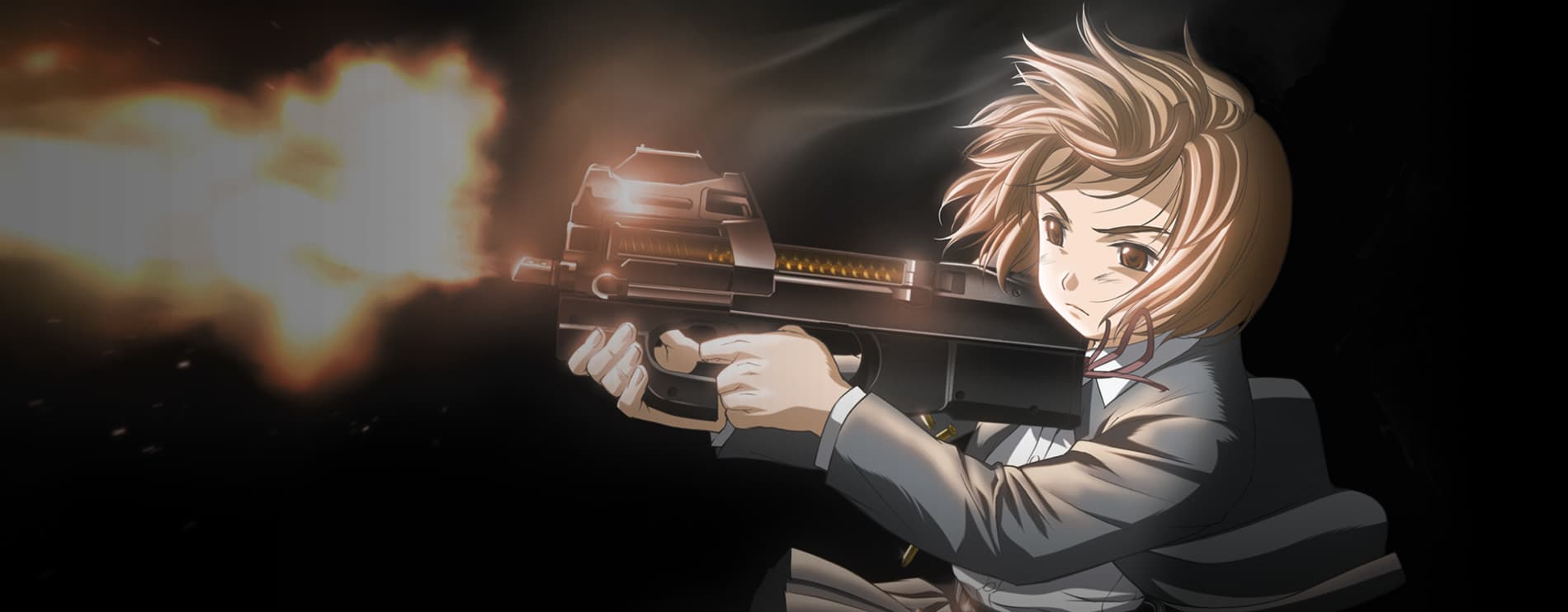
It’s been said that Italy is one of the most culturally important locations in the world. A landmark of civilization, this famous European peninsula is a titan of the arts, but no country is safe from strife. As a result of the nation’s political and economic instabilities, a new rise in domestic terrorism has threatened to destroy the Italian goverment... And retaliation has been swift. To maintain the status quo, the Italian Government has established the Social Welfare Agency... Masquerading as a charity organization, the Agency has adopted several very young girls, all cast out from society and on the verge of death, in order to brainwash them and transform them into the perfect cyborg assassins. Paired with an adult agent, otherwise known as her ‘handler,’ each girl has been trained and conditioned to act as her partner’s bodyguard, as well as a living weapon in his service. Together, these pairings... Known as “Fratellas,” or siblings... Battle on the front lines to protect the country from a deadly enemy within, but this ongoing war is nothing compared to the battle inside of each girl as the assassin struggles to come to terms with what little humanity they have left.
For some reason, I’ve been under the impression for a very long time that Gunslinger Girl was one of the higher budget Madhouse titles. Up until my rewatch for this review, I hadn’t seen the series in over ten years, and because the visuals always stuck out in my mind as being high quality, my memory must have worked off of that assumption... Because watching it now, my eyes are telling me a far different story. Gunslinger Girl does not look like an expensive anime. The character and background designs are sharp as a whip and highly attractive, but outside of the combat scenes, which clearly had the bulk of the production budget poured into them on top of a number of admittedly tricky corner-cutting techniques, this is a very dialogue heavy show, and it takes full advantage of that. The majority of the series consists of barely moving keyframes stitched together. Maybe a character’s lips are moving, or someone’s image is being bounced to create the illusion of walking, but motion is still minimal, and extras in the background show little to no sign of life.
In spite of all of this, Gunslinger Girl looks far more impressive than it has any right to, as it is one of the most superbly directed anime I’ve ever seen. I don’t just mean that it’s able to hide how small its budget was, although that is certainly true. Morio Asaka is one of my favorite anime directors of all time, despite his limited body of work. His first serious solo project was Cardcaptor Sakura, a fairly cheap adaptation of a flowery magical girl manga that didn’t have to be as fun and exciting as he made it, and he’s also well known for Chobits, an ecchi show about a guy with a literal robot waifu that didn’t have to be so subtle and mature, nor so focused on the struggle between humanity and technology. You could blame these two successes on the fact that Clamp manga are just way meatier than they have any business being in general, but since Clamp had nothing to do with the rest of his catalogue... Including Gunslinger Girl... I think it’s fair to say Morio Asaka has a knack for taking projects that have every reason to be underwhelming, finding the depth within them, and figuring out how to accentuate it.
With Gunslinger Girl, Morio Asaka takes an almost Kubrick-like approach to the visual presentation, framing his shots in a way that very deliberately exploits the space around a character. There’s never a close-up that doesn’t put you in the character’s shoes. There’s never a distance shot where the character’s surroundings aren’t screaming silent information at you. A simple pause in conversation can create all kinds of tension, from the suspense of whether or not someone’s about to die, to a simple tug on the heartstrings where you know someone who’s lost for words is trying their best to figure out how to communicate something they can’t say. With the exception of the odd derpy off-model shot here or there... I noticed maybe three across all thirteen episodes... There isn’t a single shot in this anime that doesn’t feel like several hours of thought went into it. The audio is just as important however, as it’s kept mostly to a minimum, with about half the soundtrack being relegated to background noise, often related to traffic, pedestrian conversation or ongoing construction.
As for the other half, it’s almost entirely orchestral, utilizing several well-known European pieces from the public domain, as well as a handful of original tunes that have more of a modern edge to them. The highlight by far is the opening theme, The Light Before We Land by The Delgados, which is one of a very rare number of English language songs that have managed to become anime themes despite the obvious language barrier. Unlike a lot of them, this one was chosen not because of how beautiful it sounds, but because the lyrics have meaning to them that complements the series. The Light Before We Land is a very somber piece about the beauty of a single moment that you wish could last forever, and the fear about leaving it behind as you move into the unknown future, and there is nothing more perfect than that for a show about children who had their pasts stolen from them and are pretty much guaranteed to have shorter lives thanks to not only their dangerous line of work, but also because of the procedures that turned them into the cyborg soldiers they are. It’s an ephemeral song about ephemeral characters.
The English dub was an early Funimation endeavor, and it features a lot of recognizable voices, including a few you don’t hear that often anymore. In addition to acting as the ADR director, Laura Bailey adds layers of depth to the main character Henrietta, and she works extremely well with co-star John Burgmeier as her handler Giuse. Laura’s trembling sweetness belies a manufactured inner strength, which in itself belies fragility and a desperate need for support and affection. Laura Bailey has always had an exceptional range, and there’s definitely a hint of Tohru Honda in her delivery, making her a perfect match for the character from the outset. John Burgmeier is a very subtle actor, with a slow and noticeably paternal delivery, and he plays Giuse as a kind-hearted yet exhausted and world-weary man who wants nothing more than to know he’s doing the best he can for the life that’s been placed in his lap. The dub could have easily lived generously off of their chemistry alone, but thankfully, the rest of the cast is just as strong. Special mentions go to Caitlin Glass and Luci Christian, but also to Brina Palencia, who has an absolutely bone-chilling performance in a brief and damn near unrecognizable role.
At first glance, the concept of Gunslinger Girl sounds like it was designed to be as off-putting as possible. To be fair, I don’t think it’s ever explained why the program only uses little girls, nor why their handlers can only be adult males, so from that perspective, I can kind of understand why someone might get the impression that this series is just an edgelord action shock-fest designed to serve as a thinly veiled lolicon wish fulfillment fantasy, especially when you add in the plot element that most of these girls DO have crushes on their handlers. I wish I didn’t see where this argument was coming from, but the silver lining is that it really only seems to come from two places... People who haven’t seen Gunslinger Girl and only know it by reputation, and people who have somehow only seen the second season. I’m not normally the kind of guy who says ‘you can’t judge a book by its cover,’ and I do in fact think it’s entirely fair to base whether or not you’ll like a show on the aesthetic as well as the information in the synopsis, but there are exceptions to that rule... There are some anime that are either vastly better, or vastly worse, than their concept may imply, and Gunslinger Girl is definitely one of them.
I will bet dollars to donuts that at some point, you have come across an anime that seemed like it would be a perfect match for you, only to wind up a massive disappointment. How could they possibly fuck this up, you wonder? Well, it works in reverse, too. It is entirely within the realm of possibility to skate perfect tens across the thinnest ice possible, as long as the project is helmed by the right people, with the right intentions, and the right vision. Another anime with an objectively terrible concept was Psycho-Pass, but the first season was still a near masterpiece because of the efforts of legendary director Gen Urobuchi, to the point that the second season wound up being straight up garbage without his guidance. Now, Urobuchi did not direct Gunslinger Girl... In fact, Gunslinger Girl came out before Urobuchi’s career renaissance, back when he was still cutting his teeth on grimdark hentai light novels... But somehow, some way, I still see a lot of modern day Urobuchi in this series. I already mentioned how Morio Asaka used his artistic direction to keep the show feeling serious, mature and subtle, and I could also mention how the complete and utter lack of anything resembling fanservice does it a TON of favors, but what it ultimately comes down to is a simple philosophy that Morio Asaka and modern day Gen Urobuchi both share.
In order to tell a story with a bad concept, you need to make absolutely sure of three things; First, your story has to be about more than just that concept. I see people throw around words like ‘depth’ when talking about literally any anime that made them think and/or cry, but the reason it’s called depth is that it’s below the surface. Second, you have to approach that concept in a way that’s engaging enough to distract the audience from asking the wrong questions, and third, it has to support the message/topic you’re actually exploring. Gunslinger Girl isn’t about a government agency turning broken little girls into soldiers. If it were, that would be the definition of shallow, and while it isn’t always a bad thing to be shallow, it is a death sentence for a show whose subject matter is as potentially offensive and problematic as this one’s. What Gunslinger Girl is about... And this is my interpretation, by the way, you can of course disagree with me... Is in the banality of evil, and the tragedy of the mundane.
As I mentioned before, Gunslinger Girl is extremely subtle, and in numerous ways. It has a story to tell, and it has a concept to explore, but it never makes any attempt to manipulate you or tell you what to think. It doesn’t have its own philosophy, or at least not an obvious one. If this were just saying “child soldiers be bad,” I mean, no doy. But at the same time, no matter what’s going on at any given time, be it a pulse pounding action scene or a heart-warming moment between the girls, you are never allowed to forget just how fucked up this situation is. Every interaction is twinged with some kind of tragic undertone. The narrative never directly calls out the Social Welfare Agency as evil, rather, it lets you draw your own conclusion. On the one hand, brainwashing children to serve as soldiers is horrifying. On the other hand, the agency is pretty damn effective at quelling a terrorist threat, implying it to be, at worst, a necessary evil. In my personal opinion, while both of these statements are presented as true within the narrative, this situation is unquestionably evil, and no matter how much we learn about it in the text, the most evil thing about it is never directly spelled out to us.
The absolute best argument you could make for the Social Welfare Agency is that they’re giving these poor unfortunate children another chance at life. This is true only in the most shallow sense of the word. In the first season alone, we’re told the circumstances of three of the girls... Rico, who was bedridden from birth and a burden to her parents. Angelica, who was hit by a car and left paralyzed. Henrietta, most disturbing of all, was brutally raped by the thugs who murdered her parents in front of her and left traumatized and suicidal. In the cases of Angelica and Rico, yes, an argument can be made that the program probably saved their lives, although the fact that they weren’t given a choice in the matter is still morally questionable. But in the case of Henrietta, what she needed was counseling, therapy and a good foster family, and it’s infuriating that the agency took “she has confessed to having suicidal thoughts’ as proof positive that her life was over and her humanity was subject to termination.
But at the same time, those apparently loosening standards are part of the overall point. Real evil... True evil... Isn’t some cackling witch who’s going out to eat children, or some boogeyman hiding in the shadows, or some maniacal mad scientist holding the world ransom for money and power. True evil is what happens when normal human beings compromise their principles, set aside their consciences and allow injustice to take place for what they consider the greater good, and that injustice becomes normalized to the point that people become conditioned to ignore it and accept it as part of their daily lives. People can make mistakes and regrettable decisions, but it doesn’t become evil until it becomes commonplace. Evil is when suffering is just part of the system. The Social Welfare Agency is a predatory system. They specifically hunt for children whom they deem to be lost causes, using the idea that they’re giving them a second chance purely as an excuse, a justification to tell themselves so they can sleep at night and defend their actions, but saving them was never the point. These girls aren’t heroes... They’re victims in a story that HAS no heroes.
Furthermore, the tragedy of the series lies in the mundane... These living weapons, their humanity stolen from them, knowing damn well that they’ll never have the opportunity to grow up and experience adulthood, going about their daily lives as if they were in a light-hearted slice of life. It’s in hearing them compare notes about the specifics of their conditioning... One dealing with menstrual pain, another noting matter-of-factly about her uterus being removed. It’s in one girl saying she’s just been conditioned(in other words, beaten) with a blood-stain on the corner of her lips, so another girl wipes it off as casually as if it were just a stain on her dress. It’s in the handlers, each of whom take a different approach to the relationship they share with their weapon. It’s in seeing just how rarely things go catastrophically wrong in this arrangement, and how seamlessly the Agency is able to sweep it all under the rug. The tragedy of this series is that no matter how repulsive this entire system is, everyone involved... Even those who have lost the most... Have just come to accept it, letting one of mankind’s greatest assets... Our adaptability... Also act as our most deadly weakness.
Gunslinger Girl is available from Funimation, along with an OVA, and a second season called Il Teatrino which... I mean, I don’t wanna dwell on this, but the only real positive thing I can say about it is that it has a more focused story. Aside from the OVA, even the most basic home release of season 1, season 2 OR the entire collection together is a bit on the pricey side, so good luck with that. The original manga is available stateside from Seven Seas Entertainment. Three video games were released in Japan for the PS2, but from what I’ve seen, they’re just some pretty crappy rail-shooters.
Gunslinger Girl may have several intense fight scenes, but it’s not an action story. It may star a cast of cute little girls going about their daily lives, but it is not a slice of life, nor is it a moe series. It may not have a plot, but it does have a purpose, and goes above and beyond the call of duty to achieve it. This show is a cautionary tale about what can happen when people go too far down the wrong path, ignoring the risks and focusing purely on what they want, allowing the ends to justify the means. It’s about pursuing a bad idea to the point that anyone seeing you from the outside who didn’t travel the same path you did can’t even begin to fathom how you wound up where you did, and how you allowed things to get so broken that they can never be fixed. By taking the high road at every opportunity and never compromising the integrity of its message to pander to the audience, it’s able to keep a consistent tone, and handle some of the most volatile subject matter imaginable with an unshakeable grace and sense of respect. While parts of it may be too disturbing for some viewers, it’s an experience I’d highly recommend to everyone else.
I give Gunslinger Girl a 10/10.
13.5 out of 15 users liked this review